Debate for Democracy
NBR split logical, protests regrettable: Prof Abu Ahmed
Professor Abu Ahmed, Chairman of the Investment Corporation of Bangladesh (ICB), on Saturday termed the ongoing protests against the proposed division of the National Board of Revenue (NBR) into separate entities for tax policy and tax management ‘unwarranted’.
“While legitimate demands can be placed before the government, protests driven by corrupt motives are regrettable,” Prof Ahmed said.
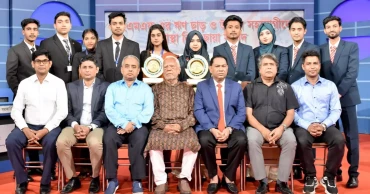
He made the remarks while speaking at a shadow parliament event organised by Debate for Democracy at the Bangladesh Film Development Corporation (FDC), titled ‘Increased Confidence of Development Partners Due to IMF Loan Disbursement’.
Reforming revenue management is a positive step for the economy, noting that many countries worldwide maintain similar revenue structures, he added.
Referring to the country’s debt situation, he noted that the previous government left behind a debt burden of US $103 billion. “Currently, Bangladesh is repaying an average of $2 to $2.5 billion annually, and the repayment rate is expected to rise,” he added.
Bangladesh need not to worry excessively about US tariff: Debapriya
He expressed optimism that market-based dollar pricing, in line with IMF conditions, would help stabilise the local currency. However, he cautioned against the activities of mafia groups involved in dollar hoarding.
“The era of a mafia economy in the country has hopefully ended,” Professor Ahmed remarked, lamenting the looting of several banks, including Islami Bank. He said foreign currency was siphoned off by “thieves and robbers,” causing immense pressure on Bangladesh Bank and the nation as a whole. He admitted that recovering the laundered money would be a difficult task.
Hasan Ahmed Chowdhury Kiran, Chairman of Debate for Democracy, said the IMF loan serves as a symbolic certificate that boosts the confidence of other development partners, thereby encouraging further budget support and loan disbursements.
However, he stressed that simply following IMF prescriptions is not sufficient. “Transparency, accountability, good governance, democracy, and voting rights in the financial sector are essential to sustain the interest of development partners,” he said.
Kiran also advised caution in accepting IMF recommendations that may harm the country’s public interest, particularly with regard to the withdrawal of subsidies on essential services.
In the shadow parliament session, debaters from Government Shaheed Suhrawardy College defeated the team from Presidency University. The judging panel comprised Professor Abu Muhammad Rais, Dr SM Morshed, and journalists Iqbal Ahsan, Sushanta Sinha, and Arifuzzaman Mamun.
At the end of the programme, trophies, crests, and certificates were awarded to the participating teams.
1 year ago
Possible ‘War’ Impacts: Manabzamin Editor-in-Chief proposes all-party talks by Prof Yunus
Expressing his desire to see an end to the conflict between the two South Asian countries, Daily Manabzamin Editor-in-Chief Matiur Rahman Chowdhury on Saturday proposed Chief Adviser Prof Muhammad Yunus to hold talks with all political parties soon to discuss ways for facing the challenges that might emerge if the “war” between India and Pakistan is prolonged.
"It seems to me that Bangladesh will be the most affected country (in the region) if the ‘war’ between India and Pakistan continues for a longer period. To face these likely challenges, our politics and political leadership must remain united. I suggest Professor Yunus to hold talks with all political parties about this issue," Chowdhury said.
America's Rubio speaks to Pakistan Army Chief, Indian FM
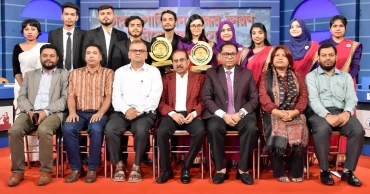
He made the remarks while speaking as the chief guest at a shadow parliament debate competition at the Bangladesh Film Development Corporation (BFDC) where the participants debated on the causes of the India-Pakistan war highlighting political and historical aspects.
Debate for Democracy hosted the event chaired by its Chairman Hasan Ahmed Chowdhury Kiron.
The debaters of Begum Badrunnesa Government Women's College won the competition against the debaters from Bangladesh University.
The judges of the competition were Daily Amader Shomoy Executive Editor Mainul Alam, Dr Tajul Islam Chowdhury Tuhin, poet and senior journalist Jahanara Parvin, UNB Special Correspondent AKM Moinuddin and Daily Manabzamin Diplomatic Correspondent Mizanur Rahman.
Chowdhury said Bangladesh is a peaceful country, and the country needs to look at its own interest.
He said Bangladesh needs to remain very cautious while making any remarks, stressing that Bangladesh needs to remain careful so that it does fall into a geopolitical trap.
"We must remain careful from all fronts so that no remarks from our side contribute to war tensions," said the Editor-in-Chief.
1 year ago

Industrial failures rooted in past misgovernance: Labour Adviser
Labour and Employment Adviser Brig Gen (retd) M Sakhawat Hossain on Saturday blamed past misgovernance and political abuse for the failure of the country’s industrial sector, stating that factory owners used to hold political power and parliamentary positions, leading to exploitation rather than fair governance.
“Many ministers and MPs of the former regime, who also won factories, fled abroad without paying workers' wages. Their assets, including houses, cars and land, are being liquidated to compensate the workers,” the adviser said while speaking at a shadow parliament organised by Debate for Democracy on labour rights.
He said efforts are underway to issue red alert via Interpol to bring back absconding owners who escaped without clearing workers’ dues.
Labour and Employment Secretary AHM Shafiquzzaman attended the event as special guest, while Debate for Democracy Chairman Hasan Ahmed Chowdhury Kiron presided over the session.
Referring to the July Uprising, Sakhawat said the movement saw significant participation and casualties among students and also labourers, driven by long-standing frustration and injustice.
He also alleged that the Rana Plaza rescue of a female worker 17 days after the collapse was a “staged drama,” and blamed previous government negligence for the disaster.
Bangladesh advances on press freedom index due to govt’s non-interference: Info Adviser
Chairman Kiron warned that unless the legitimate demands of workers are fulfilled, the achievements of the July revolution could be lost.
He urged political parties to clearly commit to fair wages and worker rights in their election manifestos, ahead of the upcoming national polls.
Kiron claimed that after the fall of the Awami League government, both local and foreign vested interests tried to destabilise the garments sector, and that provocateurs behind labour unrest often had no actual ties to worker communities. “Much of the aid received from home and abroad for victims of the Rana Plaza tragedy was misappropriated by the previous government insiders and their beneficiaries at the time,” he alleged.
As part of the celebration of the May Day-2025, the debaters of Tejgaon College emerged victorious, defeating the debaters of Daffodil International University in the shadow parliament organised by Debate for Democracy.
1 year ago
Pilkhana massacre part of 'international conspiracy' to keep AL in power: AG
Attorney General Md Asaduzzaman has said that the Pilkhana massacre was the part of an "international conspiracy" to keep the Awami League in power.
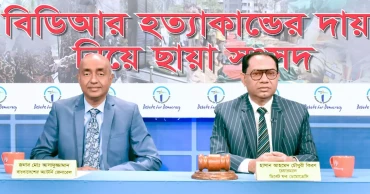
"It wasn’t a mutiny; it was rather a planned murder. In the Pilkhana massacre, we lost the nation's brave sons. Their loss was an attack on the sovereignty of Bangladesh," he said while speaking at a shadow parliament organised by Debate for Democracy at the FDC in the capital on Saturday.
By killing 57 army officers, the then Awami League government created an atmosphere of anarchy in Bangladesh, he said, adding that many of the masterminds behind the Pilkhana massacre are still at large, and efforts are being made to bring them to justice.
Pilkhana massacre reinvestigation: Commission seeks army's cooperation, as they meet General Waker-uz-Zaman
He said that the activists of the Chhatra League and Jubo League, dressed in BDR uniforms, were allegedly involved in the massacre.
Hasan Ahmed Chowdhury Kiron, chairman of Debate for Democracy, presided over the event.
Kiron said just two months after the Awami League returned to power under Sheikh Hasina’s leadership for a second term, the Pilkhana massacre occurred. “It remains a dark chapter in our history.”
Pilkhana Tragedy: Martyred Army families demand fair probe, call for Martyred Army Day
He said that the massacre was aimed at undermining the country’s sovereignty, not to fulfil any demands. "It was carried out to weaken the army and prevent any strong force like the BDR from existing," Kiron added.
1 year ago