Potato cultivation
Bumper harvest, plunging prices; Chandpur’s potato market in crisis
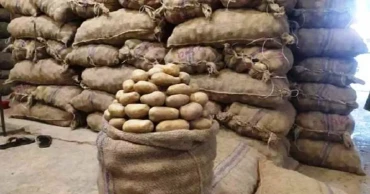
Rows of unsold potato sacks in Chandpur’s cold storages reflect a season of deepening losses, turning what was once a lucrative crop into a source of financial despair for thousands of farmers.
In local markets, old potatoes are fetching as little as Tk 7–8 per kilogram, well below production and storage costs, leaving farmers with little incentive to withdraw their stored produce, locals said.
Outstanding dues for seed potatoes purchased on credit last season remain unpaid, while storage fees continue to accumulate, they said.
Agriculture officials said the district’s 56,860 potato farmers are concentrated mainly in Chandpur Sadar, Matlab South, and Kachua upazilas, where some 5,000 hectares are under potato cultivation.
Read more: Delays push up cost of seed potato project to Tk 1,138.74 crore
Despite the market downturn, they said, planting continues, though many farmers have scaled back their operations in response to last season’s losses.
“The absence of syndicates this season has kept potato prices low,” said Mobarak Hossain, officer at the Department of Agricultural Extension (DAE).
“Last season, syndicates pushed prices up to Tk 80 per kilogram. That situation does not exist this year,” he said.
The ripple effect is felt throughout the supply chain. Cold storage operators in Kachua upazila are struggling as farmers hesitate to withdraw their produce.
Mangal Khan and Yasin Mia, managers of local facilities, said that with market prices so low, even selling the stored potatoes fails to cover storage costs.
A bumper harvest last season exacerbated the problem. Good-quality old potatoes now sell for Tk 8–10 per kg, while new potatoes are priced around Tk 20 per kg. Farmers who invested heavily are counting losses.
“I produced 100 maunds of potatoes and made no profit at all—everything turned into a loss,” said Bachchu Miji, a grower and trader at Bakila Bazar in Hajiganj upazila. Others, including farmers from Shah Mahmudpur in Chandpur Sadar, echoed his frustration.
Hanif Patwary, whose 33 sacks of potatoes stored at Baborhat BSCIC cold storage sold for just Tk 3,000 per 50 kg sack, said, “After suffering such losses, I will not cultivate potatoes again.”
Bangladesh hosts its first-ever Potato Festival
The situation is mirrored in Kachua upazila, where more than half of stored potatoes remain in cold storage past the usual withdrawal period of November–December, frustrating both farmers and storage operators.
Meanwhile, the prices of other vegetables have also softened. Beans, snake beans, bitter gourd, and carrots now sell at Tk 60 per kg, and tomatoes at Tk 40 per kg, down from Tk 90–120 per kg just two weeks ago.
Despite the downturn, potato planting continues in Chandpur Sadar, Haimchar, Kachua, and Matlab upazilas, with some farmers reducing cultivation areas due to past losses.
Shamsul Islam of Bagadi and Ismail Hossain and Suruj Mia of Dhanpardi said they planted on smaller plots, wary of another season of poor returns.
New potatoes arriving from Munshiganj have further driven prices down, falling sharply from Tk 70 to Tk 20 per kg, boosting consumer demand. Currently, 5 kg of new potatoes sell for Tk 100, while 10 kg of old potatoes go for Tk 50–60.
Chandpur’s 10 operational cold storages are holding 80,169 tonnes of potatoes against a maximum capacity of 80,250 tonnes, according to Mobarak Hossain.
Abu Taher, Deputy Director of DAE Chandpur, said the cultivation target for the current season has been set at 7,200 hectares, down 1,000 hectares from last year, citing farmers’ discouragement and mounting debts.
“Farmers are naturally drawn to crops that guarantee fair prices. While about 4,000 hectares are already under potatoes, the focus is shifting to crops that ensure financial returns,” he said.
Read more: Sirajganj’s mustard fields bloom into golden seas, promise bumper harvest
For Chandpur’s potato farmers and storage operators, the coming months will be critical, as the market continues to weigh on livelihoods and investment decisions, according to the officials.
9 months ago
Naogaon farmers face uncertainty as unseasonal rain hits early crops
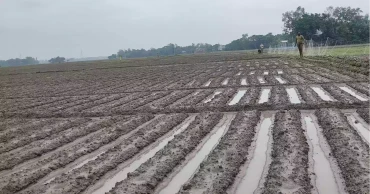
Farmers in the northern district of Naogaon are struggling with fresh uncertainty as unseasonal rain, triggered by a low-pressure system over the Bay of Bengal, has damaged prepared seedbeds for early winter vegetables and partially ripe Aman paddy.
Potato fields, in particular, have been affected, causing concern among growers hoping to recover losses from last year.
Agriculture officials said stagnant water in the fields has raised fears of widespread damage to newly planted potato seeds, transplanted Aman paddy and early winter vegetables, including cauliflower, cabbage, tomato, chili, eggplant and radish.
Many plants, they said, are lying flattened in waterlogged fields across several upazilas.
Read more: Polyshade tomato farming reviving Narail’s rural economy
According to the district Department of Agricultural Extension (DAE), Aman has been cultivated on 193,000 hectares this year, while early winter vegetables cover 1,845 hectares. Potato cultivation is targeted on 21,000 hectares.
A field visit revealed that farmlands prepared for potato cultivation or recently sown are submerged, forcing farmers to focus on draining the water to save their crops. Farmers also fear delays in planting on fallow lands that remain waterlogged and excess moisture has already caused root rot in some vegetables.
Zainal, a farmer from Kalikapur Dangapara in Atrai upazila, expressed his worries, saying, “Last year I suffered a big loss from potato farming; hence I planted early this year in hopes of a better price. But now rainwater has submerged the field and I fear the seeds may not sprout properly. I don’t know what to do.”
Sharing a similar experience, Ashraf Hossain from Varsho village in Manda upazila said, “Early potato farming is always risky, but I wanted to try since others were doing it. I planted on one bigha of land, but the sudden rain has filled the field with water.”
Read more: Hidden hands in the fields: Dealers blamed for artificial fertiliser shortage in north
Ratan Mollah of Barshail in Sadar upazila said, “I just finished planting potato seeds when the rain began. It’s still drizzling, and the soil remains soaked. Potato seeds rot easily if they stay wet. I’m worried most of my field will be damaged.”
Meanwhile, Susheel Mistri of Hapania reported that his Aman paddy, which was ripening, had been flattened by rain and gusty winds. Vegetable grower Indri Mia from Kirtipur said, “The rain over the past few days has caused rot at the base of my cauliflower and other vegetable plants.”
Downplaying the extent of the damage, DAE Deputy Director Homayra Mondal said, “Although it rained, it wasn’t a heavy downpour. Potato planting has just started and the newly planted seeds may face minor setbacks, but fields planted eight to ten days ago will likely remain safe. The rainfall is even beneficial for Aman. If the water drains quickly, there won’t be any major problem.”
Read more: Rain pushes green chilli price to Tk 300 per kg, almost all vegetable prices upward
As farmers race against time to salvage their crops, the unseasonal rainfall has once again highlighted the vulnerability of early winter cultivation to unpredictable weather.
11 months ago
Lawn farming gains traction in Khulna
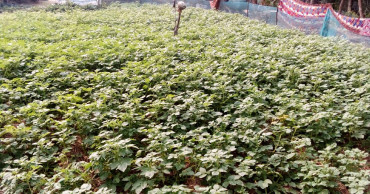
The residents of Khulna’s coastal Koyra upazila are increasingly becoming interested in lawn farming to feed their families and make some money.
Crops like tomato, brinjal, bean and potato are cultivated but the tuber is the most popular item since it takes less efforts.
The Department of Agricultural Extension (DAE) said villagers in the upazila cultivated potato on 90 hectares of land at approximately 6,000 house yards this year. Upazila Agriculture Officer Mizan Mahmud said they regularly meet and encourage lawn farming and sometimes arrange training for the villagers.
“With our support, more villagers have become interested in cultivating potato in their front yards this season,” he said.
Koyra was hit hard by cyclones Sidr and Aila that damaged not only the crops but also increased the salinity in soil. Over the years, the salinity has decreased, prompting people to cultivate crops in their lawns, the DAE said.
Locals said farmers had poor harvest in the last five years as most of the villages and fields were inundated many times by salty water.
Md Monirul Islam of South Bedkati union said the area suffers from soil salinity since it is close to the Sundarbans. “The region normally gets inundated during cyclones and its crops are damaged,” he said.
But during this winter, many villagers cultivated crops in their yards. “I’m growing potatoes on three decimals of land at my yard,” he said.
Achintya Sarkar of Mazer Athi area said he is growing potato on 15 decimals in his lawn to meet the family’s demand. “I hope to produce 22-25 maunds of potato this season. I’m planning to sell the rest after meeting my family’s demand for some extra cash,” he added.
Many women are also directly involved in lawn and backyard farming. Mita Rani Mondol of Bizlighata Bazar is one of them.
She said she takes care of the potato after finishing household chores. “Cultivating crops in the yards is empowering women since it helps feed their families and provides a source of earning,” she said.
6 years ago