scientists-bureaucrats
Empower scientists, not bureaucrats, say speakers urging structural reforms
Scientists on Wednesday expressed grave concern over the stagnation of scientific advancement in Bangladesh, citing the absence of appropriate state policies, bureaucratic complications, and a narrow-minded outlook among officials as key barriers.
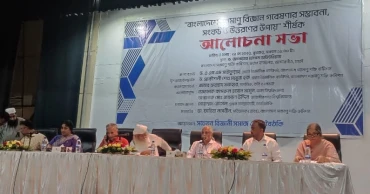
Speaking at a roundtable titled “Prospects, Challenges, and the Way Forward for Nuclear Science in Bangladesh”, held at the Dr. Anwar Hossain Auditorium of the Bangladesh Atomic Energy Commission (BAEC) headquarters, they emphasized the urgent need for reform to ensure the autonomy and effectiveness of the country's foremost nuclear research institution.
Organised by the Conscious Scientific Community of Bangladesh and think tank Bhavboithoki, the event featured prominent intellectuals, including philosopher, poet, and writer Farhad Mazhar as chief guest. Other panelists included Prof. Kamrul Hasan Mamun of the Department of Physics at Dhaka University and Prof. Md. Jamal Uddin of the Department of Environmental Sciences at Jahangirnagar University.
Chief Scientific Officer of BAEC Dr. A.S.M. Saifullah delivered therecommendations s followed by a keynote presentation by Dr. Engr. Sheikh Manzura Haque, also a chief scientific officer. The presentation outlined the history, current state, potential, and challenges facing nuclear research in Bangladesh.
Panelists highlighted that nuclear science and technology, as specialised fields, remain under stringent bureaucratic control and subject to undue state interference. They called for structural reforms to enhance research independence and ensure efficient governance.
Seminar urges hike in tobacco price and taxes in upcoming budget
In his remarks, Mazhar endorsed 10 key demands made by BAEC scientists and officials, warning that a state incapable of fostering independent scientific inquiry undermines its own sovereignty. He stressed that empowering scientific institutions and restoring BAEC's autonomy are vital to national strength and self-reliance.
The session concluded with a series of recommendations to establish a fully functional commission with a Chairman and four members, avoiding ad-hoc or acting appointments, restore BAEC’s authority to approve higher education, training, and government orders (GOs), and remove mandatory information submission through ministry-developed software to ensure data confidentiality and financial independence.
They also said the ministry must cease direct administrative control and allow BAEC to function as an autonomous statutory body
Demanding on equalising service grades and benefits with university faculty, executing a Power Purchase Agreement (PPA) between the government and BAEC as the owning body, they also asked for regularizing temporary positions, creating new pathways with the extention of benefits such as housing loans, interest-free loans, and transportation allowances.
Urging to remove artificial barriers imposed by the ministry to improve human resource development, they also demanded for the improvement of protocol ranking (Warrant of Precedence) for BAEC's top officials with the the initiative of increasing budget allocations, fostering free thought, and expanding the scope of fundamental research.
The organisers concluded that without appropriate policies and structural reforms, scientific research—essential to the collective welfare of the people—will remain stifled. They urged policymakers to act in the spirit of public sovereignty and national interest.
1 year ago