monsoon floods
Living with Monsoon floods: Can Surma–Kushiyara project change Sylhet’s fate?
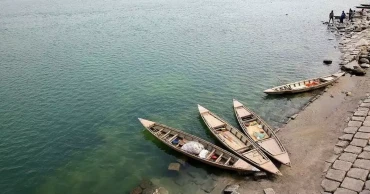
For generations, the Surma and Kushiyara rivers have shaped life in Sylhet and Habiganj—nurturing fertile floodplains while also unleashing destruction with alarming regularity.
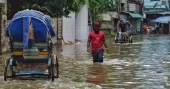
Each monsoon, swollen waters spill over Surma and Kushiyara banks, washing away cropland, homes and roads, and forcing thousands into cycles of loss and recovery.
In a bid to break that cycle, the government has taken up a Tk 1,273.77 crore project aimed at strengthening flood protection, stabilising riverbanks and introducing integrated water resources management in Surma–Kushiyara river basin.
The project—titled Surma–Kushiyara River Basin Development and Flood and Integrated Water Resources Management Project (Phase I)—will be implemented by the Bangladesh Water Development Board under the Ministry of Water Resources between January 2026 and June 2028.
Fully financed by the government, it will cover 11 upazilas of Sylhet and Habiganj districts, where agriculture remains the backbone of local livelihoods.
At the heart of the initiative lies large-scale river dredging.
More than 121 kilometres of river stretches will be dredged, with an estimated 120.53 million cubic metres of sediment to be removed.
Besides, , riverbank protection works will be carried out along 17 kilometres of erosion-prone sections—areas that have repeatedly borne the brunt of the rivers’ shifting courses.
The Surma and Kushiyara are part of the vast Ganges–Brahmaputra–Meghna basin, originating from the Barak River in India before entering Bangladesh.
After crossing the border, the river splits into two branches, flowing through Sylhet’s hilly valleys before reuniting at Ajmiriganj in Habiganj as the Kalni River, which later merges with the Meghna near Bhairab Bazar and eventually drains into the Bay of Bengal.
Their mountainous origin makes both rivers naturally fast-flowing and highly meandering.
Erosion is a regular phenomenon, especially along concave bends.
In recent years, however, the problem has intensified.
Climate change–induced extreme rainfall, coupled with widespread destruction of upstream hill forests, has increased sediment loads entering the rivers.
These sediments settle along convex bends, choking river channels and accelerating erosion along opposite banks, according to the project document obtained by UNB.
During the monsoon, the volume of upstream runoff often exceeds the rivers’ carrying capacity, triggering floods that inundate vast tracts of land.
Crops are destroyed, homesteads collapse into the river, and public infrastructure—from roads to schools and religious institutions—suffers repeated damage.
Sylhet waterlogging mitigation project delayed again; sees 44pc cost surge
The basin also includes other transboundary rivers such as the Sarigoain, Sonai and Piyain, which enter Bangladesh from India and merge with the Surma.
Severe erosion along these rivers has displaced families and erased farmland, underlining the urgency of coordinated intervention.
Officials say the new project is designed to address these challenges in a more integrated manner—maintaining natural river flow through dredging, reducing erosion, enhancing fisheries resources and protecting both public and private infrastructure.
Special attention will be given to erosion-prone border stretches in Zakiganj upazila where riverbank protection works are expected to help safeguard Bangladesh’s territorial integrity—an often-overlooked consequence of unchecked river erosion along transboundary rivers.
Once completed, the project is expected to protect crops, homes, roads, mosques, madrasas, orphanages and other key installations from both early and peak monsoon floods across the region.
Beyond immediate protection, officials hope it will lay the foundation for more sustainable water resource management, agricultural stability and long-term socio-economic resilience in one of Bangladesh’s most flood-vulnerable landscapes.
During the monsoon of 2022, northern and northeastern Bangladesh experienced an unprecedented flood, widely regarded as the worst to strike the region in 122 years.
The disaster affected 18 districts, with Sylhet, Sunamganj, Moulvibazar, Habiganj and Netrakona bearing the heaviest damage. The flooding claimed 12 lives and disrupted the lives of around 7.2 million people.
Abdul Karim, a resident of Sylhet city said, “If this project can really control erosion and reduce flooding, it will give people like us some peace of mind. But we hope the work is done properly and finished on time.”
7 months ago

Choked canals, plastic peril: Dhaka’s struggle with prolonged waterlogging
Though long accustomed to monsoon floods, Dhaka has in recent years experienced unprecedented waterlogging that persists for weeks, even after moderate rainfall.
A growing number of studies blame clogged drains from polythene bags and the loss of natural canals due to encroachment as major reasons for the prolonged waterlogging in the city.
A study led by Sarwar Uddin Ahmed and Keinosuke Gotoh, affiliated with Nagasaki University’s Faculty of Engineering and Graduate School of Science and Technology, respectively, has delved into the environmental dynamics of Dhaka’s waterlogging problem.
Their research, combining Contingent Valuation Method (CVM) surveys and satellite remote sensing, highlights the complex interplay between human behaviour, urban development and environmental degradation in exacerbating flood risks.
Polythene Bags: Small Culprits, Big Impact
For decades, Dhaka’s drainage system has struggled to cope with the city’s rapid urbanisation and monsoon rains. But the surge in polythene bag usage has proved to be an especially pernicious problem. These lightweight, durable plastic bags are frequently discarded in the streets, blocking drains and water channels.
Comfort in the rain, discomfort in the streets
As Ahmed and Gotoh point out, polythene bags have jammed the drainage infrastructure, preventing free water flow and causing water to stagnate.
“Waterlogging is no longer just a result of heavy rainfall. Even moderate showers can lead to floods bcause the city’s drainage is clogged by plastic waste, particularly polythene bags,” Ahmed explained.
1 year ago