Dhaka’s blacksmith lanes
Steel Stands Still: Blacksmiths brace for a quiet Eid-ul-Azha
With the blessed Eid-ul-Azha approaching, the rhythm of hammers on steel should be echoing through Dhaka’s blacksmith lanes like a festive drumbeat, but this year, that symphony is curiously subdued.
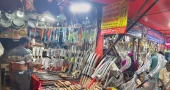
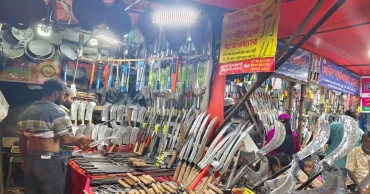
In Karwan Bazar’s age-old alleys, where iron and fire are forged into tradition, blades of every kind sit poised—ready for the season's sacred rituals.
Knives, cleavers, axes and the famed round tamarind chopping blocks known as khaitta lie in neat rows under the open sky and tin roofs.
Forging Faith: Jashore’s blacksmiths toil tirelessly ahead of Eid-ul-Azha
Their sharp edges glint in the morning sun, their handles polished, their weight balanced. And yet, they are met not with eager hands, but with the still air of waiting.
At Zerin Hardware, owner Md. Jewel gestures to his displays, a craftsman’s pride gleaming in his eyes. “We’ve got everything ready,” he says, standing amidst an arsenal of blades.
The small to medium knives are modestly priced, between Tk 150 and Tk 600. The locally made cleavers, known as chapati, sell by the kilo—Tk 800 per kilogram. A traditional axe fetches Tk 1,000, while Chinese models are slightly lighter on the wallet, priced between Tk 700 and Tk 800.
Just beside, sparks fly as heated metal meets anvil. The sound should draw a crowd—but it doesn’t.
The same quiet unfolds miles away in Bhola Sadar, where blacksmiths still hammer each blade by hand, each strike a testament to muscle and memory.
Muhim, a blacksmith whose arms bear the marks of his trade, leans over his workbench. “We have all types of tools for cutting meat,” he says.
His voice carries the weight of tradition. On the subject of imported tools, he is firm: “Local steel tools are best for cutting meat. Chinese tools may be fine for fruit, but they’re not ideal for meat.”
In his shop, the gleam of newly sharpened blades speaks for itself. Steel tools are sold by weight—Tk 800 per kilogram—a price that reflects both skill and steel.
A few stalls down, the scent of freshly carved tamarind wood lingers in the air. Here, the khaitta blocks rest like old companions, their rough textures echoing decades of tradition.
Seller Md. Shamim names his prices without fanfare—Tk 300 for small, Tk 400 for medium, and Tk 500 for large blocks. Each one waits for a buyer, just as it waits to cradle the sacrifice.
And still, the market breathes quietly. The usual buzz of pre-Eid-ul-Azha excitement seems to have softened. Blades remain unsold, blocks unmoved, and blacksmiths wary.
They have prepared for the season, just as they always do. Fire and forge, steel and sweat—all ready for hands that are yet to come.
1 year ago