Iranian military leader
Massive crowds mourn Iranian military leaders, scientists killed in Israeli strikes
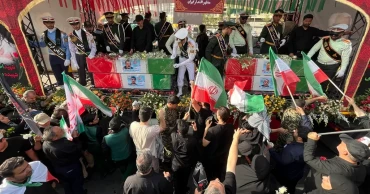
Vast crowds gathered in downtown Tehran on Saturday for the funeral of Iran’s top Revolutionary Guard commanders and nuclear scientists killed during the recent 12-day conflict with Israel.
The funeral procession saw the coffins of Revolutionary Guard chief Gen. Hossein Salami, ballistic missile program head Gen. Amir Ali Hajizadeh, and other prominent figures transported along Azadi Street on trucks. The streets were filled with mourners chanting slogans such as “Death to America” and “Death to Israel.”
Both Salami and Hajizadeh were killed on June 13, the first day of the fighting, when Israel launched a military campaign aimed at crippling Iran’s nuclear capabilities by targeting senior military officials, scientists, and critical infrastructure.
According to state media, over one million people attended the funeral, though independent verification of the figure was not possible. Images showed a dense sea of people lining the 4.5-kilometer (nearly 3-mile) route through central Tehran.
There was no public appearance by Iran's Supreme Leader Ayatollah Ali Khamenei during the ceremonies which were broadcast on state television.
Traditionally, Khamenei leads prayers over the coffins of high-ranking officials, although those moments are often aired separately. Khamenei has not been seen publicly since before the conflict began.
Among those present were Iranian Foreign Minister Abbas Araghchi, Quds Force commander Gen. Esmail Qaani, and senior adviser Gen. Ali Shamkhani, who appeared leaning on a cane after being wounded in Israel's initial strike.
Established after Iran's 1979 Islamic Revolution, the Revolutionary Guard has evolved from a domestic paramilitary force to a key regional player, backing Tehran’s allies across the Middle East, including in Syria, Lebanon, and Iraq. The Guard also commands Iran’s ballistic missile arsenal, which has been used against Israel during the recent Gaza conflict.
Iran says chief military commander dies of injuries from Israeli attack
During the 12 days of fighting that ended with a ceasefire on Tuesday, Israel reported killing around 30 Iranian commanders and 11 nuclear scientists, as well as striking eight nuclear facilities and over 720 military targets. Human Rights Activists, a Washington-based group, reported more than 1,000 deaths, including at least 417 civilians.
In retaliation, Iran fired over 550 ballistic missiles at Israel. While most were intercepted, several managed to strike targets, causing casualties and damage, with 28 people confirmed dead.
Saturday’s funeral was the first for high-ranking officials since the ceasefire. State media said ceremonies were held for 60 victims in total, including four women and four children. Government offices were closed to allow employees to attend.
Many in the crowd voiced anger and a desire for revenge. “This is not a ceasefire, this is just a pause,” said Ahmad Mousapoor, 43, waving an Iranian flag. “Whatever they do, we will definitely give a crushing response.”
State television also showed the grave prepared at Tehran’s Behesht-e-Zahra cemetery for army chief of staff Gen. Mohammad Bagheri, who died on the first day of the conflict. He will be buried next to his brother, a Guards commander killed during the Iran-Iraq war in the 1980s. Other fallen officials will be laid to rest in their hometowns.
Meanwhile, Iran's judiciary confirmed that Ali Ghanaatkar, the chief prosecutor at the notorious Evin prison, was killed in an Israeli strike earlier this week. Ghanaatkar, known for his role in prosecuting dissidents, had faced widespread criticism from human rights groups. He will be buried in Qom at a revered shrine.
Iran has repeatedly maintained that its nuclear program is for peaceful purposes. However, Israel views Tehran’s nuclear ambitions as a direct threat and has justified its military campaign as necessary to prevent Iran from acquiring atomic weapons.
Khamenei's last in-person appearance was on June 11, two days before the fighting began. He resurfaced Thursday in a pre-recorded video — his first public message since the ceasefire — in which he issued warnings to the U.S. and Israel and declared Iran victorious.
The 86-year-old leader dismissed the damage from U.S. strikes on three Iranian nuclear sites, saying they failed to “achieve anything significant.” However, Rafael Grossi, head of the U.N.'s nuclear watchdog, described the damage to Iran’s Fordo nuclear facility — built deep inside a mountain — as “very, very, very considerable.”
1 year ago