Middle East tensions
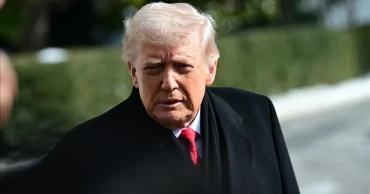
Trump says Iran agreed not to have nuclear weapon, signals progress in talks
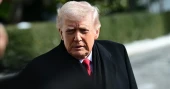
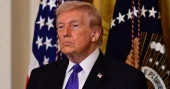
US President Donald Trump has said Iran has agreed not to develop nuclear weapons, expressing optimism about ongoing negotiations and the prospects of a long-term deal.
Speaking to reporters at the White House, Trump said the agreement under discussion would extend “beyond 20 years” and described the outlook for a deal as “looking very good.”
He added that the next round of talks with the Iranian delegation could take place over the weekend, reports Al Jazeera.
Trump also said the recently announced ceasefire between Israel and Lebanon includes Hezbollah, indicating broader involvement in the truce arrangement.
The US president further said he plans to meet Israeli Prime Minister Benjamin Netanyahu and Lebanese President Joseph Aoun, though he did not specify a timeline for the meetings.
5 months ago
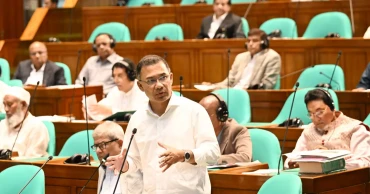
Govt has plans to explore alternative labour markets amid Middle East tensions: PM
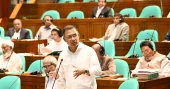
Prime Minister Tarique Rahman on Wednesday told Parliament that the government has specific plans to explore alternative labour markets in the context of recent instability in Iran and across the Middle East.
“Bangladesh missions abroad have been instructed to explore labour markets and assess profession-specific demand for Bangladeshi workers. In addition, local lobbyist firms are being appointed in different countries as needed based on recommendations from Bangladesh missions overseas,” he said.
The Prime Minister made the remarks while responding to a question from BNP MP Ashraf Uddin (Narsingdi-5 MP) during the question-answer session.
He said initiatives have been taken to sign bilateral agreements to expand alternative labour markets in new countries including Serbia, Greece, North Macedonia, Romania, Portugal, Brazil and Russia.
The Prime Minister said initiatives have been taken to arrange high-level visits to countries beyond the Middle East that recruit workers, aiming to strengthen bilateral relations.
Mentioning that efforts are underway to reopen the Malaysian labour market, he said steps have also been taken to sign agreements with Thailand to open up employment opportunities there.
The Prime Minister also said, given the high demand for Bangladeshi workers in Japan, the scope of Japanese language and skills training has been expanded to increase manpower exports to the country.
He said Japanese language training is now being provided at 53 Technical Training Centres (TTCs), while steps have been taken to recruit instructors for Japanese, Russian, Arabic, German and Italian languages. “So far, 41 instructors in various languages have been appointed.”
Replying to another question from Faridpur-3 MP Nayab Yusuf Ahmed, Tarique said Bangladeshi missions have been asked to assess the potential for employing Bangladeshi professionals including doctors, bankers, engineers in the Middle East as professionals from different countries are leaving the region due to the war situation.
He said the loan limit for language student visas has been increased from Tk 300,000 to Tk 10,00000 without collateral.
The Prime Minister said steps have also been taken to retrain returning workers and improve their skills so they can go abroad again based on international job market needs.
He also said their previous education and work experience are being recognised and certificates are being provided.
The parliamentary session began in the morning with Speaker Hafiz Uddin Ahmed in the chair following a recess on April 10, with the Prime Minister’s question-answer session scheduled first on the day’s agenda.
Members of Parliament took part in the scheduled question-answer session at the start of the sitting.
5 months ago
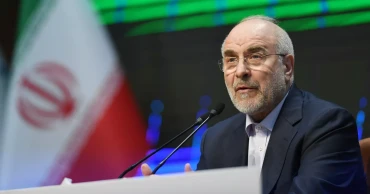
Ghalibaf says Trump threats have ‘no effect’ as IRGC warns over Strait of Hormuz
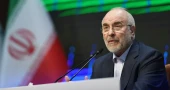
Iran’s parliamentary Speaker Mohammad Bagher Ghalibaf has said US President Donald Trump’s recent threats “have no effect on the Iranian nation,” amid escalating tensions over the Strait of Hormuz.
In comments carried by state media, Ghalibaf said Iran had shown “very good initiatives” and goodwill in talks with the United States, which he claimed had led to progress, reports Al Jazeera.
He warned Washington, saying, “If you fight, we will fight, and if you come forward with logic, we will deal with logic.”
Meanwhile, Iran’s Islamic Revolutionary Guard Corps (IRGC) said in a statement that the Strait of Hormuz remains “open to the harmless passage of civilian vessels” in line with international law.
Trump warns of Hormuz blockade as US-Iran talks end without deal
However, it warned that military vessels approaching the waterway would be considered in violation of the ceasefire and “will be dealt with severely.”
The remarks come amid heightened tensions in the Gulf region following US threats of maritime action and growing concerns over the security of the world’s most critical oil shipping route.
US President Donald Trump on Sunday said the US Navy would “immediately” begin a blockade to stop ships from entering or leaving the Strait of Hormuz after US-Iran talks ended without an agreement.
He said he had instructed US naval forces to “seek and interdict” vessels in international waters that have allegedly paid a toll to Iran, warning that “no one who pays an illegal toll will have safe passage on the high seas.”
US Vice President JD Vance said the latest round of marathon negotiations ended without agreement after 21 hours of talks in Islamabad.
While, Iran’s semi-official Tasnim news agency reported that the talks concluded without outcome, citing “excessive demands” from Washington as a key obstacle to a deal.
5 months ago
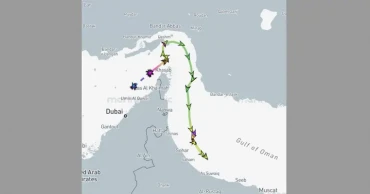
Pakistani oil tanker takes unusual route through Strait of Hormuz amid tensions
A Pakistan-flagged oil tanker took a longer and unusual route through the Strait of Hormuz, raising questions as tensions remain high in the region.
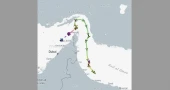
Tracking data from the maritime monitoring site MarineTraffic showed the tanker, named Karachi and owned by the state-run Pakistan National Shipping Corporation, sailing north into Iran’s Exclusive Economic Zone before turning south into the Gulf of Oman.
The vessel passed between Iran’s Qeshm and Larak islands and moved close to the Iranian coast while carrying a cargo of crude oil.
Experts say the route may have been taken in response to directions from Iranian authorities controlling passage through the area.
Former US Navy captain Bradley Martin said the unusual path could suggest the ship was following specific instructions from Iran regarding transit through the strategic waterway.
Martin, now a senior researcher at RAND Corporation, said the route could also indicate the possible presence of naval mines in the area.
Another analyst, Jonathan Schroden, said the route may have been chosen either because mines exist or to create the impression of a mining threat as a deterrent.
About one-fifth of the world’s oil shipments pass through the Strait of Hormuz, making it one of the most critical energy transit routes globally.
With inputs from BBC
6 months ago

Iranian ambassador reassures Dhaka: 'Bangladeshi tankers can pass Strait of Hormuz'
Bangladesh has received reassurance from Iran regarding the safe passage of fuel shipments amid growing concerns about global oil supply disruptions.
Iranian Ambassador to Bangladesh Jalil Rahimi Jahanabadi on Friday said his country Iran stands ready to ensure that Bangladeshi oil tankers can pass safely through the Strait of Hormuz, despite the ongoing tensions in the Middle East.
"I have seen that there is an energy crisis in your country. Due to the energy problem, Prime Minister Tarique Rahman and the Energy Minister (Iqbal Hassan Mahmood) have requested the Iranian government to allow Bangladeshi oil tankers to pass through," said the Ambassador.
“I have spoken with Iranian government officials and they are ready. If you have vessels willing to transport fuel, we will allow them to pass safely so that the people of Bangladesh do not face difficulties,” the Ambassador told reporters following an event in Dhaka.
Iran’s secretive new leader issued his first public statements Thursday, resolving to keep fighting, promising more pain for Gulf Arab states and threatening to open “other fronts” in a war that has already disrupted world energy supplies, the global economy and international travel, reports AP.
Early Friday, U.S. President Donald Trump issued a new threat online to Iran, writing: “Watch what happens to these deranged scumbags today.” Trump tallied the damage inflicted on Iran and its leaders and called it a “great honor” to be responsible for it.
The remarks by Supreme Leader Ayatollah Mojtaba Khamenei came as Israeli Prime Minister Benjamin Netanyahu said his country’s attacks were creating conditions for the Iranian population to topple the government.
“It is in your hands,” Netanyahu said at a news conference, addressing the Iranian people. “We are creating the optimal conditions for the fall of the regime.”
Energy conservation plea goes unheeded as Dhaka malls glow with lights
Iran will continue blocking the Strait of Hormuz, the world's busiest oil shipping channel, according to a statement attributed to Iran's new Supreme Leader Mojtaba Khamenei, reports the BBC.
His message was broadcast on Iranian state TV, but Khamenei did not appear in person. His message was instead read out by a newsreader.
Iran would "avenge the blood" of Iranians killed in the war with the US and Israel, Khamenei said in the statement, which also warned neighbouring countries to stop hosting US bases.
He was named supreme leader on 8 March after his father, Ayatollah Ali Khamenei, was killed on the first day of the war.
Ambassador Jahanabadi defended his country’s position, and said, "We are not seeking a regional war, but we cannot remain indifferent while being attacked from American bases in neighbouring countries."
The first week of war with Iran cost the United States $11.3 billion, according to the Pentagon, which provided the estimate to Congress in a briefing earlier this week, according to a person familiar with the situation who spoke on condition of anonymity to discuss the private meeting.
The US military reported spending $5 billion on munitions alone in the war’s first weekend.
The war continued to escalate on its 13th day as oil prices spiraled up again to $100 per barrel, and stocks sank worldwide over fears that the conflict could drag on longer than hoped.
To relieve the surge in prices, the U.S. Treasury Department announced it was further easing sanctions on Russian oil by granting a license that authorizes the delivery and sale of some Russian crude oil and petroleum products for the next month.
Trump signaled earlier this week that he would take more action to address the squeeze on oil flows. The move follows the administration’s decision to grant temporary permission for India to buy Russian oil.
The new exemption applies only to Russian oil already at sea. Last week, analysts estimated there were about 125 million barrels loaded on tankers. To put that in perspective, about 20 million barrels of oil per day usually pass through the Strait of Hormuz, according to the International Energy Agency.
6 months ago
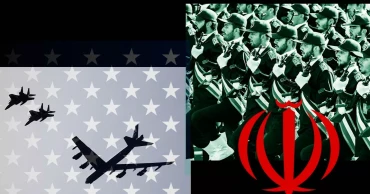
Iran will not negotiate with US, warns citizens against supporting Israel
Iran has ruled out negotiations with the United States and warned citizens against any cooperation with Washington or Israel as the conflict intensifies.
Mohammad Mokhber, a senior aide to the late supreme leader, said Iran has no intention of engaging in talks with the US and maintains no form of contact with Washington, report Al Jazeera.
“We have no trust in the Americans, and we have no basis for any negotiations with them,” Mokhber said on Iranian state television. He added that Tehran is prepared to continue the war “as long as we want.” Mokhber previously served as Iran’s acting president and first vice president.
Separately, Iran’s judiciary chief Gholam Hosseini Mohseni Ejehe warned the public against expressing support for the United States or Israel during the ongoing war.
“We have announced that those who cooperate with the enemy in any way will be considered an enemy,” Ejehe said in remarks broadcast on state television. He stressed that individuals who “say or do anything in line with the will of America and the Zionist regime” would be treated as siding with the enemy and dealt with under what he described as “revolutionary, Islamic principles” appropriate to wartime conditions.
The warnings come after both the US and Israel publicly called on Iranians to rise up against their government. Former US President Donald Trump said the conflict could represent the Iranian people’s “only chance for generations” to overthrow the leadership.
Earlier this year, nationwide protests in Iran resulted in thousands of deaths, according to UN officials and international human rights organizations, which documented widespread use of deadly force against demonstrators.
The latest statements signal Tehran’s firm stance against external pressure and suggest continued domestic crackdowns as hostilities with the US and Israel persist.
6 months ago
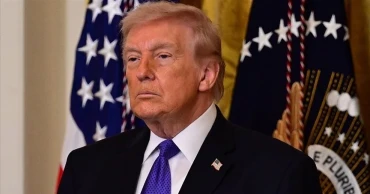
Senators to vote on limiting Trump’s military authority after Iran strikes
The US Senate is scheduled to vote Wednesday on a war powers resolution aimed at limiting President Donald Trump’s ability to conduct further military action against Iran without congressional approval.
Debate on the measure will begin at 11:00 a.m. local time (16:00 GMT), with the vote planned for 4:00 p.m. (21:00 GMT), reports Al Jazeera.
The resolution comes amid growing criticism from lawmakers and public figures over Trump’s recent strikes on Iranian targets, which many say were carried out without proper legislative authorization.
Proponents argue the vote is necessary to reassert Congress’s constitutional role in approving military action, while opponents, including most Republican lawmakers, have voiced support for the administration’s decision, citing national security concerns.
The resolution would require a two-thirds majority in both chambers to override a presidential veto, making its passage challenging given the narrow Republican majorities. Lawmakers have pledged to use the vote to publicly state their positions on the ongoing conflict and US military engagement in the Middle East.
The vote comes as the Trump administration faces scrutiny over its justifications for the strikes, with critics claiming the attacks served strategic interests aligned more with Israel than the United States.
Meanwhile, US Central Command (CENTCOM) chief Admiral Brad Cooper reported that nearly 2,000 targets across Iran have been struck since the start of joint US-Israeli operations. The campaign, described by Cooper as the largest US military buildup in the Middle East in a generation, involves more than 50,000 troops, around 200 fighter jets, two aircraft carriers, and bombers.
The strikes have reportedly destroyed hundreds of Iran’s ballistic missiles, air defence systems, drones, and 17 naval vessels, including a submarine. Iran has responded with over 500 ballistic missiles and 2,000 drones targeting US and allied forces, though Cooper said Tehran’s offensive capacity is diminishing.
The escalating conflict, part of Operation Epic Fury, follows Iranian retaliation against US bases and diplomatic posts after the initial US-Israeli assault. The situation continues to evolve, with civilian casualties mounting and global markets reacting to rising Gulf tensions.
6 months ago
Fuel crisis, price hike unlikely amid Middle East tensions: BPC Chairman
Bangladesh has sufficient fuel stock and there is no risk of supply disruption or price hike despite the ongoing tensions in the Middle East, Bangladesh Petroleum Corporation (BPC) Chairman Md Rezanur Rahman said on Tuesday.
“We have already opened letters of credit (LCs) for 15 consignments for March. For April, another 15 consignments have been scheduled, of which payment for seven has already been completed. So there is no reason for any fuel shortage in the country,” he told reporters at the BPC office in Karwan Bazar.
The BPC Chairman said the country currently has fuel reserves sufficient for several days, including diesel for 14 days, octane for 28 days, petrol for 15 days, furnace oil for 93 days and jet fuel for 55 days.
Iran death toll hits 787 as Israeli, US strikes intensify
Responding to a question about possible supply chain disruptions due to the conflict in the Middle East, the BPC chairman said a crude oil consignment was loaded on March 1 and is scheduled to pass through the Strait of Hormuz.
“It will start its journey once the situation remains normal. Another consignment will be loaded on March 22. Suppliers have informed us that supply will remain uninterrupted for now,” he said.
Rezanur said BPC is also exploring alternative sourcing options in view of the evolving situation.
UNGA Presidency: UK to give due consideration to Bangladesh’s candidature
If necessary, additional refined fuel will be imported, he added.
The government last adjusted fuel prices on March 1, keeping retail prices unchanged for March. Diesel remains at Tk 100 per litre, octane at Tk 120, petrol at Tk 116 and kerosene at Tk 112 per litre.
6 months ago
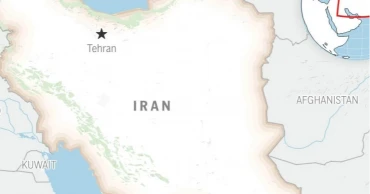
Iran labels EU militaries as terrorist groups amid rising tensions
Iran’s parliament on Sunday labeled all EU militaries as terrorist groups in response to the EU’s designation of its Revolutionary Guard..
Speaker Mohammad Bagher Qalibaf, a former Guard commander, said the designation is largely symbolic. Iran has previously used a 2019 law to reciprocally label foreign militaries as terror groups after the United States classified the Guard as such that year.
The announcement comes amid heightened Middle East tensions, with U.S. President Donald Trump weighing potential military action against Iran. The country has also scheduled live-fire drills in the strategic Strait of Hormuz, through which a fifth of the world’s oil trade passes.
Qalibaf and other lawmakers donned Guard uniforms during the parliamentary session in a show of support. He criticized the EU, saying their decision to target the Guard “goes against the interests of their own people” and blamed the bloc for following U.S. influence. Lawmakers later chanted anti-American and anti-Israel slogans.
Trump has warned Iran against killing peaceful protesters or executing detainees in the crackdown. He also raised concerns over Iran’s nuclear program, which was previously the subject of negotiations with the U.S. before Israel launched a 12-day war against Iran last June, during which the U.S. bombed three Iranian nuclear sites. Satellite observations suggest Iran may be trying to obscure activity at two of the sites.
Trump, speaking to reporters en route to Florida, avoided confirming any military decision, but reiterated that Iran should reach a “satisfactory” nuclear deal. “I don’t know that they will. But they are talking to us. Seriously talking to us,” he said.
Satellite images show new activity at Iran nuclear sites amid protest tensions
Meanwhile, Iran’s top security official Ali Larijani tweeted that “structural arrangements for negotiations are progressing,” though no direct talks with the U.S. have been confirmed, with Supreme Leader Ayatollah Ali Khamenei repeatedly ruling them out.
7 months ago
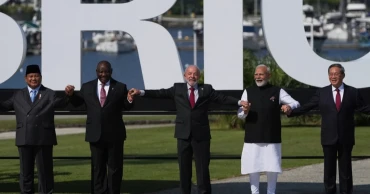
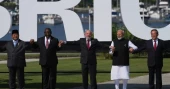
BRICS summit overshadowed by Middle East tensions, condemns tariffs
The BRICS group of developing nations on Sunday condemned rising global tariffs and military attacks on Iran but stopped short of naming US President Donald Trump or directly criticizing member states like Russia. The group’s joint declaration also condemned Israel's military actions in the Middle East while mentioning the ongoing war in Ukraine only once.
The two-day summit, hosted in Rio de Janeiro, was overshadowed by the absence of key leaders. Chinese President Xi Jinping skipped a BRICS summit for the first time since taking power in 2012. Russian President Vladimir Putin addressed the meeting via videoconference, continuing to limit his international travel due to an arrest warrant related to Russia's invasion of Ukraine.
In an apparent swipe at the US, the group expressed “serious concerns” over tariff hikes, stating they are “inconsistent with WTO (World Trade Organization) rules” and could “threaten reduce global trade, disrupt global supply chains, and introduce uncertainty.”
Responding on his social media platform, Trump warned of new tariffs, saying any nation aligning with “the Anti-American policies of BRICS” would face an additional 10% tariff.
Brazilian President Luiz Inácio Lula da Silva, hosting the summit, criticized NATO's plan to raise military spending to 5% of GDP by 2035 — a position later reflected in the BRICS declaration.
“It is always easier to invest in war than in peace,” Lula said at the summit’s opening session, which continues Monday.
Iranian presence and condemnation of Middle East violence
Iranian President Masoud Pezeshkian, expected to attend, stayed away following last month’s attacks on Iran. His foreign minister, Abbas Araghchi, represented the country instead.
The BRICS declaration condemned the attacks on Iran but avoided mentioning the US or Israel, the countries believed to have carried them out.
In his address, Araghchi urged BRICS leaders to push for strong international condemnation of Israel. He also called for accountability from Israel and the US for alleged human rights violations.
“The aftermath of the war will not be limited to one country,” Araghchi warned. “The entire region and beyond will be damaged.”
BRICS leaders voiced “grave concern” over the humanitarian crisis in Gaza, called for the release of hostages, and urged a return to negotiations in support of a two-state solution.
However, in a later statement on Telegram, Araghchi expressed Iran’s reservations about the two-state proposal, saying it “will not work, just as it has not worked in the past.”
Separately, Russia's foreign ministry used Telegram to name the US and Israel directly, condemning their “unprovoked military strikes” against Iran.
Russia spared criticism, Ukraine mentioned once
Despite Russia’s role in the Ukraine conflict, the BRICS declaration mentioned Ukraine only once, while condemning “in the strongest terms” recent Ukrainian attacks on Russian territory.
“We recall our national positions concerning the conflict in Ukraine as expressed in the appropriate fora, including the U.N. Security Council and the U.N. General Assembly,” the declaration said.
João Alfredo Nyegray, an international business and geopolitics professor at the Pontifical Catholic University in Parana, said BRICS missed an opportunity to present itself as a unified alternative to global instability.
BRICS summit opens in Brazil amid Trump tariff concerns
“The withdrawal of Egypt’s President Abdel Fattah al-Sisi and the uncertainty about the level of representation for countries like Iran, Saudi Arabia, and the UAE are confirming the difficulty for the BRICS to establish themselves as a cohesive pole of global leadership,” Nyegray said. “This moment demands high-level articulation, but we are actually seeing dispersion.”
Trump tariffs loom as Brazil treads carefully
While Lula advocated for reform of global institutions, Brazil avoided provocative topics to shield its economy from Trump’s threats of higher tariffs.
Trump has already warned of 100% tariffs on BRICS nations if they attempt to undermine the US dollar. At last year’s BRICS summit hosted by Russia, the Kremlin pushed for alternatives to US-controlled payment systems to bypass sanctions imposed after the invasion of Ukraine in 2022.
Brazil deliberately steered the summit toward less controversial topics like boosting trade among members and global health cooperation, according to Ana Garcia, a professor at the Federal Rural University of Rio de Janeiro.
“Brazil wants the least amount of damage possible and to avoid drawing the attention of the Trump administration to prevent any type of risk to the Brazilian economy,” Garcia explained.
Expansion and divisions within BRICS
Founded by Brazil, Russia, India, China, and South Africa, BRICS expanded last year to include Indonesia, Iran, Egypt, Ethiopia, and the United Arab Emirates.
The group also created a new “strategic partner” category that includes Belarus, Cuba, and Vietnam.
Brazil placed institutional development on the summit agenda to integrate new members and strengthen internal unity.
Despite internal challenges, the summit remains significant for member states, particularly amid global tensions and Trump’s tariff policies, said Bruce Scheidl, a researcher with the University of Sao Paulo’s BRICS study group.
“The summit offers the best opportunity for emerging countries to respond, in the sense of seeking alternatives and diversifying their economic partnerships,” Scheidl said.
Protests and domestic backdrop
Earlier Sunday, a pro-Israel group staged a protest on Rio’s Ipanema beach by placing dozens of rainbow flags, criticizing Iran's policies toward LGBT+ individuals. On Saturday, Amnesty International protested Brazil’s plans for offshore oil exploration near the Amazon River’s mouth.
For Lula, the summit also provided a temporary respite from domestic political challenges, including declining popularity and tensions with Congress.
The event served as a platform to advance environmental protection commitments ahead of November’s COP 30 climate talks in the Amazonian city of Belém.
1 year ago