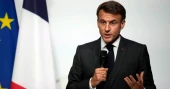
French President Emmanuel Macron
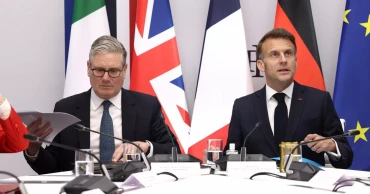
Macron, Starmer welcome Strait of Hormuz reopening, call for permanent stability
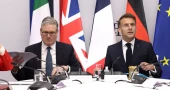
French President Emmanuel Macron and British Prime Minister Keir Starmer have welcomed the announced reopening of the Strait of Hormuz but said the key global shipping route must remain permanently open and secure.
Macron said after a meeting of around 50 countries in Paris that “we all demand the full, immediate and unconditional reopening of the Strait of Hormuz by all parties.” Starmer said announcements by Iran and the United States declaring the waterway open must become “both lasting and a workable proposal.” He added that France and the U.K. would lead a multinational mission to safeguard maritime shipping “as soon as conditions allow,” with military planners set to meet in London next week.
Iran, US say Strait of Hormuz is fully open to commercial vessels
The Paris gathering, attended by more than 30 heads of state and government either in person or virtually, excluded the United States. It aimed to advance plans for the Strait of Hormuz Maritime Freedom of Navigation Initiative, following disruptions linked to the U.S.-Israeli war on Iran that had pushed up global oil prices.
Iranian Foreign Minister Abbas Araghchi earlier said passage for commercial vessels would remain “completely open” during a 10-day ceasefire in Lebanon, while U.S. President Donald Trump said American naval restrictions would continue until a full agreement with Iran was reached.
Macron said the proposed mission would be “strictly defensive,” involving non-belligerent countries and deployed only when security conditions permit.
France and Britain are leading military planning efforts, considering roles such as mine-clearing, intelligence sharing and maritime coordination, rather than direct naval escorts. Experts said such tasks would be more feasible for coalition partners given limited naval capacity.
Dozens of countries, including Australia, Canada, South Korea and Ukraine, have participated in discussions, though commitments to deploy forces remain uncertain.
5 months ago
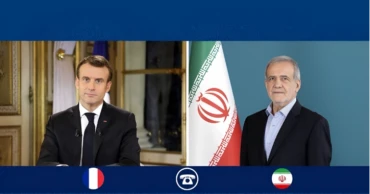
Pezeshkian tells Macron Europe can push US to respect international law
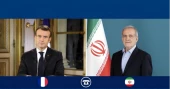
Iran’s President Masoud Pezeshkian has told French President Emmanuel Macron that Europe can help ensure the United States adheres to international law, according to Iran’s state-run IRNA news agency.
During a joint phone call, Pezeshkian said a “lack of goodwill” and “maximalist positions” from the United States prevented the finalisation of an agreement during talks held in Islamabad last week.
He warned that threats, pressure and military action would only worsen what he described as the US’s “self-made problems” in the region.
China slams US action over Iran ports, UN urges safe navigation in Strait
Reiterating Iran’s stance, the Iranian president said “diplomacy is the preferred path to resolving disputes,” adding that Europe has a constructive role to play in encouraging Washington to respect international law.
5 months ago
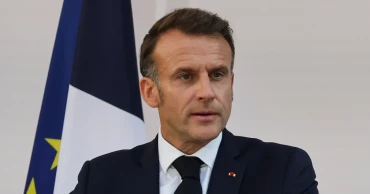
France to recognize Palestine as a state: Macron
French President Emmanuel Macron on Thursday announced that France will recognize Palestine as a state, marking a significant diplomatic move amid growing global outrage over the humanitarian crisis in Gaza.
Macron made the announcement in a post on X, stating that he will formalize the decision at the United Nations General Assembly in September. “The urgent thing today is that the war in Gaza stops and the civilian population is saved,'' he wrote.
The largely symbolic step is expected to increase diplomatic pressure on Israel as its military offensive in the Gaza Strip continues. France has now become the most influential Western nation to recognize Palestine, a move that could encourage others to follow suit. Over 140 countries worldwide, including more than a dozen European nations, currently recognize a Palestinian state.
Palestinians are seeking an independent state comprising the occupied West Bank, annexed east Jerusalem, and Gaza—territories that Israel seized during the 1967 Middle East war. However, Israel’s government and much of its political establishment remain firmly opposed to Palestinian statehood, especially following Hamas' attack on October 7, 2023.
“We strongly condemn President Macron’s decision,'' Israeli Prime Minister Benjamin Netanyahu said in a statement. “Such a move rewards terror and risks creating another Iranian proxy, just as Gaza became. A Palestinian state in these conditions would be a launch pad to annihilate Israel — not to live in peace beside it.''
The Palestinian Authority, meanwhile, welcomed France’s decision. A formal letter was handed over to Palestinian President Mahmoud Abbas in Jerusalem on Thursday.
“We express our thanks and appreciation'' to Macron, said Hussein Al Sheikh, the PLO’s vice president under Abbas, in a post. “This position reflects France’s commitment to international law and its support for the Palestinian people’s rights to self-determination.''
UN reports surge in child malnutrition in Gaza as Israeli strikes kill 93
However, the United States has strongly opposed Macron's announcement. Secretary of State Marco Rubio, in a post on X, said, “This reckless decision only serves Hamas propaganda and sets back peace. It is a slap in the face to the victims of October 7th."
France is home to both the largest Jewish and the largest Muslim populations in Western Europe and has often experienced domestic tensions related to the Middle East conflict.
Macron, who initially expressed strong support for Israel following the Hamas attack, has grown increasingly critical of Israel’s ongoing war in Gaza.
″Given its historic commitment to a just and sustainable peace in the Middle East, I have decided that France will recognize the state of Palestine,'' he posted. ″Peace is possible.''
His announcement follows the U.S. withdrawal from Gaza ceasefire talks in Qatar, citing a lack of good faith from Hamas. It also precedes a U.N. conference co-hosted by France and Saudi Arabia next week focused on a two-state solution.
Last month, Macron reiterated his determination to recognize the state of Palestine and has advocated for advancing a two-state solution in parallel with recognition of Israel and its right to self-defense.
This week, momentum has been building internationally against Israel’s actions. France, along with over two dozen mostly European nations, condemned Israel’s restrictions on humanitarian aid and the deaths of Palestinians trying to access food.
Macron is expected to join the leaders of Britain and Germany on Friday for emergency talks on the Gaza situation, focusing on aid delivery and ending the conflict.
“We are clear that statehood is the inalienable right of the Palestinian people. A ceasefire will put us on a path to the recognition of a Palestinian state and a two-state solution which guarantees peace and security for Palestinians and Israelis,'' British Prime Minister Keir Starmer said in a statement announcing the call. “The suffering and starvation unfolding in Gaza is unspeakable and indefensible.''
Israel annexed east Jerusalem after the 1967 war and considers it part of its capital. It has also established numerous settlements in the West Bank, now housing over 500,000 Jewish settlers, while about 3 million Palestinians live under Israeli military control, with limited autonomy granted to the Palestinian Authority.
Formal peace negotiations between Israel and the Palestinians last broke down in 2009, when Netanyahu returned to power. Most of the global community still views the creation of a viable Palestinian state alongside Israel as the only workable resolution to the decades-old conflict.
1 year ago
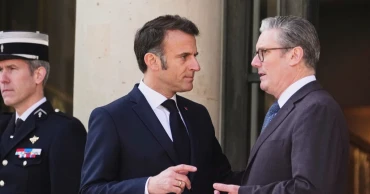
Macron begins UK visit focused on migration, Ukraine cooperation
French President Emmanuel Macron has arrived in the United Kingdom for a three-day state visit marked by royal ceremony and high-stakes political discussions focused on curbing cross-Channel migration and supporting Ukraine.
Macron’s visit comes at the invitation of King Charles III and represents the first state visit by a European Union head of state to the UK since Brexit, symbolizing Britain’s efforts to rebuild ties with the EU following its 2020 departure from the bloc.
The French President and his wife, Brigitte Macron, were received at a Royal Air Force base by Prince William and Princess Catherine. They then traveled to Windsor Castle in a horse-drawn carriage, passing through streets decorated with Union Jacks and French tricolor flags.
Upon arrival at Windsor, the Macrons were welcomed with a military honor guard and will attend a state banquet hosted by King Charles and Queen Camilla. This visit follows a reciprocal state visit by the British royals to France in September 2023.
While the monarch is expected to avoid direct political commentary, King Charles will use his address at the banquet to make a broader call for international unity, stating that the UK and France “face a multitude of complex threats” that “know no borders,” adding that “no fortress can protect us against them.”
During his stay, President Macron will also address both houses of the British Parliament in the historic Royal Gallery before holding bilateral talks with UK Prime Minister Keir Starmer. Discussions will focus on migration, defense cooperation, and investment.
Focus on migration: "New tactics to stop boats"
A major item on the agenda is tackling illegal migration across the English Channel. At a UK-France summit scheduled for Thursday, senior officials from both governments will discuss joint efforts to reduce the number of small boats carrying migrants from northern France to the UK.
Though the UK receives fewer asylum seekers compared to southern European nations, it remains a popular destination for migrants. Thousands use northern France as a launching point, especially after increased security measures targeted truck stowaways.
In 2024, around 37,000 people crossed the Channel in small boats, making it the second-highest annual total after 2022. Over 20,000 crossings have already been recorded in the first half of 2025 — a nearly 50% increase over the same period last year. The journey remains perilous, with dozens losing their lives attempting it.
Ukraine pursues joint weapons production with allies as US pauses some arms shipments
Prime Minister Starmer, whose centre-left government came to power a year ago, has vowed to “smash the gangs” behind the human smuggling networks. His strategy emphasizes closer cooperation with France and countries along migrant routes in Africa and the Middle East. The UK is also pursuing bilateral agreements with individual countries to repatriate failed asylum seekers.
British officials have urged French police to take more aggressive action to prevent crossings. Recent footage of French officers slashing rubber dinghies was welcomed by the UK. Home Secretary Yvette Cooper commented that the French are “bringing in important new tactics to stop boats that are in the water.”
The UK is also pushing France to allow its officers to intervene in deeper waters, a proposal currently under consideration in Paris. However, some migrant rights advocates and a police union have warned that such moves could pose risks to both migrants and law enforcement personnel.
Tom Wells, spokesperson for Starmer, acknowledged the complexity of the discussions, stating, “Some of the tactics being discussed are operationally and legally complex, but we’re working closely with the French.”
Keeping Ukraine on the agenda
Macron and Starmer are also coordinating closely on Ukraine. Both leaders have championed efforts to establish an international peacekeeping force to help enforce a future ceasefire, should one be reached. The proposed force would involve European troops, military equipment, and U.S. security guarantees.
However, the plan has met resistance from Washington, with U.S. President Donald Trump showing limited enthusiasm for the idea. Russia, meanwhile, has continued its military aggression in Ukraine, making a ceasefire uncertain.
Despite these hurdles, British officials maintain that the initiative — referred to as a “coalition of the willing” — remains viable. Macron and Starmer are expected to participate in an international videoconference on Thursday to continue planning efforts.
Starmer spoke with Ukrainian President Volodymyr Zelenskyy on Monday and discussed the “significant progress being made by military planners,” according to a statement from the Prime Minister’s office.
1 year ago
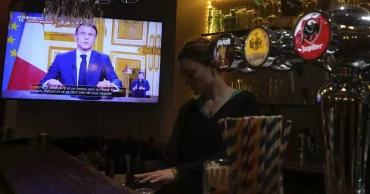
Macron vows to complete term, Promises new premier amid political crisis
French President Emmanuel Macron has vowed to serve out his term until 2027 and announced plans to appoint a new prime minister within days to address the political impasse caused by the ousting of former Prime Minister Michel Barnier.
The resignation of Barnier, following a historic no-confidence vote over budget disputes in the National Assembly, left France without a functioning government. Macron, addressing the crisis, blamed the far-right opposition for orchestrating the downfall, accusing them of choosing “disorder.”
“The far right and far left have joined forces in an anti-Republican front,” Macron said. “I will not shoulder the irresponsibility of others.”
While he refrained from naming a successor for Barnier, Macron promised swift action to restore stability, emphasizing that the next prime minister must form a “government of general interest.”
Acknowledging Responsibility Amid Chaos
Macron admitted to his own role in the political turmoil, citing his June decision to dissolve parliament. This move led to legislative elections that produced a hung parliament, with three minority blocs unable to secure a majority.
“I recognize that this decision was criticized and not fully understood,” he said. “But I believe it was necessary to let the voters express their will.”
Budget Priorities and Avoiding Shutdown
The immediate task for Macron's new government will be addressing France’s budget crisis. He confirmed plans to introduce a special law by mid-December to prevent a shutdown and ensure tax collection for 2024 based on existing rules. The government will also focus on passing the 2025 budget to invest in military, justice, and police services while supporting struggling farmers.
Rising Challenges and Economic Pressure
Macron highlighted France’s mounting challenges, including international crises like the wars in Ukraine and the Middle East and domestic economic struggles, particularly ballooning debt levels. Moody’s warned that the political instability could worsen the country’s financial outlook, with interest rates potentially rising and debt levels projected to hit 7% of GDP next year.
Read: Macron to address France after no-confidence vote ousts govt
The president urged the nation to take inspiration from recent achievements, such as hosting the Paris Olympics and the upcoming reopening of Notre Dame Cathedral, as symbols of resilience.
Opposition and Calls for Resignation
The no-confidence vote has emboldened opposition leaders, with some calling for Macron’s resignation. Manuel Bompard, leader of the far-left France Unbowed party, stated that “stability requires the departure of the President of the Republic.”
Marine Le Pen, leader of the far-right National Rally, stopped short of demanding Macron’s resignation but warned of increasing pressure on the president.
Despite the political turmoil, the French constitution does not require a president to step down after a government collapse, nor does it allow for new legislative elections before July, leaving policymakers in a precarious position.
Public Unrest and Teachers’ Protests
Amid the crisis, teachers protesting education budget cuts voiced frustration with Macron’s leadership. Demonstrators in Paris linked their demands to the broader political instability, with banners calling for Macron’s resignation.
“Macron is dismantling public services like schools,” said Dylan Quenon, a middle school teacher. “The only way to change this is to remove him.”
Read more: For the first time Macron recognizes 1944 Thiaroye killings as massacre
Although some protesters welcomed Barnier’s ousting, others expressed concerns about the uncertainty ahead. “This government’s fall could lead to something even worse,” said Élise De La Gorce, a teacher from Stains.
As Macron works to name a new prime minister and restore order, the stakes remain high, with economic and political stability hanging in the balance.
Source: With inputs from agencies
1 year ago

For the first time Macron recognizes 1944 Thiaroye killings as massacre
French President Emmanuel Macron, for the first time, formally acknowledged the killing of West African soldiers by French forces in 1944 as a massacre, in a letter addressed to Senegalese authorities on Thursday. The recognition comes on the eve of the 80th anniversary of the Thiaroye massacre, a dark chapter in World War II history that occurred in a fishing village near Senegal’s capital, Dakar.
The acknowledgment coincides with a period of waning French influence in West Africa, where Paris has faced growing challenges in maintaining its ties with former colonies.
The massacre occurred on Dec. 1, 1944, when French soldiers killed between 35 and 400 West African troops—members of the Tirailleurs Sénégalais, a colonial infantry unit that had fought for France in the Battle of France in 1940. The killings followed a dispute over unpaid wages. French forces reportedly rounded up the mostly unarmed West African soldiers, accusing them of mutiny, and opened fire.
Senegalese President Bassirou Diomaye Faye confirmed receiving Macron’s letter, which was reviewed by The Associated Press. Speaking to reporters, Faye expressed hope that this acknowledgment would lead to uncovering the full truth about the massacre.
“We have long sought closure on this story, and we believe that, this time, France’s commitment will be full, frank, and collaborative,” Faye said.
In his letter, Macron stressed the need for transparency about the events. “France must recognize that on that day, the confrontation between soldiers and riflemen who demanded their full legitimate wages triggered a chain of events that resulted in a massacre,” Macron wrote. He also highlighted efforts by a Senegalese government-appointed committee, led by historian Professor Mamadou Diouf, to establish the causes and facts of the tragedy.
Read: US charges Hamas leader, other militants in connection with Oct. 7 massacre in Israel
Macron’s acknowledgment comes against a backdrop of shifting dynamics in Senegal and the region. Senegal’s ruling party, PASTEF, recently secured a decisive legislative victory, granting President Faye a strong mandate to pursue economic reforms aimed at reducing dependency on foreign companies, including French enterprises.
Regarding the continued presence of French troops in Senegal, Faye hinted at potential reevaluation, citing historical grievances. “France enslaved, colonized, and stayed here,” Faye remarked. “I think it’s hard to imagine another country having a military base in France.”
Macron’s gesture, while significant, reflects broader efforts to repair strained relations in West Africa, where calls for sovereignty and reduced foreign influence are growing louder.
Source: With inputs from agencies
1 year ago
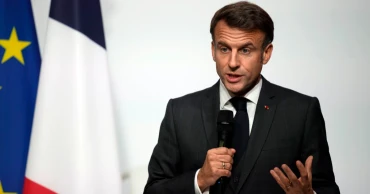
Macron in Morocco after his Western Sahara change brings a 'new honeymoon'
French President Emmanuel Macron arrives Monday in Morocco, where he is expected to meet with the North African kingdom’s leaders and discuss partnerships regarding trade, climate change and immigration.
During the president’s three-day visit to Rabat, he is scheduled to meet with King Mohammed VI and Prime Minister Aziz Akhannouch and address Morocco’s Parliament.
It comes months after Macron changed France’s longstanding public position and backed Morocco’s autonomy plan for the disputed Western Sahara. The move endeared the country to Morocco and alienated it from Algeria, which hosts refugee camps governed by the pro-independence Polisario Front and has long pushed for a U.N.-organized referendum to solve the conflict.
In the days leading up to the visit, Moroccan publications lauded the “warm reunion” and a “new honeymoon” between the two countries while French flags were hung throughout Rabat.
France and Morocco have historically partnered on issues ranging from counterterrorism to Western Sahara. Morocco is the top destination for French investment in Africa and France is Morocco’s top trade partner. Morocco imports French cereals, renewable energy infrastructure like turbines and weapons. Morocco exports goods to France including tomatoes, cars and airplane parts.
Moroccans are among the largest foreign-born communities in France, where North African immigrants are a key political constituency and a focal point of debates about the roles of Islam and immigration in French society. In recent months, France’s new Interior Minister Bruno Retailleau has pushed for the country to take a hard-line approach toward immigration and seek deals with countries like Morocco to better prevent would-be migrants from crossing into Europe.
On Macron’s last visit to Morocco, he and King Mohammed VI inaugurated Al Boraq, Africa’s first high-speed rail line, made possible by French financing and trains manufactured by the French firm Alstrom.
Despite close ties, relations have at times been fragile between France and Morocco, which was a French protectorate from 1912 to 1956. In 2021, Morocco suspended consular relations France momentarily reduced the number of visas offered to Moroccans in protest of its refusal to provide documents needed to deport people who migrated to France without authorization.
Relations between the two countries soured further that year when a 2021 report revealed Morocco’s security services had used Israeli spyware to infiltrate the devices of activists and politicians, including Macron. Morocco denied and sued over the allegations.
1 year ago

Israel must stop killing babies and women in Gaza: Macron tells BBC
Israel has to stop killing children and women in Gaza, French President Emmanuel Macron has told the BBC.During an exclusive interview, Macron said that there was "no justification" for the attack, adding that Israel would gain from a ceasefire.
While acknowledging Israel's right to self-defense, he said, "We do urge them to stop this bombing" in Gaza.However, he also emphasised that France "clearly condemns" Hamas' "terrorist" activities, the report said.
Thousands who were sheltering at Gaza City’s hospitals flee as Israel-Hamas war closes inLike Israel, the United States, the United Kingdom, and other Western countries, France views Hamas as a terrorist group.When asked about whether he wanted other world leaders to support his demands for a ceasefire, including those in the US and the UK, Macron said, "I hope they will."
Civilians flee north Gaza or shelter at a hospital as Israel and Hamas battle in the cityFollowing almost two weeks of main ground incursion into the territory and a month of Israeli shelling, the health ministry headed by Hamas in Gaza said on Friday that 11,078 Palestinians had died and 1.5 million had left their homes.Israel claimed that it followed international law when attacking military targets and that it takes precautions to lessen the number of civilian deaths by alerting civilians in advance and urging them to flee.Speaking a day after a conference in Paris on humanitarian aid related to the Gaza conflict, Macron stated that all participating governments and agencies had reached the "clear conclusion" that there is “no other solution than first a humanitarian pause, going to a ceasefire, which will allow [us] to protect... all civilians having nothing to do with terrorists.""De facto — today, civilians are bombed — de facto. These babies, these ladies, these old people are bombed and killed. So there is no reason for that and no legitimacy. So we do urge Israel to stop," the French president said.Macron, however, stated it was not for him to determine whether or not international law had been breached.
Fights in bread lines, despair in shelters: War threatens to unravel Gaza's close-knit society
2 years ago

Bangladesh, France reiterate interest in expanding bilateral trade and exploring potentials for investment in infrastructure
Bangladesh and France have reiterated interest in expanding bilateral trade and exploring potentials for investment in quality and resilient infrastructure development in Bangladesh, including in the railway sector.
Prime Minister Sheikh Hasina and President of the French Republic Emmanuel Macron expressed the hope that the Bangladesh-France Investment Summit — to be held on October 23 and 25, 2023 — in Paris and Toulouse would inject a new impetus to the bilateral trade and investment relations.
"Thank you, Prime Minister Sheikh Hasina, and the people of Bangladesh for such a warm welcome. Our friendship is long-standing and unbreakable," President Macron said.
Read: Partnership for resilience and prosperity: Dhaka, Paris want joint efforts for result-oriented COP28 in Dubai
France expressed its confidence in the economic prospects offered by Bangladesh for shared growth and inclusive development.
Both sides recalled the depth of their economic partnership, spanning every sector from industry to services, and expressed willingness to further deepen and widen it through business-to-business collaboration, according to a joint statement issued on Monday.
France lauded the adoption of the National Action Plan on the labour sector of Bangladesh (2021-2026) and stressed the importance of its implementation and the diversification of Bangladesh’s economy in order to facilitate a smooth and sustainable transition under the Generalised Scheme of Preferences (GSP) of the European Union.
Read: Bangladesh, France sign €184 credit facility deal to support urban governance, infrastructure improvement
Building on Prime Minister Sheikh Hasina’s visit to France in November 2021, at her invitation, President Emmanuel Macron paid a bilateral visit to Bangladesh on September 10-11, 2023.
The President of France and the Prime Minister of Bangladesh met on Monday in Dhaka to give a strong impetus to the bilateral relations, and stated their common conviction to develop a trusted and meaningful partnership fostering strategic autonomy — in support of global peace and security, resilience and prosperity, and people-centric connectivity.
Bangladesh and France committed to launch regular high-level dialogues to deepen the strategic dimension of their partnership.
Read: France happy with Bangladesh’s commitment for acquisition of 10 A350 from Airbus
3 years ago

Talks between PM Hasina and French President Macron end
Prime Minister Sheikh Hasina and visiting French President Emmanuel Macron on Monday held talks aimed at taking the bilateral relations to a strategic engagement.
The two countries are seeking to open new areas of cooperation, particularly in strategic assets and advanced technologies.
On arrival at the Tiger gate of the Prime Minister’s Office at 10:20am, Sheikh Hasina received President Macron.
Read: France respects Bangladesh's sovereign policy independence: PM Hasina says after talks with President Macron
The two leaders joined the delegation-level talks and restricted-level talks at Chameli hall and Shimul hall of the Prime Minister’s Office, respectively.
A couple of bilateral instruments (agreements/MoUs) will be signed in presence of the two leaders at Karobi Hall. Then PM Hasina and President Macron will hold a joint press briefing there.
Read: ‘France will be, again, on your side’
Macron will sign the visitor’s book before Hasina sees him off at the Tiger gate.
Macron, the first French president visiting Bangladesh in 33 years, arrived here in Dhaka on Sunday evening from India after attending the G20 summit in New Delhi. The French leader is scheduled to leave Dhaka at 2pm today (on Monday).
Francois Mitterrand was the last French president to visit Bangladesh on 22-24 February, 1990.
Read: Talks between PM Hasina and French President Macron end
Total trade between Bangladesh and France soared from 210M€ to 4.9 billion€ today with France being the 5th country for exports.
French companies are now involved in various sectors including engineering, energy, aerospace and water sectors.
3 years ago