VP race in DUCSU Election 2025
The 2025 DUCSU Election's Digital Mirage
The final days of the DUCSU 2025 election saw a dramatic shift in online engagement, but a new analysis reveals that much of the visible momentum was a carefully constructed mirage. A report from SharedToday exposes a phenomenon called "auto-turfing"—the use of coordinated, repetitive campaign posts to create an illusion of widespread support. This practice has cluttered the digital view, making it difficult to distinguish genuine popularity from manufactured waves.
Detecting the Deception
Auto-turfing campaigns can be identified by several key markers, as outlined in the SharedToday report:
- Identical or near-identical posts shared by multiple accounts in short timeframes.- Overuse of templated slogans and hashtags.- High engagement spikes on content with low diversity.
Read more: DUCSU Election 2025: A Campaign’s Final Twist
The Turf-Inflated Race
Looking at the final 24 hours of raw engagement, the GS race was dominated by two candidates, with a shocking shift in momentum. Meghmallar of the Left Alliance suddenly took the lead, capturing 63.6% of engagement, while Shibir’s Farhad held 33.3%. Odhikar's Sabina, once a frontrunner, collapsed to just 2.1%.
However, this sudden surge was highly artificial. The Left's rise was almost entirely from organized amplification, with over 70% of Meghmallar’s last 24-hour engagement being turfing-driven. Similarly, Shibir’s late surge was powered by organized networks, with an estimated 60-65% of Farhad’s engagement being turfing-driven.
The Real Race: Organic Engagement Only
When the "turfing" is stripped away, the true state of the race becomes clear. A "clean" analysis of organic-only engagement provides a different picture of the election:
Organic VP Race (two-week trend):
- Umama (Independent): ~40%- Abidul (JCD): ~36%- Sadiq (Shibir): ~22%- Others:
1 year ago
DUCSU Election 2025: A Campaign’s Final Twist
As the Dhaka University Central Students’ Union (DUCSU) election 2025 draws to a close, the final days have proven to be a testament to the unpredictable nature of student politics. According to a data report from SharedToday, the digital landscape shifted dramatically between September 5th and 6th, re-shaping the races for the top posts.
The Vice President's Race
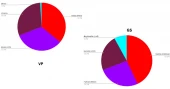
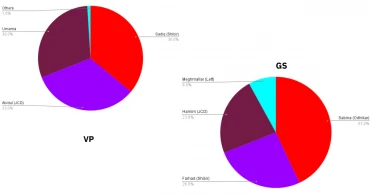
The VP race, once a clear contest between JCD’s Abidul and Independent candidate Umama, has become a three-way battle. A late and powerful digital push from Shibir’s Sadiq vaulted him to the top of the online engagement charts. SharedToday’s data shows that Sadiq now holds
36% of the online traction, just edging out Abidul at 33% and Umama at 30%. This isn't an overnight change in campus sentiment but a clear mobilization effect, demonstrating Shibir's highly disciplined and organized approach to the digital campaign.
Read more: DUCSU Election 2025: A Race of Fragile Alliances and Shifting Sentiments
The General Secretary’s Race
In the GS race, a clear front-runner has emerged. Odhikar’s Sabina has pulled ahead of her competitors by successfully branding herself as the “face of change” and a representative of the July movement’s ideals. According to data from SharedToday, she had a commanding
43% share of traction from August 22 to September 6. She is well ahead of Shibir’s Farhad, who sits at
26%, and JCD’s Hamim at 23%. This indicates that students are responding to a message of change and accountability, and Sabina has been the most effective at capturing that sentiment.
Read more: JCD alleges certain group spreading hate online centring DUCSU
What the Data Says About the BGCS Panel
While BGCS was once a symbol of the student movement's power, Shared Today’s analysis reveals that the panel is now "virtually absent" from the digital conversation. Their traction scores are negligible, with less than a 1% share. This mirrors the panel's internal fragmentation, as key leaders defected to run as independents, leaving the official BGCS panel without the digital firepower needed to compete.
1 year ago