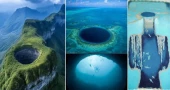
How sinkholes are created
Sinkholes: Causes, Dangers, and World’s Deadliest Examples
Sinkholes are sudden holes that open up in the ground when the surface layer drops into empty spaces below. They can be as small as a dip in a garden or so big that they swallow houses, cars, and even whole streets. To understand sinkholes let's find out how sinkholes are formed, why some are more dangerous and the some of the deadliest sinkholes around the world.
How Sinkholes Form in a Natural Way
Most sinkholes form in places where the rock under the ground can slowly dissolve in water, such as limestone, dolomite, or gypsum. Rainwater becomes slightly acidic after mixing with gases in the air and soil, and over many years it eats away at these rocks, creating gaps and hidden caves underground. As time passes, the roof of one of these caves may weaken until it can no longer hold up the weight above it. When that happens, the surface suddenly collapses, creating a sinkhole. This process can take hundreds of years, but once the ground gives way, the collapse can happen very quickly and with dramatic force.
Can Human Actions Trigger Sinkhole Formation
While sinkholes often form naturally, human actions can make them happen faster or more often. Pumping too much water from underground lowers the water level and removes the support that keeps the ground steady. Mining and drilling can leave empty spaces or weaken the layers of rock. Broken water or sewage pipes can slowly wash away the soil until the surface caves in. Building heavy structures on soft or weak ground can also cause the earth to collapse. Because of these activities, towns, cities, and farmland tend to have more sinkholes than areas left untouched.
Read more: Rema–Kalenga Wildlife Sanctuary in Habiganj: A Comprehensive Travel Guide
Why Sinkholes Are Dangerous
Sinkholes are dangerous because they often appear suddenly and can grow big enough to swallow cars, houses, or whole roads. In some areas, they are linked to complicated underground cave systems, which makes fixing the damage costly and difficult. When they happen in towns or cities, a single sinkhole can cut off power or water, pollute supplies, force people to leave their homes, and even cause deaths. Even very large sinkholes that do not directly threaten lives can still create long-term problems by changing how water flows and making the surrounding land unstable.
The Most Dangerous Sinkholes in the World
.
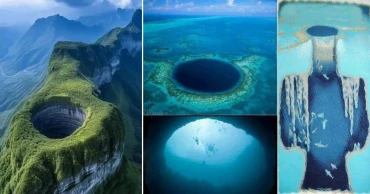
Xiaozhai Tiankeng, China
Xiaozhai Tiankeng in China is known as the world’s biggest and deepest sinkhole. It is an enormous hole with steep, vertical walls that drop hundreds of metres. Its dimensions are approximately 626 m long, 537 m wide, and between 511 and 662 m deep. The cliffs around it are very dangerous, as loose rocks can fall and the edges give way suddenly.
This natural sinkhole was formally “discovered” by geologists (outside the local population) in 1994 during exploration by the China Caves Project. Its huge size shows just how powerful natural processes underground can be.
Read more: Finland ranked again the world’s happiest country in 2025: What’s the secret
Great Blue Hole, Belize
The Great Blue Hole in Belize is a giant natural sinkhole in the sea and is well known among divers. It is very deep with steep sides that drop suddenly, making it risky to explore. While it doesn’t threaten people on land, it can be dangerous for divers who are not experienced or ready for the challenges of deep water.
Bayou Corne, Louisiana, USA
The Bayou Corne sinkhole in Louisiana, USA, was caused when an underground salt dome collapsed. It became evident on August 3, 2012, when residents were evacuated after signs of collapse in an underground salt cavern.
The ground gave way so suddenly that an entire nearby community, about 350 people, had to be evacuated. Gas was released, and the area has remained unstable ever since, showing how industrial activity underground can lead to long-lasting and dangerous problems.
Read more: How Green Industries Can Reduce River Water Pollution in Dhaka City
1 year ago