seasonal employment
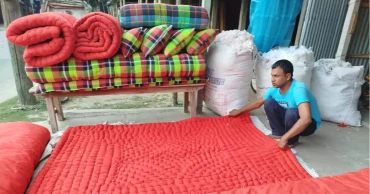
Quilt makers race against time as bone-chilling cold grips Lalmonirhat
Life across all five upazilas of northern Lalmonirhat has slowed to a shiver as the biting cold of Poush tightens its grip.
With an unrelenting cold wave sweeping the region, quilts and mattresses have become the primary shield against the freezing nights, leaving local quilt makers with barely a moment to breathe.
Read more: Cold wave disrupts life, livelihoods across northern Bangladesh
At haat-bazars and roadside shops across Lalmonirhat Sadar and surrounding areas, business is booming.
From dawn to deep night, the courtyards of quilt makers echo with the rhythmic khat-khat of sewing machines, as artisans wash cotton, stuff layers and stitch tirelessly to keep up with soaring demand.
Over the past few days of continuous cold, demand for quilts and mattresses in rural areas has multiplied several times.
Artisans say that while much of the year passes in relative idleness, these three winter months are their main earning season.
The workload has now become so intense that many shops are struggling to find time even for meals.
Alongside new quilts, there is a rush of customers bringing old ones for repairs or refilling with fresh cotton.
A visit to Tushbhandar Bazaar in Kaliganj upazila reveals clear class-based preferences. Low-income buyers are opting for cheaper quilts made from recycled cotton, while middle-income families prefer kapash or shimul cotton.
However, rising prices of cotton and fabric have made quilts more expensive across the board.
Customer Malek Mia said, “Compared to last year, it now costs Tk 300 to Tk 500 more to make a quilt. With prices rising everywhere, surviving has become increasingly difficult for ordinary people like us.”
Veteran artisan Solaiman Ali of Kaliganj said each craftsman is producing three to four quilts a day, yet meeting delivery deadlines has become a struggle.
Quilt makers in Lalmonirhat swamped with orders as winter sets in
“As the cold intensifies, the pile of orders keeps growing,” he said.
Trader Samad Mia noted that depending on quality, the cost of making a quilt now ranges between Tk 1,500 and Tk 2,000. Due to the higher price of shimul cotton, many customers are choosing kapash cotton as an alternative.
Meanwhile, members of the local civil society have called for stronger winter relief efforts for the poor and destitute.
The Lalmonirhat district administration has already begun distributing blankets, offering some relief amid one of the harshest winter spells of the season.
9 months ago
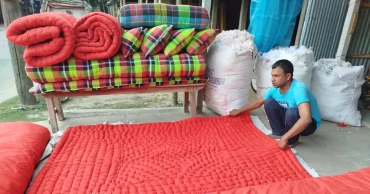
Quilt makers in Lalmonirhat swamped with orders as winter sets in
With winter’s first chills settling over the northern districts, Lalmonirhat’s quilt makers are bustling with activities, as demand for quilts and mattresses soars.
Thick morning fog, cool evening breezes and the nightly dew signal the changing season, prompting residents to prepare for colder days ahead. As temperatures dip, workshops and markets in Lalmonirhat are buzzing with both artisans and eager buyers.
A stroll through the markets of the district’s five upazilas revealed shops adorned with vibrant fabrics and cotton, catering to a growing crowd. Some customers opt for ready-made quilts, while others place bespoke orders, leaving the workers fully absorbed in their stitching.
Situated along the Teesta River and bordering the northern frontier, Lalmonirhat experiences harsher winters than much of the country. This year, preparations began earlier than usual, prompting a rush in quilt and mattress production.
From dawn till dusk, shops remain alive with activity, as middle- and upper-middle-income families flock to purchase winter essentials.
Read more: Dense fog blankets Lalmonirhat as signs of winter emerge
Rising costs are, however, casting a shadow over the seasonal bustle. Traders report that increasing prices of cotton, fabric, foam, and other materials have pushed up the cost of producing quilts and mattresses.
Currently, quilt fabric is selling for Tk 50–60 per yard, mattress fabric Tk 50–55, and jajim—a heavier mattress—Tk 160–190. Meanwhile, karpash cotton fetches Tk 180–200 per kilogram, poly-cotton Tk 120–130, wool Tk 55–60, and jute Tk 40–45 per kilogram.
Ready-made quilts are priced between Tk 1,600 and Tk 2,600, mattresses from Tk 1,700 to Tk 3,500, jajims from Tk 3,500 to Tk 6,500, and pillows range from Tk 150 to Tk 400.
Belal Mia, a seasoned quilt maker at Shialkhowa Bazar, said, “I’ve been making quilts and mattresses for nearly 10 years. With another worker, I can finish seven to nine orders a day.”
Customers, too, are adjusting to the rising costs.
Samad Mia, a local resident, explained, “We heard this winter may be colder, so I’m making my quilt in advance. We are poor people—the price of a blanket is beyond our reach. So, we are making quilts at a relatively lower cost.”
Read more: Early winter chill grips Bangladesh’s northern districts
Md Hamidur Rahman said, “It may not feel cold during the day, but nights are getting chillier. A thin sheet is no longer enough. So I made two quilts for my family, which cost Tk 5,300.”
Salma Begum remarked, “Everything has become expensive—cotton, fabric, labour costs. Still, we have to make quilts; winter will get harsher ahead.”
Shopkeepers remain hopeful despite the challenges.
Jalal Uddin said, “Demand is rising as winter gets colder. Sales are not as high as before, but we expect business to pick up in the coming days.”
Md Safiqul Islam, owner of Maa Tula Store in Aditmari Bazar, said, “November to February is our busiest season. As the cold intensifies, orders for quilts and mattresses continue to increase.”
As winter casts its frosty spell across Lalmonirhat, the rhythmic hum of sewing machines and the vibrant display of fabrics offer a comforting promise: warmth and comfort for all who prepare in time.
Read more: Dug-up road turns into knee-deep canal; Kaliganj villagers have to use rafts
11 months ago