2009 BDR Mutiny report
BDR mutiny a planned conspiracy to destabilise Bangladesh: Inquiry Commission chief
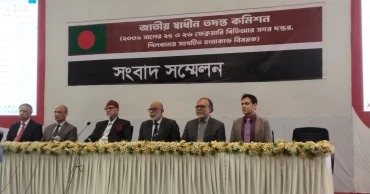
The 2009 BDR mutiny at Pilkhana headquarters, which took place on February 25–26, was a premeditated conspiracy aimed at destabilising Bangladesh, prolonging political power, and weakening the country’s security forces, said Major General (retd) Fazlur Rahman, head of the National Independent Inquiry Commission.
Fazlur Rahman made the remarks on Sunday evening (November 30) while briefing reporters at the commission’s office in Dhaka’s Science Lab area after submitting the investigation report to the Chief Adviser.
The commission found involvement of several influential political figures in the mutiny, with names of senior Awami League leaders surfacing during the probe.
Read more: Govt to ensure justice for deprived armed forces members: Chief Adviser
Those mentioned include former Prime Minister Sheikh Hasina, Barrister Fazle Noor Taposh, Sheikh Selim, Mirza Azam, Jahangir Kabir Nanak, Sahara Khatun, then Security Adviser Maj Gen (retd) Tarique Ahmed Siddique, former Army Chief Gen (retd) Moeen U Ahmed, and former DGFI Chief Maj Gen (retd) Akbar.
Discussing the causes of the mutiny, Fazlur Rahman cited multiple factors, including dissatisfaction with the Dal-Bhat programme and the creation of the BDR Shop, which significantly increased BDR personnel workloads.
He also noted opposition among some personnel to the presence of army officers within the force, along with internal crises within BDR.
“Fundamentally, the mutiny aimed to weaken the army and destabilise Bangladesh. The main reasons were to undermine the army, with neighbouring India seeking to destabilise the country. Extending the political tenure of the ruling Awami League was also among the motives. India was a beneficiary from the incident,” he said.
On reports of missing army officers, the commission found evidence supporting claims that five army officers disappeared after the mutiny.
BDR Mutiny: Probe body says Hasina had 'green signal' for entire incident
Fazlur Rahman said that RAB personnel were deployed at Pilkhana’s Gate 5 at the time but did not intervene, reportedly due to instructions from then RAB Additional Director General Col Reza Nur.
He stressed that RAB and police do not require special orders to act during such incidents.
On foreign involvement, he stated that the commission identified a “neighbouring country” linked to the incident, noting that Sheikh Hasina and her associates had taken refuge there.
He added that grievances tied to Operation Dal Bhat were reportedly used to mask the underlying objective of destabilising the country and weakening BDR.
Dhaka-Delhi ties won’t get stuck over Hasina issue: Foreign Adviser
The inquiry also highlighted that political decisions blocked army action during the mutiny, terming the absence of a military response a “major conspiracy.”
Witness accounts suggested participation from outsiders alongside BDR personnel, some affiliated with Awami League, Jubo League, and Chhatra League.
The commission said a group of 20–25 people entered the compound and later emerged with a procession of around 200.
Referring to intelligence lapses, Fazlur Rahman described them as “mountain-sized.”
Regarding former Army Chief Gen (retd) Moeen U Ahmed’s statement on not conducting an army operation during the mutiny, he said the former chief informed the commission online that intervention might provoke Indian involvement, warning, “they might not return to India like 1971.”
The investigation also found that 721 Indian nationals entered Bangladesh during the period, with 67 unaccounted for.
The commission recommended that the government trace them and seek explanations from India. Some perpetrators inside Pilkhana reportedly spoke in Hindi.
“If we fail to properly evaluate this incident, the country may face another BDR-like mutiny in the future. For national security, truth and corrective measures are essential,” Fazlur Rahman told journalists.
Read more: Sacked BDR men dispersed near Kakrail while marching to Jamuna
10 months ago
BDR Mutiny: Probe body says Hasina had 'green signal' for entire incident
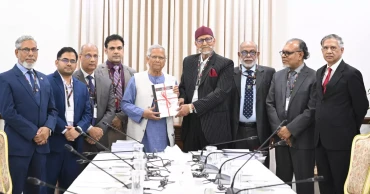
The Commission, formed to reinvestigate the 2009 BDR massacre, the brutal massacre committed in the name of BDR mutiny submitted its report to Chief Adviser Prof Muhammad Yunus on Sunday (November 30), noting that then PM Sheikh Hasina had a 'green signal' for the entire incident to take place while then MP Sheikh Fazle Noor Taposh played the role of the main coordinator behind.
Chief of the National Independent Investigation Commission Maj Gen (retd) ALM Fazlur Rahman, who was also former director general of BGB, and other members submitted the report to the Chief Adviser at the State Guest House Jamuna.
Major General Md Jahangir Kabir Talukder (retd), Brigadier General Md Saidur Rahman Bir Pratik (retd), Munshi Alauddin Al Azad, Dr M Akbar Ali, Associate Professor of the Department of Political Science, Dhaka University Md Shariful Islam, Assistant Professor of the Institute of Education and Research, Jagannath University Md. Shahnewaz Khan Chandan are the members of the commission.
Read more: Govt to ensure justice for deprived armed forces members: Chief Adviser
"The nation was in the dark about the BDR massacre for a long time. The nation will remember the role you played in uncovering the truth. On behalf of the nation, I thank you,” Prof Yunus said.
He said the nation had many questions about this most horrific incident in history and these questions will be answered through this work.
Prof Yunus said there are many lessons to be learned from this report. “It will be a valuable asset for the nation.”
Commission chief Fazlur Rahman said the highest professionalism has been maintained in the interest of making the investigation fair, impartial and error-free.
He said when they started the work, many signs of this incident 16 years ago had been destroyed and many people involved in this incident have gone abroad.
“We went through two processes. We called witnesses; we listened to some of them for up to 8 hours - as long as the individual wanted to say. We talked to those who were involved in the investigation. We collected their investigation reports and other elements,” Fazlur Rahman said.
He said through this investigation, answers have been sought for every question in the public mind about the BDR killings, an attempt has been made to uncover who had what role and why the army did not take action.
Fazlur Rahman said the investigation has found strong evidence of the direct involvement of external forces in the BDR killings and the direct involvement of the then ruling party Awami League.
Read more: BDR mutiny a planned conspiracy to destabilise Bangladesh: Inquiry Commission chief
Jahangir Kabir Talukder said about the commission’s findings that the commission has found some external and real reasons for this incident.
He said the killings were planned and the role of the main coordinator behind it was played by the then MP Sheikh Fazle Noor Taposh, according to the Chief Adviser’s press wing.
Jahangir said the local Awami League played a direct role in protecting those involved in the murder. They entered Peelkhana with a procession of 20-25 people and when they came out, there were more than two hundred people in that procession.
Jahangir said that Hasina had a 'green signal' for the entire incident to take place, according to the press wing.
Regarding the assessment of responsibility for the incident, Jahangir said that the responsibility for the incident lies with the then head of government and the army chief.
A decision has been made to resolve this incident politically. The police, RAB and intelligence agencies have also failed miserably.
Jahangir said that the role of some print and electronic media and some journalists during the incident was unprofessional.
He said that the exact names and information of the BDR members with whom Sheikh Hasina met at the State Guest House Jamuna (the then Prime Minister's residence) during the murder were not preserved.
The commission made several recommendations in its report so that such incidents can be avoided in the future and the victims of this incident get justice.
The meeting was attended by National Security Advisor Dr Khalilur Rahman, Special Assistant to the Chief Adviser on Defense and National Integration Development Lieutenant General (retd) Abdul Hafiz, and Home Secretary Nasimul Gani.
Read more: Sacked BDR men dispersed near Kakrail while marching to Jamuna
10 months ago

