questionable processing practices
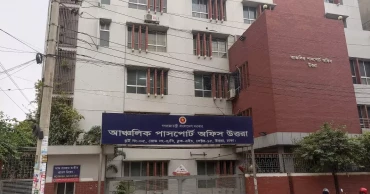
Uttara Passport Office draws scrutiny amid allegations of brokers’ influence, irregularities
The Uttara Regional Passport Office is facing renewed scrutiny after an investigation found what appears to be an entrenched network of brokers, questionable processing practices and allegations of unauthorised facilitation of passports for Rohingya nationals.
A week-long observation by journalists, conducted partly through covert visits, found more than 50 stationery and printing shops around the office operating as de facto broker hubs.
Applicants attempting to navigate the process independently frequently reported harassment, opaque requirements and last-minute document demands.
Sabbir Ahmed, a resident of Uttara, left the office visibly frustrated. He told UNB he was unexpectedly asked to provide a marriage certificate. Minutes later, a broker escorted him to a nearby shop where documents were printed immediately — a service that several shop operators openly marketed.
“Everything can be arranged with money,” said Hridoy, who runs one such shop. “If someone does not have the right papers, we make arrangements. Even passports without national IDs are possible — they just cost more,” he said.
Read more: E-passport booklets procurement gets CCGP nod
The officials concerned, however, strongly denied what residents, applicants and industry insiders say reflect a systemic problem.
Costs Balloon Through Informal Channels
While the government’s official fee for a 10-year, 48-page passport is Tk 5,750, brokers typically charge Tk 6,200–6,500 for routine cases.
More complex cases, including those requiring forged or recreated documents, can rise to Tk 10,000 and in some instances exceed Tk 100,000, according to brokers interviewed.
Brokers claimed that 250–300 out of the 400–500 daily applications at the Uttara office come through their networks, generating an estimated Tk 1 crore in unaccounted monthly payments shared through multiple layers of staff. But it could not independently verify the total amount allegedly involved.
Sensitive Allegations Over Rohingya Passport Processing
The most sensitive allegation relates to the unauthorised facilitation of passports for Rohingya nationals using fake or manipulated documents, a recurring challenge for Bangladesh’s security and identity-management agencies.
Roni, a gazetted July Warrior who previously worked in the area’s stationery sector, said the practice escalated after the fall of the former government, when oversight weakened.
Read more: Human trafficking, instability erode global trust in Bangladesh’s passports
Earlier, in February 2024, the Detective Branch (DB) of the Dhaka Metropolitan Police arrested 23 members of what it described as the largest syndicate directly involved in producing Rohingya passports.
At the time, the DB said brokers operating inside passport offices and some Ansar members were directly linked to the racket. According to investigators, brokers at stationery shops near passport offices could arrange fake birth certificates within six hours and fake NIDs within three days. In this way, thousands of fake Rohingya passports have been produced over the years.
Explaining how fake NIDs are made, Jahid, an employee of a stationery shop near the Uttara Passport Office, said, “Documents are collected in the names of people from villages or slum areas who have virtually no chance of obtaining passports. Rohingya passports are then issued using those identities. The name and NID number remain the same—the person changes.”
Stating that the process is still ongoing, Roni said a syndicate operating in the Badda and Uttara areas remains secretly involved in producing Rohingya passports at the Uttara Regional Passport Office.
Although the group lay low for several months, they have once again become active at regional passport offices in Dhaka.
Read more: Govt plans to lower passport costs for overseas Bangladeshis
He alleged that certain employees at the Uttara office were acting as intermediaries, receiving files and payments through WhatsApp channels.
He named the Deputy Director, Muhammed Nurul Huda, as being aware of these activities, a claim the DD has categorically rejected.
Shortly after talking to journalists, Roni was reportedly summoned to the office, where he says he was pressured into delivering a filmed apology.
Since the large-scale influx of Rohingyas into Bangladesh in 2017, senior officials said, attempts to obtain Bangladeshi passports using forged national identity cards and birth certificates have surged. The trend began in Chattogram and its neighbouring districts but has gradually spread to Dhaka and surrounding areas.
Authorities say the rising forgeries reflect both the growing desperation among Rohingyas and the expanding networks of brokers facilitating these illegal activities.
Read more: Getting e-passport without police verification in Bangladesh: Documents, fees, and online application process
According to Saudi government estimates, roughly 69,000 Rohingyas are currently counted among Bangladeshi expatriates in the Kingdom, intensifying pressure on Bangladesh over passport renewals.
Complaints of Applicants From Outside Dhaka
Several applicants from outside the capital said their forms were rejected for ‘native district’ reasons — comments later reversed when they went through brokers.
Antara from Kushtia said her application was initially cancelled but approved after she paid Tk 1,500 to a broker. Ipshita from Cox’s Bazar said the extra fee for her case was Tk 3,000. “Because I am from Cox’s Bazar, the rate was higher,” she said.
A broker, who spoke seeking anonymity, said, “Rohingya files cost more. And the office knows which files are problematic.”
Money Trail Allegations and Staff Responses
Several brokers told UNB that payments are typically collected after office hours, mostly through informal channels.
A former employee alleged that specific staff — including Upper Division Assistant Roni Sarkar and record keeper Subir Sarkar — handled the distribution of funds, with a senior official receiving the largest portion.
Read more: Bangladesh moves up one step in global passport strength index
He further claimed that ‘accounts are settled every Tuesday and Wednesday’ in a temporary third-floor room, and suggested reviewing CCTV recordings. These allegations could not be independently verified.
Officials Push Back: ‘Prove It’
When approached inside the Uttara office, Deputy Director Nurul Huda strongly rejected the allegations, saying, “Do whatever you can. You cannot do anything to me. Prove I am involved if you can.”
Asked about staff members named by brokers, he said some “do not work here” and insisted that night guards “are not on duty during daytime.” He dismissed claims of facilitating Rohingya passports: “Prove it. I will not say anything.”
Headquarters Imposes Restrictions
At the Agargaon Department of Immigration and Passports headquarters, journalists faced strict access protocols, including a requirement to deposit electronic devices before meeting officials.
Director General Major General Md Nurul Anwar declined to comment directly but directed UNB to Director (Admin & Finance) Shihab Uddin Khan.
Shihab Uddin later told UNB the department maintains a zero-tolerance policy.
Read more: Why India’s passport is slipping in global rankings
“Earlier, three officials of the Uttara office were dismissed. If irregularities are proven again, action will be taken — even if senior officials are involved. We encourage anyone with specific evidence to come forward," he said.
Public Confidence Erodes
Many residents of Uttara told UNB the passport office has become a ‘symbol of harassment’, saying it is now nearly impossible to receive services without informal payments.
They called for immediate reforms, including digital monitoring, stricter oversight of scanning centres, and the removal of unregistered intermediaries from the premises.
9 months ago