Vaccine
No vaccine for new Covid sub-variants, 3.2 million old doses in stock
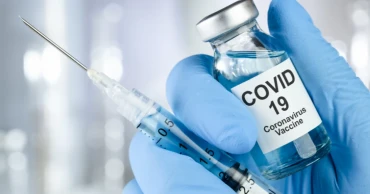
Bangladesh has no vaccine available for the newly detected sub-variants of the Omicron strain of Covid-19, although 3.2 million doses of older vaccines remain in stock with a few months’ shelf life, according to the Directorate General of Health Services (DGHS).
Covid-19 infection rates have seen a recent uptick across the country over the past month.
Data from the Institute of Epidemiology, Disease Control and Research (IEDCR) shows that out of 1,409 samples tested in May, 134 were positive — an infection rate of 9.51 percent, the highest recorded from January to May 2023.
Genome sequencing of positive samples confirmed the presence of new Omicron sub-variants XFG and XFC, previously undetected in Bangladesh.
The DGHS noted that these new sub-variants exhibit higher transmissibility compared to previous strains. Between January and June this year, seven Covid-related deaths were reported — all occurring in the first 17 days of June.
Fresh COVID sub‑variant wave hits Bangladesh; experts urge vigilance
Patients are again being admitted to the specialised Covid hospital in Mohakhali, and the demand for tests is rising.
This resurgence has prompted questions regarding the availability and efficacy of vaccines.
Despite the rising infections, no new vaccines specifically targeting the sub-variants have been imported and no vaccine committee has yet been formed.
Halimur Rashid, Line Director of the Communicable Disease Control (CDC) unit at the DGHS, told UNB, “In total, there are around 3.2 million doses of vaccines.
According to the 2024–25 US-CDC guidelines, the available vaccines are applicable for Omicron variants. Besides, the previously used vaccines in Bangladesh can still be administered.”
When asked whether any new vaccines have been brought in to tackle the sub-variants, Rashid said, “No new vaccines for the sub-variants have arrived so far. However, the process of procurement is ongoing. A vaccine committee will be formed soon to make a prompt decision.”
Despite the rise in cases, public interest in vaccination remains low. “There are various rumours about vaccines that have no scientific basis,” said Rashid, adding, “People can still get vaccinated by visiting designated centres.”
Official records show that only 43 people received a Covid-19 vaccine in the first three months of this year, with 7 receiving the first dose, 5 the second dose, 16 the booster dose, and 15 a fourth dose.
Data also indicates that those who have never received any Covid vaccine are the least likely to seek vaccination now.
Health authorities maintain that mass vaccination is not currently necessary. Only certain vulnerable groups are being advised to get vaccinated.
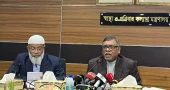
Speaking at a recent press conference, DGHS Director General Dr Abu Jafar stated that individuals who are frontline workers involved in public-facing jobs and those with compromised immune systems should receive the vaccine if they have not yet done so.
Mask prices double as COVID infections surge in Bangladesh
He also advised that people over 60, those with comorbidities and those with weakened immunity should take another dose six months after their last jab.
In addition to vaccines, the DGHS has already begun distributing detection kits to hospitals nationwide and is preparing hospital beds for potential admissions.
When asked whether the current rise in cases warrants public alarm, Professor Mahmuda Yasmin of the Department of Microbiology at the University of Dhaka said, “Although the infection rate is increasing, the situation is not yet alarming.”
Experts, however, stress the importance of early preparedness to combat the spread of new sub-variants. They note that with sufficient preparation, both infection and mortality rates can be minimised.
According to DGHS data, more than 29,500 people have died of Covid-19 in Bangladesh to date.
Although the fatality rate remains low compared to the number of detected cases, the virus continues to pose a public health concern.
Since the beginning of the pandemic, Bangladesh has reported a total detection rate of 13.05 percent, with a recovery rate of 98.42 percent and a mortality rate of 1.44 percent per 100 confirmed cases.
1 year ago

ADB to lend $336.5 million to Bangladesh to help develop vaccine production
The Asian Development Bank (ADB) and the government of Bangladesh on Tuesday (November 28, 2023) signed a loan agreement for $336.5 million to establish domestic vaccine, therapeutics, and diagnostics manufacturing capacity and strengthen the national regulator to ensure vaccine supply security in Bangladesh.
Md. Shahriar Kader Siddiky, secretary, Economic Relations Division, and Edimon Ginting, ADB country director for Bangladesh signed the agreement on behalf of Bangladesh and ADB, respectively.
The vaccines, therapeutics, and diagnostics manufacturing and regulatory strengthening project will establish a vaccine, therapeutic, and diagnostics manufacturing facility and warehousing unit in Essential Drugs Company Limited's (EDCL) existing location at Gopalganj, with a capacity to manufacture 58 million vials of vaccines per year, said the regional development bank.
An in-house research and development center will be established to support the production of diagnostic kits and packaging of biosimilar therapeutics.
Read: ADB to provide $200 million to promote energy efficiency, transition in Bangladesh
It will also support the manufacture of at least two full-cycle vaccines by developing a seed bank, master cell bank, and working cell bank, in addition to at least five fill-and-finish vaccines.
“Bangladesh has attained remarkable success in implementing its vaccination programs supported by subsidized vaccines supplied through the Global Alliance for Vaccine and Immunization (GAVI). As Bangladesh graduates from the Least Developed Country status, the supply of vaccine from GAVI will gradually be phased out,” said Country Director Edimon Ginting.
“This project will help create vibrant ecosystem for vaccine production in the country, ensuring sustainable supply in the medium-term, and at the same time, building Bangladesh’s capacity to manage future pandemics better,” he added.
The manufacturing facility will incorporate features to promote gender equality and social inclusion as well as green and resilient production using less energy and materials while reducing waste and carbon missions.
The facility will seek certification from the World Health Organization (WHO) for good manufacturing practices (GMPs).
The ADB loan will support the Directorate General of Drug Administration (DGDA) to upgrade its regulatory capacity to WHO maturity level 3 and beyond. ADB will help strengthen laboratory quality management and regulatory inspection systems while improving testing capacity modalities in compliance with WHO's Global Benchmarking Tool.
Read: JICA to help improve Bangladesh’s justice delivery system
It will create a stable, well-functioning, and integrated regulatory system; help foster international collaboration and trade; and improve private sector participation in Bangladesh's pharmaceutical industry.
The project will help EDCL and DGDA train their staff in essential GMPs, quality assurance, quality control, validation, and calibration programs in compliance with the biosafety levels, according to ADB.
The project is financed through ADB’s $9 billion Asia Pacific Vaccine Access Facility, launched in December 2020 to provide rapid and equitable vaccine-related support to ADB developing member countries.
It builds on ADB’s $940 million support to Bangladesh to purchase safe and effective vaccines against COVID-19 in June 2021.
Read more: ADB provides $90 million for clean water, sanitation services in the Hill Tracts
2 years ago
Vaccine drive to prevent cervical cancer from September: Health Minister
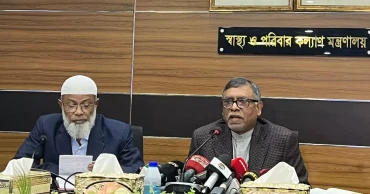
The human papillomavirus (HPV) vaccine will be administered to the adolescents girls aged between 10 -15 years from September free of cost, said Health Minister Zahid Maleque on Monday.
The number of patients in cervical cancer is increasing, so there is a plan to increase screening to detect the cancer, he said, while speaking at a programme at the ministry.
The government has undertaken a plan to administer the HPV vaccine and it will be administered like other vaccines, he said.
“It will be effective if we can administer the vaccine to the adolescents girls aged 10-15 years. The vaccine will be provided free of cost and only one dose will be given to the girls,” said Maleque.
Referring to breast cancer, the minister said “We will try to provide necessary machineries at the upazila level so that the disease can be detected as early as possible.”
Also read: Govt to provide Tk. 50,000 worth of free health care to 15 lakh families: Minister
Replying to a question, Maleque said: “The government is sincere about health care services and in case of importing medical equipment, the government will try its best to fulfill the need by opening LC. But there is no crisis of equipment now at the government hospitals.”
3 years ago

Govt starts administering 2nd booster dose of Covid-19 vaccine in Bangladesh
The government started administering the fourth dose (second booster) of Covid-19 vaccine today.
Professor Dr Ahmedul Kabir, additional director general (ADG) of the Directorate General of Health Services (DGHS), inaugurated the campaign at 9:30 am at Kurmitola General Hospital in Dhaka.
The government has taken the initiative to administer a fourth dose against Covid-19 as the antibody from the vaccine doesn't last long, said Ahmedul Kabir.
“Our aim is to vaccinate 80 lakh people in five categories at the moment though four crore people are eligible to receive the fourth dose in the country. Already 460 people have received the fourth dose on a trial basis,” he said.
Read More: 4th dose of Covid vaccine to be administered from Dec 20
The priority will be given to frontline workers and pregnant women, he added.
Dr Shamshul Haque, DGHS director of the vaccine campaign, said 15 crore people got the first dose, 12 crore the second dose, and 6.5 crore the third dose of vaccine against Covid-19.
“Still there are 1.33 lakh doses of vaccine in stock and will bring more after administering those. There are 11.5 crore people aged above 18 years and all will get vaccinated with the second booster dose in phases,” he added.
According to an earlier announcement, the fourth dose will be given at seven centers in the beginning. One hundred people will be vaccinated at each designated centre and they will be kept under observation for two weeks, said the ADG. All citizens having health risks will be vaccinated with the second booster dose from January 1 next year.
Read More: Citizens aged above 60 to get 4th dose of Covid vaccine: Health Minister.
3 years ago

COVID-19: US vaccine donations to Bangladesh exceed 100 million
The United States has donated another six million pediatric doses of Pfizer COVID-19 vaccines to Bangladesh, bringing the total number of American vaccine donations to more than 100 million.
The US is the largest COVID-19 vaccine donor to Bangladesh. American COVID-19 vaccine donations now account for more than 70 percent of all international COVID-19 vaccine donations to Bangladesh.
Read more: US donates additional 10mn Pfizer COVID-19 vaccine doses to Bangladesh
“This milestone underscores the strong partnership between our two countries and is just one part of the incredible progress Bangladesh has made in fully vaccinating nearly 75 percent of the entire country,” said US Ambassador to Bangladesh Peter Haas.
Read more: Bangladesh receives more doses of Pfizer COVID-19 vaccine from US
He said this is a remarkable achievement. “I congratulate everyone involved in protecting Bangladeshi children and adults against the pandemic,” said Ambassador Haas.
Ambassador Haas and Mayor of Narayanganj City Corporation Dr Selina Hayat Ivy joined a programme at school vaccination site in Narayanganj to mark this milestone in the Bangladesh-US partnership to fight the pandemic.
The United States has contributed more than $140 million in COVID-19 related development and humanitarian assistance to Bangladesh.
3 years ago

First two doses of Covid-19 vaccine won’t be available after Oct 3: DGHS DG
Directorate General of Health Services (DGHS) Director General (DG) Prof Dr Abul Bashar Mohammad Khurshid Alam has said that the government won’t provide first and second doses of Covid-19 vaccine after October 3.
The DG said this during a press conference at the conference room of DGHS in the capital Wednesday noon.
“On the occasion of Prime Minister Sheikh Hasina’s birthday, we’ve started a special vaccination campaign for those who haven’t received first and second doses of Covid-19 vaccine yet. The campaign will continue till October 3 and we won’t provide the first two doses of the vaccine after this time. However, we’ll keep administering the booster doses,” said Khurshid.
About the fourth dose of the Covid-19 vaccine, the DG said that it’ll be provided once World Health Organization (WHO) allows it.
Pointing out that the government has already reached its vaccination target, Khurshid added that they’re trying to increase the pace of vaccination campaigns as there are still some people who are unvaccinated.
Read: First dose of Covid-19 vaccine won’t be administered after Oct 3: Health Minister
“Out of the country’s total population, 97 per cent has received the first dose of the vaccine while the rates of receiving the second and booster doses of the vaccine are 90 percent and 41 per cent respectively. Our stock is limited while the expiry dates of some of the vaccines are also approaching. The good news is that we still have three crore doses of vaccine,” Khurshid added.
Dr Shamsul Haque, member of DGHS’s vaccination committee, informed during the press briefing that vaccination campaign for children aged between 5-11 years will begin at the district and upazila levels on October 11.
Prof Dr Ahmedul Kabir, Additional DG (Admin) of DGHS and Dr Nazmul Islam, Director (Disease Control) of DGHS, among others, were present during the press conference.
3 years ago
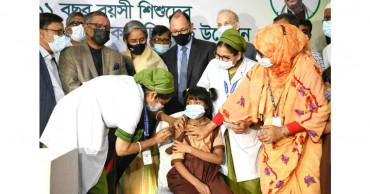
Children aged 5-11 get Covid jabs on trial basis
Bangladesh on Thursday started administering Covid-19 vaccine to the children aged between 5-11 years on experimental basis.
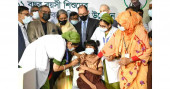
Health Minister Zahid Maleque, Education Minister Dr Dipu Moni and US Ambassador to Bangladesh Peter Haas jointly launched the campaign at Bangabandhu International Conference Center (BICC) in the city.
The full-fledged vaccination programme for children will start from August 25, said the Health Minister.
He said about 20 lakh children of primary schools will be vaccinated under this campaign. “We will need about 4.40 crore doses of vaccine for these children.”
“We have already received about 30 lakh doses of vaccine. The US government has assured us to provide the rest of the vaccine through COVAX facility,” he added.
The received vaccines will be administered among the children in two months gap.
Pfizer vaccine is specially developed for the children which was also approved by Directorate General of Drug Administration, he added.
Read: Children aged 5-11 to get Covid-19 jabs on trial basis on August 11
Mentioning the low risk among children from Covid, the minister said about 29,000 people have died of Covid in the country so far, of which 80 to 85 percent are above 50 years. The fatality rate among the youths is very low.
“We ranked first in South Asia in conducting vaccination programs. Many countries are still unable to vaccinate 10-15 percent of the population,” said the minister.
He said, “We have a record of inoculating 1.20 crore people in a single day.”
The United States recently donated over three million pediatric doses of Pfizer vaccines and committed to donating a total of over 40 million (4 crore) pediatric doses.
US support for this new children’s COVID-19 vaccination campaign includes over $7.3 million and comes alongside other assistance from COVAX.
“This is a remarkable step for kids, for parents, and for the entire nation. We hope these vaccines enable young Bangladeshis to return to more normal lives to pursue their studies and dreams more fully,” said Ambassador Haas.
The United States has donated over 75 million (7.5 crore) doses of COVID-19 vaccines to Bangladesh, accounting for more than two-thirds of all international COVID-19 vaccine donations to Bangladesh to date.
The United States has contributed more than $140 million in COVID-19 related development and humanitarian assistance to Bangladesh, said the US Embassy in Dhaka.
UNICEF Country Representative Sheldon Yett, government officials and representatives of international organizations attended the event
4 years ago

Children aged 5-11 to get Covid-19 jabs on trial basis on August 11
Children aged between 5-11 will get vaccine against Covid-19 on experimental basis on August 11, Health Minister Zahid Maleque said on Sunday.
The full-fledged vaccination programme for children will start from August 26, he said while talking to reporters after a programme marking the World Breastfeeding Week-2022 at National Institute of Preventive and Social Medicine (NIPSOM) in the city.
“Fifteen lakh doses of Pfizer vaccine have arrived on Sunday and we have taken all preparation to bring the children under vaccination programme,” he said.
Read: Covid-19 vaccine consignment for kids arrive in Dhaka
Currently, the health workers are administering first, second doses and booster shots of Covid-19 vaccine but people will not be able to get second doses after some days as stock of vaccines will expire soon, he said.
He also urged people to take Covid-19 jabs as soon as possible.
Referring to the monkey pox virus, Zahid said already the virus has spread to many countries including those in America and Europe but there is nothing to be worried about as it has not been declared as pandemic.
About the Breastfeeding Week, the minister said 60-70% children are now under breast feeding and still 40% deliveries take place at home which should be come down.
4 years ago

70% of Covid deaths among unvaccinated: DGHS DG
A significant proportion of the people, 70 percent, who have died of Covid were not vaccinated against the disease, according to Directorate General of Health Services (DGHS) Director General (DG) Dr Abul Bashar Mohammad Khurshid Alam.
Khurshid was addressing an event, organised by the National Liver Foundation of Bangladesh and Bangladesh Health Reporters' Forum, at a Dhaka hotel Sunday.
He added: "Vaccination does make much of a difference. No vaccine is 100 percent effective, but immunisation reduces the risk of dying from Covid substantially."
"We never said vaccinated people who get Covid will not die. Vaccination reduces the risk of death. Covid vaccines have been developed after a lot of research and testing."
Read: Govt taken all-out preparation to procure Covid-19 vaccine: PM
Khurshid said: "We recently observed limited spread of Covid. But, suddenly, cases have started to creep up again."
"Most of those who tested positive for Covid after getting jabbed recently did not have to be hospitalised. So, everyone needs to get jabbed as soon as possible."
4 years ago

Covid: BA.4, BA.5 variants spur 20% rise in cases
Covid cases are on the rise in some 110 countries, driven by the BA.4 and BA.5 variants, amounting to a 20 percent spike overall, and a rise in the number of deaths across three of the six world regions monitored by the World Health Organization, the UN health agency chief has said.
The global figure overall remains relatively stable, but nobody should be under any illusion that the coronavirus is on the way out, WHO Director-General Tedros Adhanom Ghebreyesus said Wednesday.
"This pandemic is changing but it's not over. We have made progress but it's not over, he added. "Our ability to track the virus is under threat as reporting and genomic sequences are declining. The optimistic mid-year deadline for all countries to vaccinate at least 70 percent of their populations is looking unlikely, with the average rate in low-income countries, standing at 13 percent."
However, in the past 18 months, more than 12 billion vaccines were distributed around the world, and 75 percent of the world's health workers and over-60s are now vaccinated.
The influential Lancet medical journal estimates that 20 million lives were saved because of vaccines, Tedros said.
Read: Bangladesh reports no death from Covid-19, new cases 56
Last year, it was the hoarding of vaccines by rich and manufacturing countries which proved to be the major barrier to access, but this year, it is what he described as the wavering "political commitment to getting vaccines out to people and challenges of disinformation," which is thwarting the pace of inoculations at the national level.
4 years ago