Boro crop

Farmers in tears as flash floods inundate Boro crop in Chhatak haors
An early wave of flash floods, triggered by upstream hill runoff and days of relentless rain, has inundated vast stretches of haor land in Chhatak upazila of Sunamganj, leaving thousands of farmers staring at devastating crop losses.
Within hours of heavy rainfall from Saturday morning, water levels rose sharply across the low-lying wetlands, submerging ripened boro paddy—the region’s primary and often only annual crop.
The sudden flood has turned once-golden fields into an endless expanse of water,said farmers.
Villages under Chormohalla union—including Buraigiri, Boroghatti, Bagachhara, Gojahati, Baruka and Ura beel—are now largely underwater.
The situation worsened dramatically after a key embankment at Khaner Badh in Boroghatti beel collapsed, sending torrents of water rushing into nearby fields and submerging nearly 400 acres of mature paddy in a short span.
“I watched my paddy go under water right before my eyes,” said Abdus Sobhan, a farmer from Buraigiri, holding a handful of soaked rice stalks.
“This boro crop was our only hope for the year. Now there won’t even be enough rice to feed my family.”
Abul Kalam, a farmer from Srinagar village, said his 17 bighas of land—along with nearly 200 bighas in his village—have been completely submerged. “It breaks my heart. I don’t know how we will survive this,” he said.
Similar scenes have been reported from multiple haors across unions such as Kalaruka, Uttar Khurma, and Dakshin Khurma.
Areas including Jhawar beel, Borobara, Puraidubi, Banderlama, Bhathgaon, Jauabazar, and Singchapair are all grappling with the same crisis.
Many farmers said the rapid rise in water left them with no time to harvest their crops.
Official estimates from the upazila agriculture office state that a total of 14,996 hectares were cultivated with boro this season—3,382 hectares in haor areas and 11,614 hectares in non-haor lands.
As of May 1, officials said 2,513 hectares in haor areas and 3,833 hectares in non-haor areas have already been harvested.
However, farmers on the ground contest these figures, alleging that the official data does not reflect the scale of devastation.
“Large parts of Chormohalla and surrounding areas are now under water. Thousands of hectares of ripe paddy have been lost,” said Advocate Abdul Ahad, a local resident and additional public prosecutor at the Sunamganj Judge Court. “The government estimates are far from the reality.”
Farmers also blamed poor water management for aggravating the disaster.
They alleged that inadequate drainage systems, silted canals, absence of functional sluice gates, and weak embankments have made the haor areas highly vulnerable.
“Even if the rain stops, the water has nowhere to go,” said a farmer in Boroghatti. “On one side there is hill runoff, and on the other, broken embankments—our crops are trapped in between.”
The crisis has been compounded by an acute shortage of agricultural labourers during the peak harvesting season, said farmers.
With fewer seasonal workers arriving this year, many farmers took to the fields themselves. But rising water levels and strong currents have made it nearly impossible to salvage the submerged crops.
As the waters continue to rise, uncertainty looms large over the livelihoods of thousands of farming families in Chhatak’s haor belt, where a single crop failure can push households into prolonged financial distress.
4 months ago

Sunamganj flood-hit farmers to get incentives: Agriculture Minister
The government will take steps to provide incentives to the flood-hit farmers in haor areas of Sunamganj, said Agriculture Minister Dr Muhammad Abdur Razzaque on Tuesday.
Intensive will be given to the affected farmers as Boro is the only crop in haor areas, he said adding the government will stand by the farmers to help them recoup losses.
The agriculture minister revealed this information while talking to reporters after attending a meeting of the National Coordinating and Advisory Committee on Fertilizers at the Bangladesh Secretariat.
Also read: Sunamganj farmers apprehend missing Boro harvest
Replying to a question Razzaque said, “ 300 millimeters rains were recorded in India in the two days and there is a possibility of more rains on April 14 and 15. We have no control on nature. But we are taking measures to tackle any kind of disaster.”
Every year, two crore tonnes of boro paddy are produced across the country and 12 lakh tonnes are produced in the haor areas which may get damaged and this is a matter of big concern for Bangladesh, he said.
4 years ago

Farmers in Bishwanath happy with Boro yield
Even after hail storm and insect attack, this season Boro crop has provided a good yield for farmers in Sylhet’s Bishwanath upazila this year.
Cultivation of Boro paddy has exceeded the target there.
Already Boro on 1.6 thousand hectares of land has been harvested and the farmers are happy at the super yield this year. Most farmers are busy harvesting ripe paddy.
Also read: Jagannathpur farmers fret over stagnant water as boro yield hit
There is no labour crisis this year and the government is providing subsidized rice harvesting machines.
According to the Upazila Agriculture Extension Department, the target for borough cultivation in Bishwanath this year was set at 7.2 thousand hectares of land.
Already Boro crop have been cultivated over 7.3 thousand hectares of land.
Read Farmers in Laxmipur char leading the way in vegetable production
The target for paddy production is 35 thousand metric tons this season.
Farmer Jaber Ahmed of the upazila said, "I have cultivated Boro paddy at low cost without insecticides. Compared to other seasons, this time the yield has been as expected."
“We are also happy getting a good price of paddy in the market," he added.
Also read: Severe cold threatens Boro seedbeds in Kurigram
Bishwanath Upazila agriculture officer Kanak Chandra Roy said farmers have already harvested 22% of the planted paddy and several sophisticated rice harvesting machines have been distributed among the farmers at subsidized rates.
He further said, farmers will undoubtedly benefit from the good yield of Boro paddy this season.
Due to low rainfall this year, the haor areas are not still filled with water and several crop fields are still visible.
Read The curious case of onion 'lifting’ in Satkhira
5 years ago
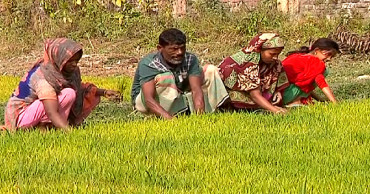
Faridpur farmers losing interest in boro crops
A high production cost and low prices of the products have led to a decline in boro cultivation in Faridpur over the years as frustrated farmers go for cash crops.
6 years ago