FTA talks
Dhaka calls for early FTA talks with EU to attract more investment
Chief Adviser Prof Muhammad Yunus on Sunday called for an early start to Free Trade Agreement (FTA) negotiations with the European Union, stressing the need for safeguarding Bangladesh’s trade preferences in its largest export market once the current duty-free access expires in the coming years.
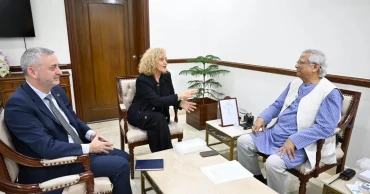
The Chief Adviser made the remarks during a courtesy call by Nuria Lopez, Chairperson of the European Chamber of Commerce in Bangladesh (EuroCham), at the State Guest House Jamuna in Dhaka.
European Union Ambassador to Bangladesh Michael Miller took part in the meeting.
During the discussion, they discussed the need to accelerate European investment in Bangladesh, how to ensure smooth trade relations between Bangladesh and the EU, and the need for further reforms to improve the country’s business climate, said the Chief Adviser’s press wing.
They also discussed the upcoming elections and the deployment of international observers to monitor the polls.
Prof Yunus said the interim government has recently concluded an Economic Partnership Agreement (EPA) with Japan, paving the way for duty-free access for more than 7,300 Bangladeshi products to the world’s fourth-largest economy.
He said that Bangladesh is preparing to hold similar negotiations with other countries, including the European Union, to ensure continued duty-free access for its products, particularly ready-made garments, to the EU market for the foreseeable future.
“The EPA with Japan has opened doors for us. It gives renewed hope to our export items. We definitely hope to sign an FTA with the EU to expand our market,” the Chief Adviser said.
EuroCham Chairperson Nuria Lopez said Bangladesh needs to begin FTA negotiations urgently, as the country may lose its existing trade preferences in the EU, its largest export destination, after graduating from Least Developed Country (LDC) status.
She said that an FTA would attract more European investment to Bangladesh, create jobs and boost exports to advanced Western markets.
Lopez pointed out that India is signing an FTA with the EU, while Vietnam already has such an agreement, allowing both middle-income countries preferential access to the European market.
“We are advocating for an FTA. I will go to Europe to encourage private companies to invest in Bangladesh,” she said.
EU Ambassador Michael Miller said that the commercial relationship with Bangladesh will evolve after graduation but not before 2029.
He underlined the EU’s strong interest to bring European investment and technology to the country, an important market with a population of nearly 200 million, and spoke about the EU readiness to organise an EU/Bangladesh Business Forum in 2026.
“We are looking for early political signals that EU companies will be encouraged to come and will enjoy a level playing field,” he said.
The Chief Adviser also emphasised the relocation of factories to Bangladesh, noting that European firms can take advantage of the country’s large pool of skilled labour at competitive costs.
“We are building a free trade zone. Our aim is to turn Bangladesh into a manufacturing hub for global businesses. We want more European investment in Bangladesh,” he said.
Prof Yunus expressed satisfaction over the EU’s decision to deploy a large contingent of election observers to Bangladesh for the upcoming general elections and referendum.
“It is important that EU election observers are here. It is a huge vote of confidence in revitalising our democracy,” he said, adding that the overall picture of the election campaign was ‘very positive’.
Lamiya Morshed, SDGs Affairs Principal Coordinator and Senior Secretary of the government, was also present at the meeting.
7 months ago