Tamabil highway
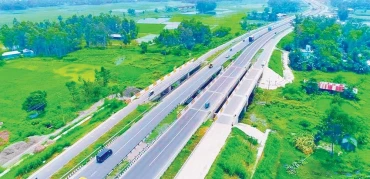
Dhaka–Sylhet-Tamabil highway upgrade hit by land acquisition hurdles
Persistent complications in land acquisition and repeated alignment adjustments have pushed the implementation timeline of a project linked to Dhaka–Sylhet–Tamabil highway , forcing the government to extend the deadline for the fourth time.
The project titled “Land Acquisition and Utility Relocation in Support of Dhaka (Kanchpur)–Sylhet–Tamabil Highway Four-Laning with Separate Service Lanes on Both Sides (1st Revised)” will now run until December 2027, nearly seven years beyond its original completion target.
The project spans seven districts and 25 upazilas in Dhaka, Mymensingh, Chattogram and Sylhet divisions.
It aims to complete land acquisition and relocate utilities in advance to facilitate the eventual expansion of the Dhaka–Sylhet–Tamabil highway into a six-lane corridor with separate service lanes on both sides.
Officials said the project, implemented by the Roads and Highways Department (RHD) under the Road Transport and Highways Division has faced persistent delays since it was approved in September 2018 with an initial deadline of December 2020.
Workers block Dhaka-Sylhet highway in Rupganj over unpaid wages
According to project documents, the slow pace of land acquisition remains the main obstacle.
The original acquisition plan was prepared using outdated State Acquisition (SA) maps.
Since then, most corresponding Bangladesh Survey (BS) records have been published, forcing authorities to revise the acquisition proposals in line with the latest mouza maps as required under the Acquisition and Requisition of Immovable Property Act, 2017.
Officials said converting the earlier SA-based plans into updated BS maps proved technically complex and time-consuming, significantly slowing implementation.
The process became even more complicated after several new government and strategic installations were built along the proposed alignment following the project’s approval.
These include the Shah Paran (R) Mazar Gate, parts of Sylhet Cantonment, a Rapid Action Battalion (RAB) office, and other key establishments.
Road to Heaven: Gujarat’s surreal highway flanked by water and salt pans
Their construction forced repeated adjustments to the highway alignment, requiring fresh land acquisition proposals and additional administrative approvals.
Legal disputes over land ownership have also contributed to the delay.
In several land acquisition (LA) cases, inconsistencies between ownership records from different surveys particularly RS and BS records resulted in multiple claimants for the same plots.
These disputes have led to court cases that are still pending, preventing authorities from completing acquisition and handing over land in several sections of the highway.
Officials involved in the project said such legal complications often take years to resolve under existing procedures, further prolonging the acquisition process.
Despite these setbacks, the project has made some progress where land-related obstacles have been cleared.
Hili land port highway upgrade delayed again, cost jumps to Tk 588cr
As of October 2025, cumulative spending reached Tk 5,782.90 crore, accounting for 72.51 percent of the total revised cost.
Financial and physical progress are reported at the same level, indicating that implementation has advanced in available sections.
The project’s revised cost now stands at Tk 7,975.31 crore, up from the originally approved Tk 3,885.72 crore, with the entire funding coming from the government.
In the 2025–26 fiscal year, the project received an allocation of Tk 748.22 crore under the Annual Development Programme (ADP).
Dhaka-Sylhet-Tamabil road corridor forms part of the Asian Highway-1 route, designed to connect India’s Meghalaya and West Bengal with Bangladesh through the Tamabil-Sylhet-Kanchpur-Dhaka-Jashore-Benapole corridor.
The initiative also includes construction of new bridges and flyovers.
Implemented in phases by Chinese and local joint ventures, the project is expected to significantly reduce travel time and strengthen regional trade and economic activity.
Experts say repeated deadline extensions reflect deeper structural weaknesses in project preparation, particularly inadequate initial surveys, reliance on outdated land records and insufficient anticipation of future urban and institutional developments.
6 months ago