Anti-hawker
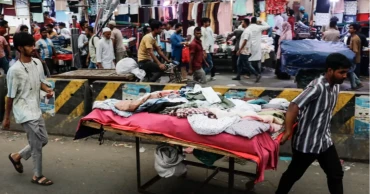
Anti-hawker drive : Without rehabilitation, reoccupation becomes inevitable
Barely two weeks after eviction drives cleared major footpaths in Gulistan and Baitul Mukarram areas, hawkers have started returning to the spots they had vacated, raising fresh questions as to whether the government was merely flexing its muscles, or truly serious about pursuing a sustainable solution to the problem.
To many, the government 's commitment can only be ensured via a rehabilitation component or merely repeating a cycle of eviction and reoccupation.
On a recent visit to the area, our correspondent found that vendors have gradually resumed business along the stretch from the Gulistan intersection to Paltan, awaand in front of Baitul Mukarram Mosque. Crowds of customers have also started returning to the sidewalks.
A shoe seller in Gulistan told UNB, “We have been doing business here for many years. We do not know of any alternative livelihood right now. That is why we have returned despite the risks.”
Another vendor said, “We have very little capital. With such limited resources, street vending is our only option.”
Pedestrians, however, said the sidewalks had remained relatively clean and accessible for several days after the eviction drives before vendors started returning.
Zubayer, a commuter walking from Paltan toward Gulistan, said, “For the last few days the roads were much cleaner and easier to walk through. Since yesterday, I noticed shops are coming back again. The familiar picture of occupied footpaths is returning.”
Dhaka’s two city corporations spend millions of taka every year to remove illegal structures and free public spaces from encroachment. Authorities also conduct regular eviction drives that involve significant operational costs.
Despite repeated operations, vendors continue to return, highlighting the lack of a long-term solution. Urban experts say eviction alone cannot resolve the issue, as Dhaka’s footpaths have evolved into a major informal economic hub.
According to various studies and sector insiders, around 250,000 to 350,000 hawkers are currently active across Dhaka.
Thousands of temporary stalls operate daily in key commercial areas such as Gulistan, Farmgate and New Market, selling clothes, food, electronics and other daily essentials at affordable prices for low- and middle-income consumers.
Traders say an average hawker earns between Tk 500 and Tk 1,000 in daily sales, while earnings in busy areas can be much higher. Based on these estimates, the total daily transactions in Dhaka’s footpath economy could reach nearly Tk 300 crore.
Economists say the sector plays a significant role in the country’s informal economy, although most of its activities remain outside official records.
The sector has also long been associated with allegations of extortion, illegal control networks and political patronage.
There are claims that following eviction drives, extortion demands often increase in some areas while new groups attempt to establish control over footpaths.
Urban planners call for long-term policy
The Institute for Planning and Development (IPD) has proposed a 10-point plan for sustainable management of hawkers in Dhaka.
Its recommendations include creating designated hawker zones, introducing licensing and digital databases, allowing time-based vending in selected areas, establishing holiday and night markets, dismantling extortion syndicates, and creating alternative employment opportunities.
Executive Director of IPD, Professor Adil Muhammad Khan, said, “Eviction without comprehensive planning will not produce sustainable results. What is needed is a clear policy and legal framework for hawker management.”
He said authorities must address the political economy behind footpath control and identify those involved in extortion networks instead of repeatedly targeting only poor vendors.
According to him, long-term solutions require vendor registration, rehabilitation measures, alternative employment opportunities and social protection for the urban poor.
He also stressed that Dhaka’s streets “cannot continue to bear the burden of poverty from across the country,” calling for decentralised economic development and employment generation outside the capital.
Urban planners believe the hawker issue is no longer simply about illegal occupation of sidewalks, but also about poverty, employment, urban management and political influence.
As vendors continue returning to the streets shortly after eviction drives, the debate remains unresolved: will authorities move toward structured rehabilitation and regulation, or continue the recurring cycle of eviction and reoccupation?
Dhaka South City Corporation Administrator Abdus Salam said “Businesses cannot be allowed to operate indiscriminately on the streets causing public inconvenience. However, we do not want to be
inhumane toward hawkers and rickshaw pullers. Following the directives of the Prime Minister, we are working to reduce public suffering while ensuring humane treatment.
“To conduct temporary business on footpaths, vendors will have to obtain licenses from the city corporation. We are currently preparing area-based lists of hawkers with the assistance of the police," he said.
He added "Once the list is completed, a specific number of hawkers will be allowed to operate in designated areas at designated times. We are also planning to introduce ‘holiday markets’ and ‘night markets.’ We do not want to evict people; rather, we want to rehabilitate them.”
Dhaka North City Corporation (DNCC) Administrator Shafiqul Islam Khan has said plans are underway to set up temporary markets in six open fields to rehabilitate street vendors currently occupying footpaths in Dhaka.
He said hawkers will be relocated to these designated areas through a registration process, and the sites will be managed by collecting a fixed fee.
4 months ago