US, Iran war
Oil prices ease after US and Iran pause their attacks
Oil prices eased in early trading Sunday, falling further from a two-month high set last week, after the United States and Iran refrained from launching military strikes in the Persian Gulf for a second straight day.
The price for a barrel of Brent crude oil to be delivered in September dropped 4.9% to $92.02 shortly after trading resumed. The decline followed a 3.9% drop on Friday.
Brent crude, the international standard, briefly hit $102 a barrel last week. That was $30 more than the most actively traded contract in the Brent market was going for early in the month, and the highest it had been since May.
Oil prices surged this month because of increased fighting in the Middle East and worries a return to all-out war would further slow the global flow of crude.
The ability of tankers to pass safely through the Strait of Hormuz has been the central concern for the oil market since the U.S. and Israel attacked Iran in late February. The narrow strip of water off Iran’s coast is the route through which a fifth of the world’s oil typically leaves the Persian Gulf and heads to customers worldwide, and the conflict has largely halted shipping traffic.
Oil producers have since searched for alternative routes, but those are under pressure too. Last week, attacks hit Saudi oil tankers that were using the Red Sea to leave the region. When less oil is available for customers to buy, the price goes up and fuel prices do as well.
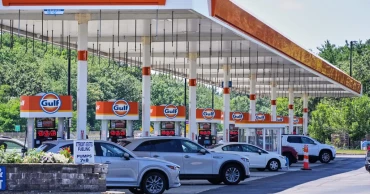
In the United States, the average price for a gallon of regular gasoline on Sunday was $4.11, up from $3.90 a month ago and just $3.15 a year ago, according to motor club AAA.
If oil prices stay elevated, it could lead to higher prices for every product that gets shipped, trucked or flown around the world, including groceries. Although the U.S. economy continues to grow, the ongoing conflict with Iran has dragged consumer confidence in it lower.
The reacceleration of oil prices this month took place just as inflation had begun to slow more than economists expected. Now, traders believe inflation pressures have grown enough that they’re betting on a 36% chance the Federal Reserve will hike its main interest rate at an upcoming meeting, according to data from CME Group.
Higher interest rates would help keep a lid on inflation, but they could also slow the economy by making it more expensive for all kinds of Americans and businesses to borrow.
Long-term U.S. mortgage rates have already hit their highest levels in nearly a year, for example, chilling the housing industry. And more expensive borrowing could slow the boom in building artificial-intelligence data centers, which have become a big engine for the U.S. economy's growth.
While oil prices have given back some of their big July gains, much uncertainty still remains.
The price for a barrel of benchmark U.S. oil to be delivered in September fell 5.6% to $84.34 on Sunday. It dropped 3.1% on Friday.
In the oil market, traders are buying and selling contracts for barrels of oil to be delivered many months in the future. The price for a barrel of Brent crude to be delivered in October, which is now the most actively traded part of the market, fell 4.6% to $87.48.
2 months ago
A timeline of the Iran conflict and negotiations
The United States and Iran have again traded strikes after a week in which U.S. President Donald Trump mused that fragile negotiations between them might be “over.”
The countries are now nearly halfway through the 60-day period that began with their signing of an interim deal aimed at permanently ending the war.
At stake are the lives of Iranians and others throughout the region, including Israel and Lebanon, along with foreign residents of Gulf nations, U.S. military personnel stationed in multiple countries and thousands of mariners on ships still hoping to exit the Strait of Hormuz.
The strait between Iran and Oman, considered an international waterway before the war, has become one of Tehran’s strongest pressure points in talks. Iran insists it alone now controls the strait.
Here’s a brief timeline of the war and efforts to end it:
Feb. 28
Israel and the U.S. attack Iran, killing Supreme Leader Ayatollah Ali Khamenei and other top officials, sparking the war. Iran quickly responds with strikes against Israel and across the Gulf region and asserts control over the Strait of Hormuz, a key waterway for global oil and natural gas supplies from the Gulf.
March 2
The Iranian-backed Hezbollah militant group in Lebanon enters the war by firing rockets at Israel.
Israel retaliates, leading to an invasion that will occupy large swaths of southern Lebanon.
March 8
Iran names one of Khamenei’s sons, Mojtaba, as the new supreme leader. He still has not been seen in public and is believed to be in hiding after reportedly being hurt in the war’s opening strikes.
3 months ago
US, Iran near agreement to end ongoing war
The United States and Iran appeared to be moving closer Wednesday to an initial agreement to end the war, as U.S. President Trump sought to pressure Tehran with threats of a new wave of bombing if a deal is not reached.
Trump posted on social media that the two-month war could soon end and that oil and natural gas shipments disrupted by the conflict could restart. But he said that depends on Iran accepting a reported agreement that the president did not detail.
“If they don’t agree, the bombing starts,” Trump wrote.
Trump made his latest comments after he suspended a short-lived U.S. effort to force open a safe passage for commercial ships through the Strait of Hormuz, a vital waterway through which major oil and gas supplies, fertilizer and other petroleum products passed before the war.
Iran’s effective closure of the strait has sent fuel prices skyrocketing, rattled the global economy and put enormous economic pressure on countries, including major powers such as China.
Elsewhere, China’s foreign minister called for a comprehensive ceasefire Wednesday after meeting in Beijing with Iran’s top envoy. Wang Yi said his country was “deeply distressed” by the conflict, which began Feb. 28 when the U.S. and Israel launched strikes against Iran.
China’s close economic and political ties to Tehran give it a unique position of influence. The Trump administration is pressing China to use that relationship to urge the Islamic Republic to open the strait.
Report says Washington closer to a deal with Tehran
The White House believes it is near an agreement with Iran on a one-page memorandum to end the war, according to reporting by Axios. There is not an agreement yet, but the provisions include a moratorium on Iranian uranium enrichment, a lifting of U.S. sanctions and the distribution of frozen Iranian funds and opening the strait for ships.
The White House did not immediately respond to questions about the possible agreement.
Trump said in his social media post that it was “perhaps a big assumption” that Iran would agree to the terms being offered by the United States.
“If they don’t agree, the bombing starts, and it will be, sadly, at a much higher level and intensity than it was before,” Trump said.
A shaky ceasefire between the U.S. and Tehran has largely held since it began April 8. Pakistan hosted in-person talks last month between Iran and a U.S. delegation led by Vice President JD Vance, but the talks failed to result in a deal.
5 months ago