Pilkhana carnage
Pilkhana carnage was an attempt to undermine Bangladesh’s sovereignty: PM
Prime Minister Tarique Rahman on Wednesday said the 2009 Pilkhana massacre, in which 57 army officers were killed, was a sinister attempt to undermine Bangladesh’s sovereignty.
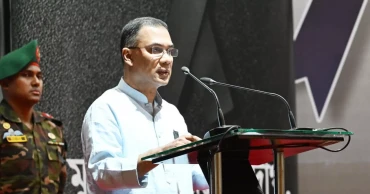
“The Army is a symbol of our sovereignty. I believe the tragic incident at Pilkhana was an evil attempt to foil our sovereignty,” he said while addressing a views-exchange meeting with the family members of the 57 army officers killed in the BDR carnage.
The programme was held at the Army Multipurpose Hall in Dhaka Cantonment, marking Jatiya Shaheed Sena Dibas (National Martyred Army Day).
PM Tarique Rahman chairs meeting on airport’s third terminal
Tarique said the Bangladesh Army has a glorious history in the War of Independence and in nation-building in the post-independence period.
Referring to the Pilkhana incident, the Prime Minister said weaknesses in the country’s national security structure were exposed through it.
“So, in line with the changing global context, our national security framework needs to be made more modern, time-befitting and stronger. Our government will certainly work towards this goal,” he said.
At the same time, the Prime Minister reaffirmed his government’s commitment to establishing long-term protection measures to ensure the education, healthcare and rehabilitation of the children of martyred families of the army.
He prayed to Almighty Allah that He would grant peace to the souls of the martyrs, give patience and strength to their families, and guide the state and its institutions on the path of justice, discipline, and responsibility.
PM Tarique paid deep tribute to the 74 brave martyrs, including 57 patriotic army officers, who embraced martyrdom in the brutal killings that took place at Pilkhana on February 25 and 26, 2009.
Third day at Secretariat, PM Tarique Rahman focuses on discipline
He prayed for the eternal peace of the departed souls and strength and patience for their bereaved families, especially during the holy month of Ramadan.
The Prime Minister said February 25 is a blood-stained and sorrowful day in the nation’s history.
“When this day returns, nature seems to fall silent again under the weight of memory and grief, and the cries of those horrific moments seem to drift through the air. Our hearts become heavy with deep sorrow. The brutal events of February 25 and 26, 2009 created a deep wound in our national life, the pain of which continues to flow even after the passage of time,” he said.
Seventeen years after the incident, the Prime Minister said his voice became heavy as he stood before the family members of victims of the Pilkhana tragedy with the memories of the martyrs.
“I have appeared before you not only as a public representative, but as a member of a military family, like the child of a fellow soldier. In that horrific incident of 2009, a total of 74 lives were lost, including 57 talented and patriotic army officers. Each name is the story of a family’s light being extinguished, a painful chapter of losing a loved one, the history of a child becoming fatherless, an unfinished epic of a dream,” he said.
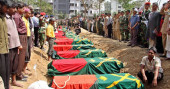
Tarique mentioned that soon after returning to the country, he visited the Banani Military Graveyard. “Standing beside the graves of the martyred army officers, I realised the depth of your unbearable struggle over the past 17 years — your immense sacrifice and the painful suffering of going from door to door in search of justice, yet not getting it.”
He expressed his belief that commemorating the Pilkhana tragedy with state dignity is a national responsibility. “If the incidents of 25 and 26 February are not given state recognition in our history, future generations will not forgive us.”
In consultation with the Army and the families, the Prime Minister said his government will work to preserve the memory of February 25 and 26 with due honour.
Tarique said the elected government, formed through the people’s mandate after a long struggle, is committed to strengthening the country’s border force.
“We will modernise and further consolidate the border guarding force, InshaAllah,” he said, adding that its members will continue to serve the nation with patriotism and professional dedication.
7 months ago
No new probe commission over Pilkhana carnage: Home Minister
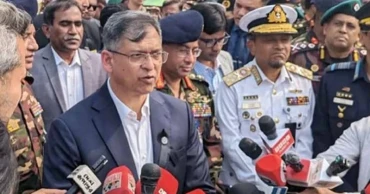
Home Minister Salahuddin Ahmed on Wednesday said the government will not form a new probe commission over the Pilkhana carnage, as a national independent commission is already in place.
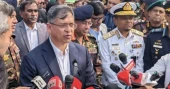
Proper justice will be served for the Pilkhana carnage and necessary steps will be taken to make sure such an incident is never witnessed in future, he told reporters after paying homage to the victims of Pilkhana BDR carnage at Banani Military Graveyard in the capital.
“During the tenure of the interim government, an independent national investigation commission was formed and its report is now before us. During the interim government, the report was already in hand but little action was taken for its implementation,” Salahuddin said.
The minister said, “From what I have seen at a glance, it contains around 70 recommendations. I will study it in more detail. Many of these recommendations are currently being implemented. The judicial process will be completed. The remaining recommendations will be implemented gradually.”
He said the previous government had formed two committees on the Pilkhana carnage but their reports were never made public.
Salahuddin Ahmed said Pilkhana carnage was a threat to Bangladesh’s independence and sovereignty aimed at weakening the nation’s armed forces.
“Such motives can only come from those who do not believe in Bangladesh’s sovereignty or who want to see the country as weak,” he added.
7 months ago
Pilkhana Carnage: President, PM pay homage to martyred army officers
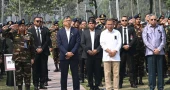
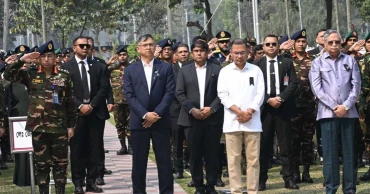
President Mohammed Shahabuddin and Prime Minister Tarique Rahman on Wednesday paid homage to the 57 army officers killed in the Pilkhana BDR carnage, marking ‘Jatiya Shaheed Sena Dibas’ (National Martyred Army Day).
The President first placed a wreath at the Banani Military Graveyard in the capital around 10:05am, followed by the Prime Minister.
The head of state and the head of government separately stood in solemn silence in honour of the 57 army officers who were killed at the then Bangladesh Rifles headquarters in Dhaka on February 25–26, 2009.
A one-minute silence was also observed as a mark of respect to the victims of the BDR tragedy while members of the armed forces offered a state salute.
A munajat was offered seeking eternal peace for the departed souls of the martyred army officers and the wellbeing of their family members.
Home Minister Salahuddin Ahmed, Chief of Army Staff Waker-Uz-Zaman, Chief of Naval Staff M Nazmul Hassan and Air Chief Marshal Hasan Mahmood Khan were present on the occasion.
Senior officers of the army, navy and air force, as well as family members and close relatives of the slain officers, were also present at the graveyard.
‘Jatiya Shaheed Sena Dibas’ is being observed today to mark the Pilkhana carnage, in which 74 people — including 57 army officers — were killed at the then Bangladesh Rifles headquarters in Dhaka on February 25–26, 2009, when BDR members staged a mutiny.
Among the victims was the then BDR Director General, Major General Shakil Ahmed.
Following the fall of the Awami League government in a mass uprising last year, the government decided to observe the tragic day as ‘Jatiya Shaheed Sena Dibas’.
After the mutiny, Bangladesh Rifles was renamed Border Guard Bangladesh (BGB), and changes were also made to its uniform.
7 months ago
Reasons behind Pilkhana carnage now understandable: PM
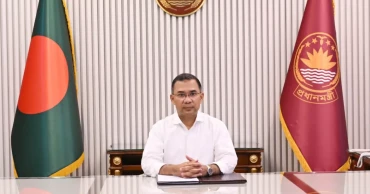
Prime Minister Tarique Rahman on Tuesday said in a fascism-free Bangladesh, the people now understand the real reasons behind the Pilkhana carnage.
In a message marking Shaheed Sena Day (Martyred Soldiers’ Day), he said, “The trial over the Pilkhana killings is ongoing. There is no scope to comment in detail on a matter that is under trial.”
The Prime Minister, however, said he believes that it is important for all citizens to understand that activities against the country’s independence and sovereignty were involved behind this massacre.
“After the killings, various attempts were made to mislead people through falsehoods and misinformation. But in a fascism-free Bangladesh, the real reasons behind the Pilkhana carnage are now understandable to the people,” he said.
The Prime Minister paid tributes to the 57 army officers and 17 others who were killed in the tragic incident on February 25, 2009, at the Pilkhana BDR headquarters.
He said the day was not observed with due importance in the years following the incident, but since 2024, after the country became free from fascism, February 25 has been observed as Shaheed Sena Day.
Abducted schoolboy freed within an hour after PM Tarique’s intervention
On the occasion, Tarique prayed for the eternal peace of the departed souls and expressed deep sympathy for the bereaved family members.
Describing the armed forces as a symbol of the honour, bravery and pride of an independent nation, he called for a renewed commitment so that no one can conspire against the armed forces in future. “Today, we must once again reaffirm that pledge with determination.”
The Prime Minister urged all to remain united against any conspiracy against the country and its people. “We will stand united against any conspiracy that goes against the interests of the country and its people—let this be the resolve of Shaheed Sena Day.”
7 months ago
Hasina spearheaded Pilkhana carnage for two days: Fakhrul
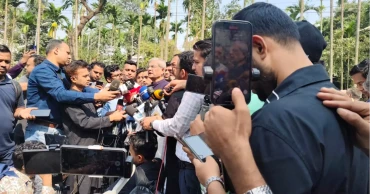
BNP Secretary General Mirza Fakhrul Islam Alamgir on Tuesday alleged that the massacre at Pilkhana lasted for two days under the leadership of deposed Prime Minister Sheikh Hasina.
Fakhrul made the allegation on Tuesday morning after placing wreaths at the graves of the martyred military officers and personnel at the military cemetery in Banani, Dhaka, marking the National Martyred Army Day.
Tributes paid to martyrs of 2009 Pilkhana tragedy
"This day is a dark chapter for the army. The enemies of the armed forces killed 57 brilliant military officers that day. Their objective was to destroy the country's security system," Fakhrul said.
The BNP leader said they appreciate the government for declaring this day as a national day. “We also extend our condolences to the families of the slain military personnel."
1 year ago

AL govt involved in BDR carnage: Fakhrul
BNP Secretary General Mirza Fakhrul Islam Alamgir on Sunday alleged that Awami League and its government were involved in the BDR mutiny at the Pilkhana Headquarters that left 57 army officers killed.
“The Awami League government gets unnerved whenever February 25 comes. One of their (govt’s) ministers said yesterday (Saturday) whether our leaders Begum Khaleda Zia and Tarique Rahman were involved in that carnage,” he said.
Speaking at a discussion, the BNP leader further said, “We would like to say very clearly that Awami League and its government were fully involved in this killing. With their direct cooperation and through their conspiracy and plan, this BDR carnage was carried out to turn Bangladesh into a weak subservient state and to completely demoralise the patriotic army of the country.”
Fakhrul said the government’s involvement can easily be understood as it talked to the rebel leaders and made a negotiation with them at the time of the mutiny. “What kind of negotiation was it? You compromised with those who were killing the smart officers of our army."
As per the rules of the Army, he said the mutiny must be suppressed through intervention, not by another means. “Moeen U Ahmed was the then Army Chief who played the main role in destroying democracy in Bangladesh through 1/11 (political changeover) and who tried to hamper the country’s independence and destroy the army.”
BNP arranged the discussion at Dhaka Reporters’ Unity (DRU) in memory of 57 army officers killed in the BDR mutiny 14 years back.
On 25-26 February 2009, a cabal of the then Bangladesh Rifles (BDR) killed 74 people, including 57 army officers, of the paramilitary force at the Pilkhana Headquarters.
Following the heinous killings of the army officers at the Pilkhana headquarters, the government renamed the mutiny-hit paramilitary force BDR as Border Guard Bangladesh (BGB), changing its logo as well as uniform.
Fakhrul criticised the media for 'not running any news' on the BDR mutiny on Saturday.
“Unfortunately we note with sadness that yesterday (Saturday) was February 25, but there was not even a single column of news in any newspaper of the country about the horrific carnage that had taken place on that day,” he said.
Fakhrul said there is a positive sign that the country’s people have started taking to the streets to restore democracy and their voting and other rights.
“We’ve already been on the streets and we’ve been observing different programmes in protest against the price hikes in the daily essentials, including rice, pulses, oil and fuel, since August last year,” he said.
During the current movement, the BNP leader claimed that police gunned down their party’s 17 leaders and activists while many others were arrested and sent to jail by implicating them in false cases. “We must get rid of such an awful situation.”
He called upon people from all walks of life and all political parties to get united to establish a pro-people and democratic government through a credible election under a non-party administration.
"No election will be held in Bangladesh until the caretaker government is established. No elections will be allowed before that,” Fakhrul warned.
He said their moving ached with their peaceful programmes in a democratic manner. “They (govt) are obstructing our programmes…they can’t stop us as people will come up with resistance very soon and we’ll move forward with redoubled speed.”
Speaking at the programme, BNP standing committee member Khandaker Mosharraf Hossain said the Awami League government must be held responsible to people someday for its all misdeeds, corruption, looting and killing incidents carried out by it.
"The people of the country have their backs against the wall. They’re waking up. Inshallah, the unelected, undemocratic, usurper and illegitimate government will be ousted. We will be there on the streets with the people until this government is removed,” he said.
3 years ago

14th anniversary of Pilkhana carnage tomorrow
The 14th anniversary of the atrocious carnage at the Pilkhana BDR (now BGB) headquarters in the capital will be observed on Saturday.
A total of 74 people, including 57 army officers, were killed in the carnage beginning on this day in 2009.
Read more: Bangladesh peacekeeper dies in Congo
Marking the day, Border Guard Bangladesh (BGB) will organize Quran Khawani, doa, and milad mahfil, said a BGB press release.
Floral wreaths will be placed at the graves of the slain army officers at the Military Graveyard in the capital's Banani at around 9 am by the representatives of President Abdul Hamid and Prime Minister Sheikh Hasina.
To mark the day, all Border Guard Bangladesh (BGB) installations will have the BGB flag at half-mast and all BGB members will wear black badges.
Besides, Home Minister Asaduzzaman Khan, chiefs of the three services -- Chief of Army Staff General SM Shafiuddin Ahmed, Chief of Naval Staff Admiral M Shaheen Iqbal and Chief of Air Staff Air Chief Marshal Shaikh Abdul Hannan -- Director General of BGB Major General Md Shafeenul Islam and the family members of the slain officers will also pay their tributes to the slain Army officers.
On February 25, 2009, several hundred Bangladesh Rifles (now BGB) men rose up in an armed revolt at the Darbar Hall of the force's Pilkhana headquarters during the three-day "BDR Week". They killed 74 people, including 57 army officers.
The mutiny finally ended the following day (Feb 26) with the surrender of firearms, ammunition and grenades through a negotiation between the then government and the BDR rebels.
A total of 58 cases including one for murder and looting and the rest for mutiny were filed in connection with the incident.
Some 152 people were sentenced to death and 423 others to different jail terms in the killing case. Besides, 277 accused were acquitted in the country’s largest-ever killing case.
Among the convicts, 262 mutineers were sentenced to different jail terms starting from three months to 19 years and 161 people, including late BNP leader Nasiruddin Ahmed Pintu and local Awami League leader Torab Ali, were sentenced to life imprisonment.
On the other hand, 5,926 BDR personnel were sentenced to different jail terms ranging from four months to seven years in the 57 mutiny cases.
3 years ago

Nation paying tribute to Pilkhana martyrs
The 12th anniversary of the atrocious carnage at the Pilkhana BDR (now BGB) headquarters in the capital is being observed on Thursday.
5 years ago
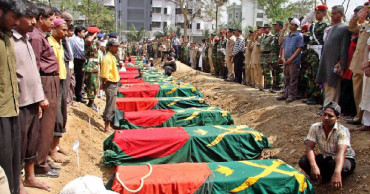
11th anniversary of Pilkhana carnage today
The 11th anniversary of the atrocious carnage at Pilkhana BDR Headquarters in the capital is being observed on Tuesday
6 years ago