corruption
Law Minister warns of strict action against graft, substandard development work
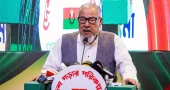
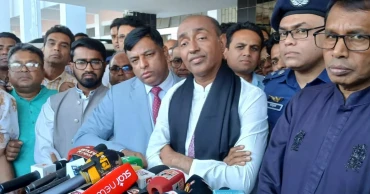
Law Minister Md Asaduzzaman on Saturday said anyone involved in institutional corruption will not only lose their job but also face imprisonment.
The minister said the government has declared zero tolerance for corruption and that funds allocated for public will be properly monitored, he said at a meeting with the members of parliament and government officials at the conference hall of Jhenaidah Deputy Commissioner.
“If anyone tries to earn commission illegally, strict action will be taken against them,” he added.
Asaduzzaman said there will be no compromise on the quality of development work.
“If anyone uses substandard materials in road or infrastructure projects, their license will be canceled. Inform me if anyone tries to make a profit through commissions or extortion. The government and opposition will work together to eliminate corruption, terrorism, extortion, and drugs,” he said.
The minister also criticised the quality of road construction from Garaganj Bazar to Shailkupa on the Jhenaidah-Kushtia road, saying the contractor will be blacklisted and face the maximum legal penalty.
He said dishonest contractors will not receive future government contracts.
The Law Minister said using substandard materials in infrastructure projects should result in the highest legal action against the contractor.
Departments failing in their duties will see disciplinary action against the heads along with complaints to the Anti-Corruption Commission, he added.
6 months ago
ACC Trap in Noakhali: Project Implementation Officer held with bribe money
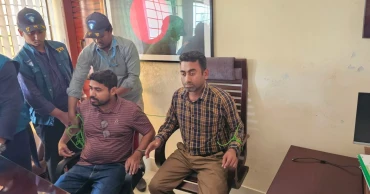
The Anti-Corruption Commission (ACC) on Thursday arrested a Project Implementation Officer (PIO) in Sonagazi upazila of Feni while he was taking bribe of Tk 100,000.
The arrested official is Md Al-Sayeed, Project Implementation Officer of Sonagazi Upazila office. His associate, office assistant Abu Naser, was also arrested during the operation.
According to the complaint, a contractor completed work on five projects under Sonagazi Upazila Project Implementation Office through sub-contract agreements and submitted the bills for payment.
ACC files 2 cases against ex-Jessore-1 MP Sheikh Afil Uddin, wife
As a condition for releasing the bills, Al-Sayeed allegedly demanded Tk 12 Lakh as bribe.
Finding no other option, the complainant agreed to pay part of the bribe money and subsequently filed an application with the ACC’s Noakhali district office seeking a trap operation.
Following approval from the Commission, an ACC team conducted the operation and caught Md Al-Sayeed red-handed while accepting Tk 100,000 in cash.
Abu Naser was arrested at the same time for his involvement.
ACC to file case over Tk 1,325cr loan scam involving Bashundhara Group, National Bank officials
ACC officials said legal proceedings are underway and the accused will be produced before a court after filing a case.
6 months ago
ACC files 2 cases against ex-Jessore-1 MP Sheikh Afil Uddin, wife
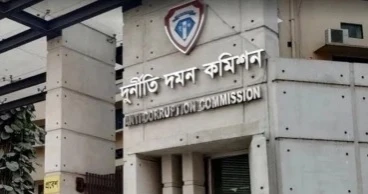
The Anti-Corruption Commission (ACC) on Sunday filed two separate cases against former Jessore-1 MP Sheikh Afil Uddin and his wife Tahera Sobha, accusing them of amassing wealth worth about Tk 62.31 crore.
The cases were lodged at the ACC’s Dhaka Integrated District Office by Assistant Director Syed Maidul Islam, ACC Deputy Director Aktarul Islam told UNB.
According to the first case, investigators found assets worth Tk 45.43 crore in Sheikh Afil Uddin’s name, including immovable properties valued at Tk 1.47 crore and movable assets worth Tk 43.91 crore.
ACC to file case over Tk 1,325cr loan scam involving Bashundhara Group, National Bank officials
His lawful income was only Tk 7.60 crore, leaving unexplained wealth of Tk 46.26 crore.
In the second case, Tahera Sobha was accused of acquiring illegal assets.
Investigators found her movable and immovable properties valued at Tk 18.55 crore.
Including expenditures, her total assets stood at Tk 19.23 crore, while her lawful income was Tk 3.18 crore, leaving unexplained wealth of Tk 16.05 crore.
Besides, the ACC issued asset disclosure notices to the couple’s three sons — Sheikh Kutubuddin, Sheikh Tamim Uddin, and Afnan Uddin — after finding evidence of suspicious assets worth around Tk 50 million in their names.
Case against 8 NHA officials over allocation of luxury flats for 2 ACC commissioners
6 months ago
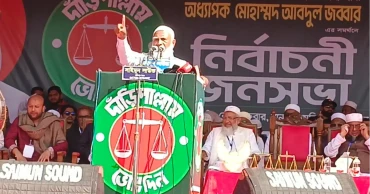
Jamaat chief pledges to uproot corruption
Jamaat-e-Islami Ameer Dr Shafiqur Rahman has called for corruption to be fully eradicated, warning that tackling only its “leaves or branches” would be insufficient.
He stressed the need for removing corruption from its roots to ensure good governance and accountability in Bangladesh.
Speaking at an election rally at Mehendiganj Government RC College ground in Barishal on Friday morning, Dr Shafiqur Rahman criticised the current legal system, saying it is “unjust that big corrupt individuals remain outside the law while small offenders are punished.”
He said if Jamaat were entrusted with running the country, it would neither engage in extortion nor allow others to do so.
The Jamaat chief highlighted his party’s commitment to the principles of the July Revolution, stating, “If Allah gives us the opportunity to run the country, we will ensure that everyone receives their rightful share. Laundered money will be recovered, as economic challenges will be a major concern.”
Get ready to lead, Jamaat Ameer tells youths
He also pledged to prioritise economic development and improvements in communication infrastructure in the historically neglected Hijla–Mehendiganj area.
Referring to a hacking incident involving his X (formerly Twitter) account, Dr Shafiqur Rahman said, “A missile was fired at me, but it hit them instead. Truth can never be suppressed. We do not want politics that creates extortionists, murderers and looters.”
He also called for a change, saying, “I have protected the party for a long time. If given the chance, I will now protect the country.”
Although the rally was scheduled to begin at 11:00 am, Dr Shafiqur Rahman arrived an hour early, with the ground already filled with supporters. The event was presided over by Maulana Shahidul Islam, Ameer of Mehendiganj Upazila Jamaat.
Jamaat Ameer vows to ensure security, rights of all, women safety
Other speakers included Jamaat Assistant Secretary General Advocate Muazzam Hossain Helal; Barishal Regional Team Member AKM Fakhruddin Khan Raji; Barishal District Ameer and Barishal-4 constituency candidate Professor Abdul Jabbar; AB Party General Secretary and Barishal-3 candidate Barrister Asaduzzaman Fuaad; District Jamaat Secretary and Barishal-6 candidate Maulana Mahmudunnabi Talukder; Barishal-2 candidate and District Jamaat Nayeb-e-Ameer Master Abdul Mannan; and Barishal-1 candidate Maulana Qamrul Islam Khan.
7 months ago
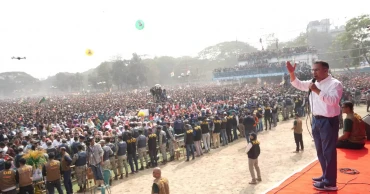
Tarique pledges strict law enforcement, anti-corruption measures
BNP Chairman Tarique Rahman on Sunday pledged a zero-tolerance stance against corruption and vowed to strengthen public security if his party comes to power through the 13th parliamentary election, warning that no one will be spared for graft or misuse of public resources.
Addressing a big election rally at the Polo Ground in the port city, he also said the BNP will make Chattogram the country’s commercial capital if elected, completing an initiative first taken during the party’s last tenure but left unfinished.
“We want to make it very clear that corruption is a crime. No matter who commits corruption, the law will apply equally. InshAllah no one will be spared,” Tarique told the crowd.
The BNP Chairman also said, “These two things — tackling corruption and ensuring public security — are our commitments to the people of this country.”
He said the BNP has proved in the past that it can control corruption, recalling how the Khaleda Zia government succeeded after coming to power in 2001.
“When BNP was in office, you saw that even some of our own party leaders who engaged in wrongdoing did not get exemption,” the BNP leader added.
Tarique said Chattogram carries historical, emotional and economic significance, and many people have long demanded the declaration of the city as the country’s commercial capital.
“That initiative was taken by Begum Khaleda Zia, but could not be fully completed due to lack of time. If BNP forms the next government, the initiative will be implemented as quickly as possible,” he said.
Tarique said such a move will create large employment opportunities, strengthen trade and boost economic activities not only in Chattogram but across the country.
Introducing BNP candidates from Chattogram, Cox’s Bazar and the Chattogram Hill Tracts, Tarique called upon voters to place their trust in the party’s election symbol, the ‘sheaf of paddy’.
“We want to build an expected Bangladesh with everyone — whether from hills or plains, Muslim or another religion,” he said.
Read More: Tarique Rahman appeals to voters, highlights BNP’s track record
Through the large gathering, Tarique appealed to voters in the wider region to trust the BNP and its party symbol, saying that those who believe in democracy, free speech and citizens’ rights should support the party.
“InshAllah, if BNP is elected, we will together build Bangladesh for working people, just like we did in the past,” he added, repeating his slogan: “Korbo kaj, gorbo desh, Shobar Aage Bangladesh” (We shall work, we shall build the country — Bangladesh before everything).
Tarique alleged that a new political plot is underway similar to the previous 15 years during which, he claimed, people’s political and economic rights were “taken away”.
“I urge you to stay alert so that your right to vote, to speak and to live is not snatched again,” he said.
Urging people to vote on the election day, the BNP chief asked supporters to wake up for Tahajjud prayers and then go to their polling stations before dawn.
“Offer Tahajjud, then Fajr in front of the polling centre, and stand in line from the very beginning,” he said, to which activists replied, “We will!” and he answered, “InshAllah.”
Sunday’s rally marked Tarique’s first major public address in Chattogram in two decades.
He last spoke at a similar rally at Laldighi Maidan on May 6, 2005 as BNP’s Senior Joint Secretary General.
Now, as party chairman, Chattogram became the second stop of his national campaign outside Dhaka after formally launching his campaign in Sylhet on January 22.
Supporters began arriving at the Polo Ground early in the morning from Chattogram, Cox’s Bazar, Rangamati, Khagrachhari and Bandarban. By 10am the field was filled to capacity.
Tarique in Chattogram for second phase of election campaign
At the beginning of his speech, Tarique greeted the crowd in the local Chattogram dialect, asking, “Onera Ken Achon?” (How are you?).
He then made historical references to Chattogram, noting that it was from this city that late President and his father Ziaur Rahman announced the country’s independence in 1971, that he was later killed here, and that his mother Begum Khaleda Zia was conferred the title of “Deshnetri” (leader of the nation).
Tarique reached Shah Amanat International Airport on Saturday night and stayed at a hotel before attending Sunday’s programme.
He arrived on stage at around 12:30pm and left for Feni at 1:40pm, where he was scheduled to address another election meeting before speaking in Cumilla’s Chauddagram, Suyagazi, Daudkandi, and later at Kanchpur near Narayanganj.
Read More: Law and order, corruption high on BNP agenda: Tarique
The rally was chaired by City Mayor and Chattogram BNP President Shahadat Hossain. BNP Standing Committee members Amir Khosru Mahmud Chowdhury, Salahuddin Ahmed and other nominees from Chattogram, Cox’s Bazar and the Hill Tracts also addressed the gathering.
7 months ago

Corruption allegations engulf Bangladesh’s haor embankment projects; farmers fear crop disaster
Allegations of bribery, document forgery and abuse of power have surfaced around haor embankment projects in Sunamganj district, raising fears that corruption could undermine flood protection works critical to the country’s boro rice harvest.
Farmers in Shalla upazila accuse officials and politically connected individuals of turning publicly funded embankment schemes into a money-making operation, using irregular project implementation committees (PICs) to siphon off crores of taka meant to protect haor wetlands from early floods.
At the heart of the allegations is a pattern of deliberate exclusion. Under government rules, PICs must be formed with five to seven members drawn from landowners and genuine beneficiary farmers in the project area.
Illegal topsoil extraction threatens ‘Gaillar Haor’, croplands in Sunamganj
Instead, farmers say, committees have been stacked with non-farmers through political influence and large-scale financial transactions, allowing control over project funds with little accountability.
“They have reduced embankment construction to a business,” said one local farmer, adding, “The committees are just tools for looting.”
Complaints filed with the administration allege widespread irregularities across multiple projects, including those numbered 108, 109, 118, 14, 33, 18, 119, 70 and 22.
In each case, farmers claim individuals with no land in the project areas were appointed to PICs, while rightful landowners were sidelined.
One of the most contentious cases involves project No. 108 under the Kalinikota Haor sub-project, covering embankment repairs from the Hawar canal to Sapuria Para.
Khondkar Habib, a farmer whose ancestral and recorded land lies directly beneath the embankment, said corruption was evident even after official inspections.
“Despite submitting all documents on time, our names were excluded from the list published on January 2,” Habib said.
“The entire embankment runs over our land, and soil must be taken from our property. Even after seeing everything on the ground, public health engineer Rashedul Islam approved a committee of non-farmers. We are hearing this was done in exchange for a large amount of money,” he said.
Allegations of financial misconduct extend beyond individual projects.
A member of the upazila-level PIC implementation committee accused senior officials of facilitating transactions rather than enforcing oversight.
“Our signatures were taken before meetings even began,” the committee member said, adding, “Money was exchanged from projects 25 and 93.
Even after informing the UNO, the projects were not suspended. From projects 45 and 98 alone, Tk 300,000 was taken, along with money from several others, by PDB committee members and public health engineer Md Rashedul Islam.”
Further inquiries have revealed allegations of document forgery and criminal backgrounds among committee leaders.
The chairman of PIC No. 70, Pradip Chandra Das, is facing an ongoing case at Dhaka’s Uttara East Police Station.
Farmers allege he secured his position by forging land ownership records for property he had already sold.
Despite policy provisions prioritising local participation, residents say several projects include committee members from neighbouring upazilas, a move they believe weakens accountability and encourages substandard work.
“Outsiders take the money and leave,” said another farmer. “If the embankment collapses and our crops are destroyed, we will suffer, not them.”
Local leaders of the Haor Bachao Andolon say the scale of alleged corruption this year surpasses previous records.
They warn that haor agriculture depends on a single annual crop, making embankment failure potentially catastrophic.
Victims have submitted written complaints seeking cancellation and reconstitution of the disputed committees to the Shalla upazila nirbahi officer (UNO) and the chairman of the upazila Kabita committee.
Copies have also been sent to the district administration and senior officials of the Bangladesh Water Development Board.
Attempts to contact the officials accused of wrongdoing were unsuccessful.
Piyas Chandra Das, Shalla Upazila Nirbahi Officer (UNO) said the allegations are under review and that action will be taken if evidence is found.
With embankment work deadlines approaching, farmers say delays in addressing corruption could leave both public funds and crops dangerously exposed.
7 months ago

ACC arrests son of former PSC driver over Tk 3.25cr illegal wealth
The Anti-Corruption Commission (ACC) on Tuesday (January 20, 2026) arrested Syed Sohanur Rahman Siam, son of former Bangladesh Public Service Commission (PSC) driver Syed Abed Ali Jibon, on charges of amassing illegal assets worth around Tk 3.25 crore.
ACC Public Relations Officer Md Akterul Islam confirmed the arrest.
Earlier, on January 5, 2025, the ACC filed three separate cases against Syed Abed Ali Jibon, his wife Shahrin Akhter Shilpi, and their son Syed Sohanur Rahman Siam, accusing them of acquiring illegal assets worth Tk 5.37 crore and engaging in suspicious financial transactions amounting to nearly Tk 45 crore. Siam was shown arrested in connection with that case on Tuesday.
Read More: ACC in no position to investigate info on candidates' affidavits
According to the case statements, Abed Ali Jibon allegedly conducted suspicious transactions totaling Tk 41.29 crore through 12 bank accounts, depositing Tk 20.88 crore and withdrawing Tk 20.41 crore. Investigators also found evidence that he acquired assets worth Tk 3.70 crore beyond known sources of income.
His wife, Shahrin Akhter Shilpi, has been accused of possessing illegal assets worth Tk 1.26 crore. She allegedly carried out suspicious transactions totaling Tk 3.56 crore through two bank accounts.
Meanwhile, their son and former Chhatra League leader Syed Sohanur Rahman Siam has been accused of acquiring assets worth Tk 3. 3 crore from undisclosed sources.
The ACC brought charges under Section 27(1) of the Anti-Corruption Commission Act, 2004, and Sections 4(2) and 4(3) of the Money Laundering Prevention Act, 2012, for concealing, converting, transferring, and handing over illegally obtained money and assets derived from corruption and bribery.
Read More: ACC files two cases against former CMP CT unit officer, wife and sisters over Tk61.19cr illicit wealth
In July 2024, the Criminal Investigation Department (CID) of police arrested 17 people, including former PSC chairman’s driver Abed Ali, in connection with the leakage of PSC question papers. Following the incident, the ACC launched an investigation into his assets.
Sources said Abed Ali had previously been dismissed from service in 2014 after allegations of question paper leakage were proven. He was found directly involved in an incident during a written examination for the post of Assistant Maintenance Engineer under the Ministry of Information and Communication Technology, where a candidate was caught red-handed with illegal answers to examination questions.
Once working as a porter, Abed Ali later learned to drive and joined the PSC. Over time, he allegedly amassed huge wealth through involvement in question paper leakage syndicates and emerged as an industrialist in his locality.
Earlier, Abed Ali and his son Sohanur Rahman were also arrested for alleged involvement in a question paper leakage ring linked to recruitment examinations for the post of Sub-Assistant Engineer of Bangladesh Railway.
Read more: Hasnat slams Public Admin Ministry; NCP submits 15-point proposal to PSC
7 months ago
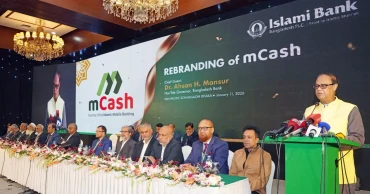
Bangladesh Bank pushes digital payments to curb corruption, boost revenue
Bangladesh Bank Governor Dr Ahsan H Mansur on Sunday said the central bank is promoting digital and QR code-based payments, even at small shops, to foster a cashless and corruption-free society.
Speaking at the rebranding inauguration of Islami Bank Bangladesh PLC’s mobile financial service mCash in Dhaka, Dr Mansur said the government could earn an additional Tk1.5-2.0 lakh crore from a fully digital payment ecosystem.
“Bangladesh spends around Tk20,000 crore annually to manage cash—the highest globally. Digital payments can significantly reduce this cost,” he added.
Governor Mansur expressed optimism about mCash, citing Islami Bank’s roughly 3 crore customer accounts—the largest for a single bank in the country.
He said mobile financial services are indispensable for expanding the digital payment system and that Bangladesh Bank is working to ensure smooth interoperability among services.
The Governor cautioned that Islami banks must operate in line with Shariah principles, highlighting that some, including S. Alam, have faced risks due to non-compliant lending. A draft law for Shariah-compliant operations has been completed by the central bank.
Microcredit Bank to operate as non-profit social business under Bangladesh Bank oversight: CDF
Dr Mansur urged mCash to leverage Islami Bank’s 400 branches, 271 sub-branches, and about 2,800 agent outlets, including its remittance flows. He stressed the importance of long-term planning, customer trust, and incentives like cashback to drive adoption.
“Encouraging digital transactions in retail and the SME sector via QR codes will reduce corruption and increase revenue,” he said.
Professor Dr M Zubaidur Rahman, Chairman of Islami Bank, presided over the event.
8 months ago

BRTA tops corruption list among public service offices: BBS survey
The Bangladesh Road Transport Authority (BRTA) has been identified as the most corruption-prone public service office in the country, according to the Citizen Perception Survey (CPS) 2025, released by the Bangladesh Bureau of Statistics (BBS).
The survey found that 63.29 percent of citizens who sought services from BRTA experienced corruption. BRTA was followed by law enforcement agencies (57.96 percent) and passport offices (57.45 percent) on the corruption list.
The report was unveiled on Wednesday at the BBS auditorium in Agargaon, Dhaka.
According to the survey, 31.67 percent of respondents admitted to having paid bribes directly while receiving government services in the past 12 months.
Read more: BRTA chairman wants to see accident-free roads
The rate of bribery was significantly higher among men (38.62 percent) compared to women (22.71 percent). An overwhelming 98.48 percent of respondents reported paying bribes in cash.
BBS conducted the nationwide CPS between February 6 and 23, 2025, covering 64 districts. Data were collected through interviews with 84,807 respondents aged 18 and above (39,894 men and 44,913 women) from 45,888 households across 1,920 Primary Sampling Units (PSUs).
The findings show that 63.29 percent of respondents who interacted with BRTA officials admitted to paying bribes to receive services, making it the most corruption-prone government office among those surveyed, while the least bribery was recorded in government and autonomous banks and insurance offices (2.98 percent), public educational institutions (2.94 percent), and the Anti-Corruption Commission (ACC) itself, which stood at 1.99 percent.
Law enforcement agencies ranked second, where 61.94 percent of service recipients said they had to pay bribes. This was followed by the passport office at 57.45 percent and the land registry (cadastre) office at 54.92 percent, highlighting persistent corruption in citizen-facing and documentation-related services.
Read more: Road crashes claim 380 lives in July: BRTA
More than half of the respondents also reported bribery in interactions with judges, magistrates, prosecutors and other legal officials (53.77 percent), and the land record, acquisition and settlement offices (51.40 percent).
At the mid-range, bribery was reported by 44.68 percent of respondents dealing with accounts offices, while customs, excise, and VAT offices recorded 35.37 percent. Local government offices at the union parishad, pourashava, and upazila levels stood at 32.91 percent, followed by district and upazila election offices at 26.04 percent.
Lower levels of bribery were reported in social security and welfare offices (19.20 percent) and public utility services such as electricity, water and gas (18.41 percent). Interactions with elected local government representatives (14.94 percent) and income tax or revenue offices (14.08 percent) showed relatively lower but still notable corruption.
Bribery incidence was lowest in the district and upazila administration (11.33 percent), agricultural offices (9.07 percent), and among public healthcare providers, including doctors and nurses (8.05 percent). Only 7.91 percent reported bribery involving elected Members of Parliament.
The data underscore deep-rooted governance challenges, particularly in transport, law enforcement and land-related services, where citizens’ dependence on officials continues to fuel informal payments despite ongoing reform efforts.
The survey assessed progress on six indicators of Sustainable Development Goal (SDG) 16, based on citizens’ perceptions and experiences related to security, good governance, quality of public services, corruption, access to justice, and discrimination.
Read more: CNG drivers block road outside BRTA prompting Mohakhali-Uttara tailback
Nationally, the average household size was four members, with 81.97 percent male-headed households and 18.03 percent female-headed households.
On security, 84.81 percent of citizens reported feeling safe walking alone in their neighbourhoods after sunset while the sense of safety was lower among women (80.67 percent) compared to men (89.53 percent). The feeling of safety inside one’s home after dark was higher at 92.54 percent.
In terms of governance, only 27.24 percent of citizens believed they could influence government decisions, while this figure dropped to 21.99 percent regarding political decision-making.
Nationally, about 24.62 percent of respondents felt that the country’s political system is inclusive and responsive, with little difference between rural (24.47 percent) and urban (24.91 percent) areas.
Regarding public service delivery over the past year, 47.12 percent of respondents accessed government health services, while 40.93 percent reported that at least one of their children attended a government primary or secondary school.
Besides, 73.77 percent sought other government services such as identity cards or civil registration.
Satisfaction levels varied across services: 72.69 percent for healthcare, 81.56 percent for primary education, 78.18 percent for secondary education, and 66.91 percent for other government services.
The survey also found that 16.16 percent of citizens experienced disputes or conflicts in the past two years.
Among them, 83.60 percent had access to some form of dispute resolution, either formal (such as courts) or informal (such as community leaders). Of these, 41.34 percent used formal institutions, while 68.96 percent relied on informal mechanisms.
On discrimination, 19.31 percent of respondents reported experiencing some form of discrimination.
Read more: BRTA provides financial assistance to families of road crash victims in Joypurhat
The main bases were socio-economic status (6.82 percent) and gender (4.47 percent). Incidents occurred most frequently within families (49.72 percent), in public transport or open spaces (34.82 percent), and at workplaces (24.85 percent). Only 5.37 percent of victims reported such incidents to the authorities.
8 months ago
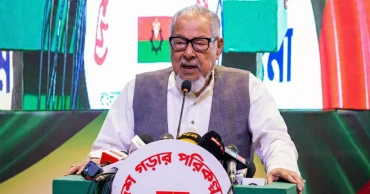
BNP worked to curb corruption, fake voter claims baseless: Nazrul
BNP Standing Committee member Nazrul Islam Khan on Tuesday (December 09, 2025) rejected allegations that the party created fake voters and made Bangladesh the ‘champion of corruption’ during its tenure, calling the claims politically motivated and factually incorrect.
Speaking at the inaugural session of BNP’s ‘Plan to Build the Country,’ discussion at Khamarbari Krishibid Institute, Nazrul said the party worked sincerely to curb corruption after coming to power, particularly in its final two years in office.
“But eliminating corruption built up over many years is not something that can be done overnight,” he added.
Nazrul Islam said corruption perception reports were not published before 2001. BNP assumed office in October that year, and Bangladesh’s position in the index reflected corruption under preceding caretaker and Awami League governments, he claimed.
Read more: ‘Religion card’ no longer fooling citizens, says Salahuddin
He also dismissed claims that BNP created 1.5 million fake voters, saying those making such allegations “are not aware of the facts.”
Nazrul Islam said BNP had sought to update the voter list, but the Awami League moved to court to block the process.
“While people are eager to register as voters, there is little incentive for relatives to remove names after someone dies. Many of those labelled as fake voters had already passed away. Their names simply weren’t removed. BNP tried to renew the list but was prevented,” he explained.
Nazrul Islam also spoke against using religion for electioneering, noting that Bangladesh’s Muslims are among the most devout in the world. “People here don’t need to vote to secure a place in heaven. They will achieve that through their own deeds,” he said.
Read more: Tarique warns BNP of ‘something terrible’ if unity falters
He assured that BNP has clear plans for the country, promising greater income equality and overall development if the party is voted into power.
Urging party activists to avoid internal divisions, Nazrul said, “You may not get nomination, may not become an MP or minister, or even a district secretary. But if BNP forms the government, your dignity and importance will increase. Keep working for the party with that in mind.”
Nazrul Islam described BNP as most organised under the leadership of acting chairman Tarique Rahman. “Ziaur Rahman founded BNP, Khaleda Zia established it as a political force, and Tarique Rahman strengthened the organization further,” he said.
BNP is currently more organised than ever, with significantly lower levels of defection compared to previous years, and that the party’s main priority is improving people’s quality of life, he added.
Read more: BNP ready to lead fresh drive against corruption: Tarique
9 months ago