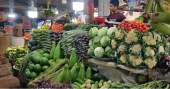
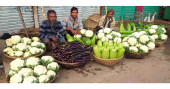
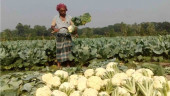
winter vegetables
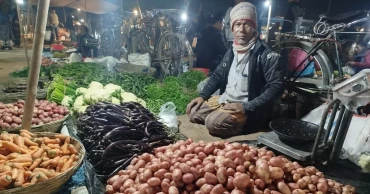
Despite ample supply, winter vegetables costly in Lalmonirhat
Prices of winter vegetables are still relatively high despite adequate supply at kitchen markets in Lalmonirhat, adding to the woes of people with fixed income already overburdened with soaring prices of daily essentials.
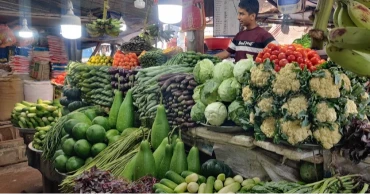
During the peak winter season, kitchen markets in five upazilas of the district including—Patgram, Hatibandha, Kaliganj, Aditmari and Lalmonirhat Sadar—are brimming with winter vegetables.
Cauliflower, cabbage, beans, carrots, radish, tomatoes, spinach and other winter produce are available in abundance, yet their prices remain sharp.
Prices of winter vegetables drop in Khulna, essentials continue to rise
During a recent visit to the market on Saturday (Jan 10) this UNB Correspondent found that potatoes are being sold at Tk 30–40 per kg, eggplant at Tk 50–60 per kg, tomatoes at Tk 70 per kg, carrots at Tk 40 per kg, beans at Tk 60 per kg, pumpkin at Tk 50 per piece, raw bananas at Tk 30 per dozen, ladies finger beans at Tk 60 per kg, pointed gourd Tk 60 per kg, bottle gourd Tk 40–60 per piece depending on size, cauliflower at Tk 40 per piece, cabbage at Tk 50 per piece, papaya at Tk 30 per kg, radish Tk 40 per kg, sponge gourd at Tk 50 per piece, bitter gourd at Tk 50 per kg, red spinach at Tk 20 per bunch and mustard leaves at Tk 20 per bunch.
Customers are negotiating prices with vendors, often moving from one stall to another in search of better deals.
Consumers said the high prices of vegetables throughout the year put pressure on household budgets and while winter usually brings some relief, the relief is minimal this year.
Salma Begum, a housewife from Shialkhowa, said that earlier they used to buy a few vegetables for 200–300 taka. Now, with the same amount of money, one can't even fill a bag with vegetables and even the variety in the family's meals is decreasing.
Another buyer, Samad Mia, an office employee at an organisation, said that because vegetable prices are high, they no longer have the opportunity to eat vegetables regularly. Winter was supposed to be truly comfortable for middle-class people like us, but now it is not.
Saiful Islam, a vegetable seller, said, “Production usually rises in winter, but this year cold weather has affected supply, keeping prices relatively high.”
Mohammad Helal Mia, a seller from Namuri market, added, farmers should have brought more vegetables to the market, but the sudden cold has disrupted supply.
Another seller said that although higher prices increase profit per unit, fewer buyers mean overall sales remain unsatisfactory.
“If the price is lower, people buy more. This way, our products don't remain unsold either,” he said.
Early variety winter vegetables raise hope among Jessore farmers
According to the stakeholders, if weather conditions are not favorable, vegetable prices may remain high throughout the winter season.
8 months ago
Chandpur’s winter harvest eases the burden on plates
As winter sets in, consumers in Chandpur are finding a welcome relief in kitchen markets, as the prices of winter vegetables see a modest decline, particularly benefiting low-income groups.
Vendors in the coastal district say this year’s price correction is a departure from previous trends, attributing the stability to the absence of syndicates that traditionally caused sudden spikes.
“If this situation continues, it could provide lasting relief for consumers,” a local vendor told UNB.
Agriculturists echoed this observation, noting that last year, potato prices had surged to Tk 80 per kilogram, while high-quality potatoes are now available at Tk 22–25 per kilogram.
Read more: Dry fish trade keeps Narail economy moving in winter
Other vegetables have also become more affordable: papaya is selling at Tk 25–30 per kilogram, and lower-quality potatoes are offered at six to seven kilograms for Tk 100 in van markets across neighbourhoods.
Similar pricing patterns are evident in the district town’s roadside markets, including Wireless, Baburhat, Bohoria, Mahamaya, Bakila, and Munshirhat in Matlab.
Over the past fortnight, fresh winter vegetables such as bottle gourd, ridge gourd, black eggplant, pointed gourd, chichinga, okra, and cucumber have seen price reductions of Tk 10–15 per kilogram, now retailing at Tk 45–50 per kilogram.
Other staples include radish at Tk 40 per kilogram, fresh cauliflower at Tk 35–40 per piece, and smaller cabbages at Tk 40 each. Bitter gourd remains relatively expensive at Tk 80–90 per kilogram, green chilli is Tk 80, coriander leaves Tk 30–40, medium-sized bottle gourd Tk 40, and carrots Tk 120 per kilogram.
Local tomatoes sell for Tk 100–120 per kilogram, taro at Tk 40–50, and leafy vegetables such as red amaranth, pumpkin, kolmi, pointed gourd, and radish are priced between Tk 20–30 per kilogram. Onion prices have fallen to Tk 50 per kilogram.
Read more: Polyshade tomato farming reviving Narail’s rural economy
Traders in the city’s busiest market, Biponibag, including Juel Mia, Jahangir Khan, Iqbal Bepari, and Abul Kalam Bepari, expect prices to fall further in the coming days.
Observations across other prominent district markets, such as Palbazar, New Market, Puranbazar, Wireless Market, and Biponibag, confirm this trend.
Vegetable vendors selling directly from vans are offering produce at Tk 5–10 lower per kilogram than retail shops, attracting crowds of low-income buyers, especially in the evenings.
Each morning, large quantities of fresh vegetables arrive via trawlers from remote char areas in Matlab Uttar, Chandpur Sadar, and Haimchar, including Raj Rajeshwar, Char Ibrahim, Harina, Char Kashim, Kanudi and Bishnupur.
Despite the ample supply, the lack of government regulation in retail markets keeps prices higher than production costs. Mohammad Mobarak Hossain, an agricultural officer at the Department of Agricultural Extension in Chandpur, told UNB that authorities have no power to control market prices.
He said winter vegetable cultivation targets cover 6,100 hectares, aiming for a total production of 134,200 metric tons. Vegetables are grown across nearly 12,000 hectares along riverbanks and chars, with additional supply coming from neighbouring districts.
“There is no shortage of winter vegetables,” he emphasised.
The current price trend provides a glimmer of hope for consumers, signalling a more stable market for winter staples this season.
Read more: Naogaon farmers face uncertainty as unseasonal rain hits early crops
9 months ago

Naogaon farmers face uncertainty as unseasonal rain hits early crops
Farmers in the northern district of Naogaon are struggling with fresh uncertainty as unseasonal rain, triggered by a low-pressure system over the Bay of Bengal, has damaged prepared seedbeds for early winter vegetables and partially ripe Aman paddy.
Potato fields, in particular, have been affected, causing concern among growers hoping to recover losses from last year.
Agriculture officials said stagnant water in the fields has raised fears of widespread damage to newly planted potato seeds, transplanted Aman paddy and early winter vegetables, including cauliflower, cabbage, tomato, chili, eggplant and radish.
Many plants, they said, are lying flattened in waterlogged fields across several upazilas.
Read more: Polyshade tomato farming reviving Narail’s rural economy
According to the district Department of Agricultural Extension (DAE), Aman has been cultivated on 193,000 hectares this year, while early winter vegetables cover 1,845 hectares. Potato cultivation is targeted on 21,000 hectares.
A field visit revealed that farmlands prepared for potato cultivation or recently sown are submerged, forcing farmers to focus on draining the water to save their crops. Farmers also fear delays in planting on fallow lands that remain waterlogged and excess moisture has already caused root rot in some vegetables.
Zainal, a farmer from Kalikapur Dangapara in Atrai upazila, expressed his worries, saying, “Last year I suffered a big loss from potato farming; hence I planted early this year in hopes of a better price. But now rainwater has submerged the field and I fear the seeds may not sprout properly. I don’t know what to do.”
Sharing a similar experience, Ashraf Hossain from Varsho village in Manda upazila said, “Early potato farming is always risky, but I wanted to try since others were doing it. I planted on one bigha of land, but the sudden rain has filled the field with water.”
Read more: Hidden hands in the fields: Dealers blamed for artificial fertiliser shortage in north
Ratan Mollah of Barshail in Sadar upazila said, “I just finished planting potato seeds when the rain began. It’s still drizzling, and the soil remains soaked. Potato seeds rot easily if they stay wet. I’m worried most of my field will be damaged.”
Meanwhile, Susheel Mistri of Hapania reported that his Aman paddy, which was ripening, had been flattened by rain and gusty winds. Vegetable grower Indri Mia from Kirtipur said, “The rain over the past few days has caused rot at the base of my cauliflower and other vegetable plants.”
Downplaying the extent of the damage, DAE Deputy Director Homayra Mondal said, “Although it rained, it wasn’t a heavy downpour. Potato planting has just started and the newly planted seeds may face minor setbacks, but fields planted eight to ten days ago will likely remain safe. The rainfall is even beneficial for Aman. If the water drains quickly, there won’t be any major problem.”
Read more: Rain pushes green chilli price to Tk 300 per kg, almost all vegetable prices upward
As farmers race against time to salvage their crops, the unseasonal rainfall has once again highlighted the vulnerability of early winter cultivation to unpredictable weather.
10 months ago
Prices of winter vegetables drop in Khulna, essentials continue to rise
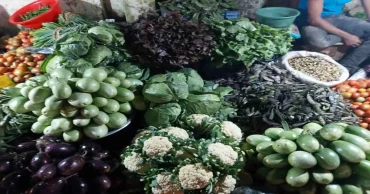
While the prices of winter vegetables have decreased in Khulna, that of essential items such as rice, lentils, edible oil, chicken, and beef have surged, creating challenges for low- and middle-income consumers.
Prices of all varieties of winter vegetables have dropped by Tk 8-10 per kilogram. However, despite regular monitoring and raids by the Directorate of Consumer Rights Protection, edible oil, chicken, beef, rice, and eggs remain expensive due to price manipulation by unscrupulous traders.
Rice prices have seen a sharp increase. As of Friday, coarse rice (Swarna) was selling at Tk 54 per kilogram, Atash Balam at Tk 65, fine Miniket at Tk 75, lower-quality Miniket at Tk 65, Basmati at Tk 75-76, and Kalijira at Tk 120. In contrast, one and a half months ago, coarse rice was Tk 45-46, Miniket was Tk 70, and Kalijira ranged from Tk 110-115, reflecting an increase of Tk 5-6 per kilogram.
Chicken prices have also soared. Broiler chicken was selling at Tk 200 per kilogram, layer chicken at Tk 340, cock chicken at Tk 320, Sonali chicken at Tk 320, and local chicken at Tk 470. Within two weeks, these prices have climbed beyond the purchasing power of many consumers, particularly those with limited incomes.
Beef prices remain steep, selling at Tk 700-750 per kilogram in both urban and rural markets. Despite fines imposed during raids by mobile courts, beef prices have not decreased, drawing criticism from consumers.
Read: Prices of meat, chicken, green chilli and vegetables still high despite falling demand
The price of edible oil has surged again. Five-liter bottles of soybean oil were sold at Tk 875, or Tk 175 per liter. Loose soybean oil was priced at Tk 195 per liter, while super oil ranged from Tk 178-179 per liter. A week ago, five-liter bottles of soybean oil were sold at Tk 860, loose soybean oil at Tk 190, and super oil at Tk 180 per liter.
Lentil prices, however, have remained stable. Fine lentils were priced at Tk 140 per kilogram, while coarse lentils sold for Tk 110.
Sugar prices have slightly dropped. White sugar was selling at Tk 125 per kilogram, and packaged brown sugar at Tk 140. Previously, they were priced at Tk 140 and Tk 150, respectively.
Egg prices remain high. Broiler eggs were priced at Tk 46 per dozen for red eggs and Tk 44-48 for white eggs in urban and rural areas.
In contrast, vegetable prices have dropped significantly. New potatoes were priced at Tk 60 per kilogram, old potatoes at Tk 40, local onions at Tk 70, Kalikata onions at Tk 40, Indian onions at Tk 50, local garlic at Tk 240, and Chinese garlic at Tk 220. Cauliflower was sold at Tk 30, cabbage at Tk 20, turnips at Tk 30, winter beans at Tk 20, green chilies at Tk 60-80, eggplants at Tk 40-50, tomatoes at Tk 60, pumpkins at Tk 30, papayas at Tk 30, red spinach and Malabar spinach at Tk 20 per bunch, and bananas at Tk 20 per dozen.
Two weeks ago, prices were notably higher. New potatoes were Tk 100, old potatoes Tk 70, local onions Tk 100, Kalikata onions Tk 60, cauliflower and cabbage at Tk 40, turnips at Tk 40, winter beans at Tk 40, green chilies at Tk 70-75, eggplants at Tk 60, tomatoes at Tk 100, pumpkins at Tk 40, papayas at Tk 30, spinach at Tk 35–40, and bananas at Tk 30 per dozen.
Read more: Prices of egg, chicken and fish up while vegetables stable at higher rate
Ripan Howlader, director of Apan Poultry Farm in Rupsha Traffic Mor, confirmed that chicken prices have risen significantly. Consumers like Hafizur Rahman, a college teacher, expressed concern about the high prices of essentials despite the drop in vegetable prices. He urged more frequent raids by mobile courts to stabilize prices.
Consumers continue to demand stricter enforcement to control prices and ease the burden on low- and middle-income households.
1 year ago

Winter in Bangladesh unlikely to begin before January: Meteorologist
While the northern regions of Bangladesh are experiencing cooler mornings with thick fog, residents of Dhaka and other parts of the country remain largely unaffected by the chill, as winter continues to delay its arrival.
In recent years, the country has typically felt the onset of winter in January, with temperatures dropping significantly between January and February.
Md Bazlur Rashid, a meteorologist at the Bangladesh Meteorological Department, said that while some regions are experiencing a mild chill, a proper winter is unlikely to be felt in December.
"Some people are feeling a bit of cold, but there is no chance of winter being felt in December," he said.
Low pressure area likely to form over Bay Tuesday
He attributed the cooler sensations to changes in wind patterns rather than a true seasonal shift, adding that the country can expect winter to begin in January. “The monsoon season is no longer active.”
Winter’s First Signs in Panchagarh and Nilphamari
In the northern district of Panchagarh, often referred to as the ‘Daughter of the Himalayas’, the arrival of winter seems imminent.
Dense fog has blanketed the area, falling like dew throughout the night and lingering well into the morning, creating a thick, misty atmosphere.
According to the Met Office, the departure of the south-west wind, coupled with the presence of clouds in the sky, has contributed to this fog, signalling the forthcoming winter.
In Nilphamari, the town has been engulfed in fog since the midnight of October 12, with visibility reduced to the extent that flights at Syedpur airport were disrupted on that day.
The fog serves as another early indicator that winter is on its way to the northern regions, even as the rest of the country waits for its arrival.
Winter Vegetables Hit Markets
Despite the delayed winter, markets across the capital are already buzzing with winter vegetables, though prices remain steep.
In markets such as Jinjira, Aganagar in Keraniganj, and the capital’s Karwan Bazar, Newmarket, and Hatirpool Raw Market, vegetable stalls are well-stocked with produce, including aubergine, cucumber, pointed gourd, snake beans, papaya, and bitter gourd.
Winter staples such as beans, carrots, radishes, cauliflower and cabbage have also made an appearance.
Dhaka’s air quality continues to be ‘unhealthy’
However, vegetable sellers at Karwan Bazar report that recent rains and floods have driven up prices. In some cases, vegetable prices have surged by as much as Tk 20 in just one week, further straining household budgets amid an already challenging economic climate.
Chill to Intensify in January
Though winter remains elusive in much of the country, meteorologists predict that temperatures will drop significantly in the coming months, particularly in the northern and hilly regions, where the average temperature can fall to 12°C.
January is expected to be the coldest month, with average temperatures across Bangladesh dropping to around 10°C. As the colder months approach, residents in these regions are bracing for the seasonal chill.
Bangladesh’s winter, though typically mild, brings a welcome respite from the high humidity and sweltering heat experienced throughout much of the year. For now, as the late arrival of winter looms, the country’s residents wait in anticipation of cooler days ahead.
Read more: 10 Tasty Immunity Boosting Winter Soup Recipes for Children
1 year ago

Top 10 Nutritious Winter Vegetables in Bangladesh
In the winter, our bodies seek rich foods that provide both warmth and nourishment. This need necessitates the consumption of warming foods. Any vegetable that takes a long time to mature and has an edible section that grows beneath the ground's surface is usually warming and a wonderful winter vegetable to eat. When it comes to eating holistically for our health, seasonal foods provide a natural diversity that we should take advantage of. Now that it is winter, let us take a look at 10 of the most nutritious winter vegetables that provide numerous health benefits.
Winter Vegetables in Bangladesh
Carrots
The carrot is a root vegetable that is crunchy, delicious, and packed with nutrients. Beta carotene, fiber, vitamin K1, potassium, and antioxidants are the nutrients that are found in carrots. They are a healthy weight-loss snack that has been linked to decreasing cholesterol and bettering eye health. Their antioxidant carotene has also been associated with a lower incidence of cancer. Carrots might trigger allergy reactions in persons who are allergic to pollen. Carrots cultivated in contaminated soils may also have greater levels of heavy metals, compromising their safety and quality. To reap the benefits of numerous fruits and vegetables, including carrots, it must be consumed in moderation to avoid any negative consequences. Bangladeshis typically enjoy carrots raw, as sautéed or as the popular dessert known as gajor er halwa.
Read Winter Cake Ideas: Yummy Recipes to add your baking bucket list
Cabbage
To enhance the diet, start with cruciferous vegetables like cabbage. These are rich in vitamins, fibers and antioxidants. Consumption of cabbage may reduce the risk of certain diseases like heart diseases, high blood pressure, and high cholesterol level, improve digestion and reduce inflammation.
4 years ago

Ranisankail farmers find fortune in cauliflower cultivation
Cauliflowers and cabbages are the most common winter vegetables, and a large number of farmers in the Birashi, Umradangi, Uttargaon, Mahalbari, Koligaon and Bhandar areas of the upazila have this year switched to their cultivation from other traditional crops much before winter. And the gamble has paid off.
Hundreds of vegetable traders from Rangpur, Bogura, Dhaka and Sylhet are flocking to the upazila everyday to purchase the fresh produce from the farmers, and that too, "at a fair price".
5 years ago
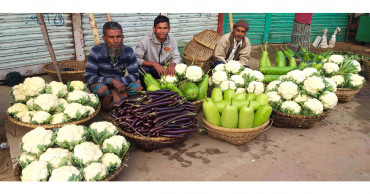
Bumper winter vegetable yield delights Sylhet farmers
The bumper production of winter vegetables brought back smiles on farmers’ faces in the bordering Gowainghat upazila of Sylhet.
6 years ago
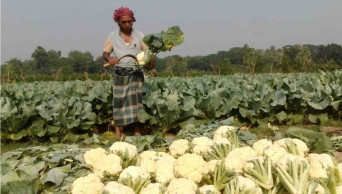
Early variety winter vegetables raise hope among Jessore farmers
Jashore, Sept 20 (UNB) –Vegetable growers in the district are passing a very busy time cultivating early variety of winter vegetables eyeing a bumper production and good profit.
6 years ago