China economy

China lowers tax refund threshold for tourists to boost spending
China announced a lower threshold for tax refunds for foreign tourists among a series of policies on Sunday to boost consumption as its economy comes under pressure during a trade war between Beijing and Washington.
Travellers can apply for a tax refund if they spend 200 yuan (about $27) at the same store on the same day and meet other requirements starting Sunday, according to a joint statement by the Ministry of Commerce and other authorities.
Previously, the minimum amount was 500 yuan (about $69), reports AP.
The upper limit for their tax rebate in cash also has been doubled to 20,000 yuan ($2,745).
Big Tech carries Wall Street to the close of its winning, roller-coaster week
The government will expand the coverage of tax refund shops and streamline the procedures. Officials encourage some regions to set up refund points for travellers to get rebates immediately after their purchases in areas highly concentrated with tourists, the statement said.
China's Vice Minister of Commerce Sheng Qiuping told reporters in a news conference that inbound tourist consumption accounted for about 0.5% of China's gross domestic product in 2024, while figures in other major countries ranged between 1% and 3%. That indicated a great potential for growth, Sheng said.
Last year, inbound tourists' spending hit $94.2 billion, up 77.8%, he added.
China’s economy expanded at a 5.4% annual pace in January-March, the government said earlier this month, supported by strong exports ahead of US President Donald Trump’s rapid increases in tariffs on Chinese products.
1 year ago
Consumer prices fell in China in February, remain flat in sluggish economy
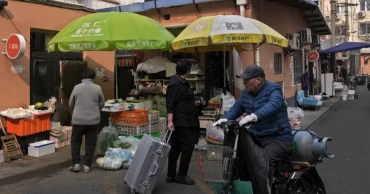
Consumer prices fell in China in February for the first time in 13 months, as persistent weak demand was compounded by the early timing of the Lunar New Year holiday.
The National Bureau of Statistics said Sunday that the consumer price index dropped 0.7% in February compared with a year ago. On a monthly basis, prices were down 0.2% from January.
While many other countries wrestle with inflation, China's policymakers face flat to falling prices, and the possibility they could evolve into a deflationary spiral that would drag down the economy. The government stressed the need to increase domestic demand and consumer spending in an annual report last week to its ceremonial legislature, the National People's Congress, but held back on unveiling any dramatic new steps to boost the economy.
The Lunar New Year, a time when spending rises for travel, dining out and entertainment, came in late January this year instead of February, as it's based on the cycles of the moon. Holiday spending helped drive the consumer price index up 0.5% in January, but it then fell last month compared with 2024's elevated level.
Factoring out the impact of the holiday, the index rose 0.1% last month, Dong Lijuan, a statistician at the government's statistics bureau, said in a written analysis.
Asian shares drop as investors brace for tariff uncertainty
That is still far lower than ideal. Last week's government annual report included an inflation target of 2% for this year, but it is likely to fall far short of that goal. The consumer price index was flat in 2024, rising 0.2%.
Besides the early Lunar New Year, two other factors contributed to falling prices in February, Dong said: Better weather boosted farm production, driving down the price of fresh vegetables and automakers also stepped up promotions to try to boost sales, reducing prices for new cars.
The producer price index, which measures the wholesale price of goods, fell 2.2% in February, the statistics bureau said. Producer prices have been falling more sharply than consumer prices, putting pressure on companies to cut labor and other costs.
The falling prices are a symptom of both weak consumer spending and a massive expansion of factories to build electric vehicles, solar panels and other green-energy products, encouraged by government subsidies.
A burgeoning trade war with the United States could add to China’s economic challenges, which include a prolonged real estate market crisis that is weighing on consumer confidence.
Government ministers, speaking to journalists at the National People's Congress on Sunday, pledged continued efforts to stabilize the real estate market and said that expanding employment in the current economic environment would be “a heavy task.”
China’s foreign minister criticizes US tariffs and accuses the country of ‘meeting good with evil’
The employment situation is showing signs of improvement but the foundation for economic recovery remains unstable, said Wang Xiaoping, the minister of human resources and social security.
“The pressure on total employment remains unchanged,” she said, noting that people are facing difficulties finding work and raising their incomes.
For real estate, a portion of this year's 4.4 trillion yuan ($600 billion) in special local government bonds would go toward purchasing completed but unsold housing projects and converting them to affordable housing, apartments for young people, staff dormitories and other uses, said Ni Hong, the minister of housing and urban-rural development.
The government will also expand a program to rehabilitate older housing including adding all compounds built before 2000 to its urban renovation scheme, he said.
1 year ago
.jpg)
China reports Jan-Feb economic activity worse than expected
China's consumer spending and factory activity fell more than expected in January and February as it fought a virus outbreak, prompting some forecasters to warn this year's economic growth might slump to its lowest level since the 1970s.
6 years ago