Nobel Peace Prize
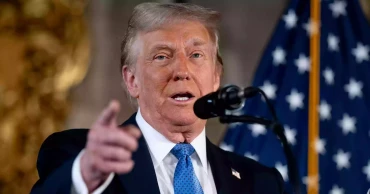
Trump links Greenland rivalry to not receiving Nobel Peace Prize
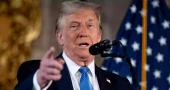
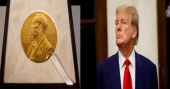
US President Donald Trump has said he no longer feels bound to think only about peace after not receiving the Nobel Peace Prize, as he again pressed his demand for US control over Greenland.
In a message sent to Norwegian Prime Minister Jonas Gahr Støre, Trump blamed Norway for not awarding him the prestigious prize and said the decision had changed his outlook.
“Considering your country decided not to give me the Nobel Peace Prize for having stopped eight wars plus, I no longer feel an obligation to think purely of peace, although it will always be predominant, but can now think about what is good and proper for the US,” Trump said in the message obtained by US media.
He added that “the world is not secure unless we have complete and total control of Greenland”.
CBS News, confirmed the authenticity of the message.
Prime Minister Støre said he received the text on Sunday in response to a message he and Finnish President Alexander Stubb had sent to Trump. He said they had opposed proposed US tariff increases linked to the Greenland dispute and urged de-escalation, proposing a three-way phone call the same day.
Nato members warn Trump’s Greenland tariff threat could trigger ‘dangerous downward spiral’
Støre also pointed out that the Nobel Peace Prize is awarded by an independent committee, not by the Norwegian government.
Trump has repeatedly said the United States needs to take over Greenland for national security reasons. The sparsely populated but resource-rich Arctic island is seen as strategically important for early warning systems against missile attacks and for monitoring shipping routes in the region.
He has again insisted that the US should buy Greenland and has not ruled out the use of military force against a Nato ally to take control of the territory.
Over the weekend, Trump said he would impose a 10 percent tariff on goods from eight Nato allies from February if they oppose his proposed takeover of Greenland, and warned the tariff could rise to 25 percent by June.
In his message to Støre, Trump said Denmark could not protect Greenland from Russia or China and questioned Denmark’s claim of ownership.
“I have done more for Nato than any other person since its founding, and now Nato should do something for the United States,” he said.
UK Prime Minister Sir Keir Starmer said on Monday that any decision on Greenland’s future “belongs to the people of Greenland and the Kingdom of Denmark alone” and described the use of tariffs against allies as wrong.
Danish Defence Minister Troels Lund Poulsen and Greenlandic Foreign Affairs Minister Vivian Motzfeldt were due to meet Nato Secretary General Mark Rutte on Monday. Last week, Denmark and Greenland, along with Nato allies, agreed to increase military presence and exercises in the Arctic and the North Atlantic, with several European countries sending small numbers of troops to Greenland on a reconnaissance mission.
EU to convene emergency summit Thursday over Trump’s Greenland threats
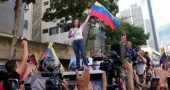
Trump has claimed he ended eight wars since beginning his second term last year. This year’s Nobel Peace Prize was awarded to Venezuelan opposition leader María Corina Machado.
After US forces later seized Venezuelan President Nicolás Maduro and removed him from Caracas on drug trafficking charges and other crimes, Trump did not back Machado as the country’s next leader and instead supported Maduro’s vice-president as interim head of government.
Machado, who has praised Trump, met him at the White House last week and handed her medal to him. The Nobel Foundation said the award cannot be passed on, even symbolically.
#With inputs from BBC
8 months ago
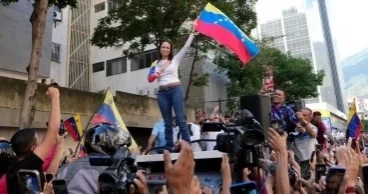
Venezuela’s Machado says she wants to share Nobel Peace Prize with Trump
Venezuelan opposition leader Maria Corina Machado says she wants to share her Nobel Peace Prize with U.S. President Donald Trump, praising his administration’s military action that led to the arrest of President Nicolás Maduro, even as she acknowledged she has not spoken to Trump since October.
Speaking on Fox News’ Hannity on Monday, Machado described Maduro’s capture as “a huge step for humanity, for freedom, and human dignity,” and said her decision to dedicate the Nobel Prize to Trump was based on her belief that he deserved it, reports Al Jazeera.
Read More: Machado’s daughter receives Nobel Peace Prize in her absence
“I dedicated it to President Trump because I believed, at that time, that he deserved it,” Machado said. “Now, after deposing Maduro, he has proven to the world what he means.”
Machado said she last spoke with Trump on October 10, the day the Nobel Peace Prize was announced. “Not since then,” she said, adding that she hopes to thank him personally.
“On behalf of the Venezuelan people, how grateful we are for his courageous vision, the historical actions he has taken against this narcoterrorist regime.”
Read More: Nobel Peace Prize for Maria Corina Machado sparks outcry over Israel ties
The right-wing opposition figure welcomed Trump’s remarks about U.S. energy interests in Venezuela, saying the country could become an “energy hub” for the United States. “We will bring rule of law, we will open markets, we will bring security for investments,” she said.
Trump, however, later questioned Machado’s political standing, telling reporters she “doesn’t have the support or the respect” to lead Venezuela. Following Maduro’s removal, former Vice President Delcy Rodríguez was sworn in as interim leader.
Machado won 93 percent of the opposition’s 2023 primary vote but was barred from running for president, forcing her into hiding for more than a year. After traveling to Norway to accept the Nobel Prize, her current whereabouts remain unknown. She said she plans to return to Venezuela “as soon as possible.”
8 months ago
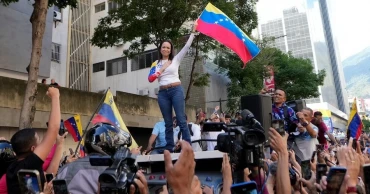
Nobel Peace Prize for Maria Corina Machado sparks outcry over Israel ties
Maria Corina Machado, a prominent Venezuelan pro‑democracy activist, has come under fire after being awarded the 2025 Nobel Peace Prize. Critics say the prize is controversial because Machado has publicly backed Israel and its military actions in Gaza and has previously called for foreign assistance to help remove Venezuela’s government.
The Nobel Committee named Machado the Peace Laureate on Friday, praising her role in defending democracy and resisting authoritarian rule in Venezuela.
orgen Watne Frydnes, the committee’s chair, described her as a "key, unifying figure in a political opposition" and hailed her as a "champion of peace" who has kept democratic hopes alive.
In his announcement Frydnes added, "In the past year, Machado has been forced to live in hiding. Despite serious threats against her life, she has remained in the country, a choice that has inspired millions. When authoritarians seize power, it is crucial to recognise courageous defenders of freedom who rise and resist."
The award prompted a swift reaction from Washington, with the White House criticising the decision for "placing politics over peace" — a rebuke that came amid a recent U.S. effort to present President Donald Trump as a global peacemaker. Machado later dedicated her Nobel to Trump; the U.S. President said he was happy for her.
Opponents have pointed to Machado’s past statements and actions as grounds for protest.
They cite social media posts and public remarks in which she expressed solidarity with Israel following the October 7, 2023, Hamas attack and voiced support for Benjamin Netanyahu’s Likud party.
One frequently highlighted line from her past posts says, "The struggle of Venezuela is the struggle of Israel." She has also referred to Israel as a "genuine ally of freedom" and once pledged to move Venezuela’s embassy to Jerusalem if elected.
Norwegian lawmaker Bjornar Moxnes noted Machado signed a cooperation document with Israel’s Likud party in 2020, arguing that association with a party blamed by some for actions in Gaza makes the award incompatible with the Nobel’s aims.
The Council on American‑Islamic Relations condemned the decision as "unconscionable," urging the Nobel Committee to reconsider and calling instead for recognition of those who have "bravely pursuing justice for all people," including students, journalists, activists and medical workers opposing what they call "the genocide in Gaza."
Machado also faces criticism over appeals she made for foreign support against the government of President Nicolás Maduro.
In 2018 she posted a copy of a letter she said she had sent to Argentina’s then‑president and to Israel’s prime minister, writing, "Today, I am sending a letter to @mauriciomacri, President of Argentina, and to @netanyahu, Prime Minister of Israel, to ask them to apply their strength and influence to advance in the dismantling of the criminal Venezuelan regime, intimately linked to drug trafficking and terrorism." That call for outside intervention remains a focal point for critics who say it contradicts the Nobel Peace Prize’s spirit.
Supporters argue Machado’s personal sacrifices and leadership in Venezuela’s opposition movement merit recognition, while detractors say her foreign alliances and statements about Israel and intervention undermine the moral standing of the prize. The debate over her selection has quickly become a flashpoint in wider discussions about how the Nobel Peace Prize should balance political realities, moral consistency and the promotion of peace.
With inputs from NDTV
11 months ago
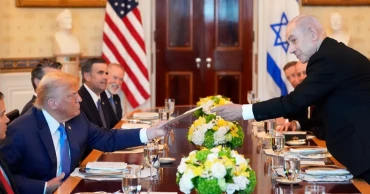
Netanyahu says he nominated Trump for a Nobel Peace Prize
US President Donald Trump has been nominated again for the Nobel Peace Prize.
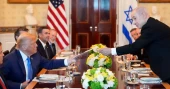
Israeli Prime Minister Benjamin Netanyahu told Trump on Monday that he recommended him for the prestigious award, handing the American leader the letter he said he sent the Nobel committee.
Trump has been nominated several times by people within the US as well as politicians abroad — but that's only one small step in the secretive process.
Trump's previous nominations
Trump's nominators have included a group of US House Republicans and two Norwegian lawmakers. The groups separately nominated him in 2018 for his work to ease nuclear tensions with North Korea. One of the Norwegians nominated him again for the 2021 prize for his efforts in the Middle East, as did a Swedish lawmaker.
Not all of the nominations have been valid: The Norwegian Nobel Committee, which selects the prize winners, said in 2018 that someone using a stolen identity had nominated Trump at least twice.
Nominations can be made by a select group of people and organizations, including heads of state or politicians serving at a national level, university professors, directors of foreign policy institutes, past Nobel Prize recipients and members of the Norwegian Nobel Committee itself.
Secret process
Once all nominations have come in, the committee — made up of five members appointed by the Norwegian parliament — sifts through them and ensures they were made by an eligible nominator.
A person cannot nominate themselves, according to the committee.
The nominations aren’t announced by the committee, and the Nobel statutes prohibit the judges from discussing their deliberations for 50 years. But those doing the nominating may choose to make their recommendations public.
Trump nominated for Nobel Peace Prize over Israel-Iran ceasefire
Nominations must be submitted before Feb. 1 each year — meaning any recent Netanyahu nomination would be for the 2026 prize. The winners are announced every October, with award ceremonies taking place on December 10, the anniversary of Nobel's death.
The prizes in medicine, physics, chemistry, literature and peace were established by the will of Alfred Nobel, a wealthy Swedish industrialist and the inventor of dynamite. An economics prize was later established by Sweden's central bank and is presented at the same time.
How to win the peace prize
According to Nobel’s wishes, the peace prize should go to “the person who shall have done the most or the best work for fraternity between nations, for the abolition or reduction of standing armies and for the holding and promotion of peace congresses.”
The peace prize committee is the only one that regularly rewards achievements made in the previous year — and the prize is the only one awarded in Oslo, Norway. For the science-related prizes, scientists often have to wait decades to have their work recognized by the Nobel judges, who want to make sure that any breakthrough stands the test of time, in Stockholm.
Former US President Barack Obama won the peace prize in 2009, barely nine months into his first term. It was met with fierce criticism in the US, where many argued Obama had not been in office long enough to have an impact worthy of the Nobel.
Former US President Jimmy Carter won a Nobel Peace Prize in 2002 for work he did after leaving the White House.
1 year ago
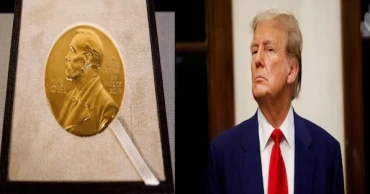
Trump nominated for Nobel Peace Prize over Israel-Iran ceasefire
US President Donald Trump has been formally nominated for the Nobel Peace Prize for his role in securing the ceasefire between Israel and Iran.
The nomination came from Republican Congressman Buddy Carter of Georgia, who submitted a letter to the Norwegian Nobel Committee praising Trump’s “extraordinary and historic role” in ending the armed conflict and preventing Iran—described as the world’s leading state sponsor of terrorism—from acquiring nuclear weapons.
“President Trump’s influence was key to forging a swift agreement that many thought impossible,” said Carter, who has represented Georgia’s 1st District since 2015. He said Trump’s actions reflect the Nobel Prize’s core principles: promoting peace, preventing war, and fostering global harmony.
Carter also acknowledged the complexity of the Middle East, saying Trump displayed both courage and clarity in achieving the breakthrough.
Israel holds back on further Iran strikes after Trump call
Trump announced the Israel-Iran ceasefire on Monday night, suggesting the conflict be named the “12 Day War.” This announcement came just two days after Trump ordered unprecedented US strikes on three Iranian nuclear facilities to support Israeli military actions.
Under Nobel rules, national lawmakers, university professors, and other qualified individuals can nominate candidates for the prestigious prize. However, Trump himself expressed doubt over winning, citing previous peace efforts that went unrecognized.
“I won’t get a Nobel Peace Prize no matter what I do,” Trump posted on Truth Social last Friday, following his administration’s role in brokering peace between Rwanda and the Democratic Republic of Congo.
He added, “I won’t get a Nobel Peace Prize for this, I won’t get one for stopping the war between India and Pakistan, I won’t get one for stopping the war between Serbia and Kosovo.”
#With inputs from New York Post
1 year ago
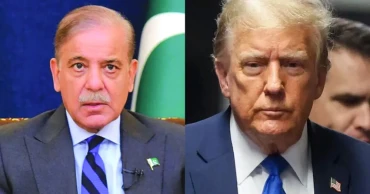
Pakistan to nominate Trump for 2026 Nobel Peace Prize
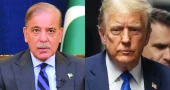
The Pakistani government announced Saturday that it will formally recommend U.S. President Donald Trump for the 2026 Nobel Peace Prize, crediting his “decisive diplomatic intervention” during last month’s India-Pakistan military standoff.
The announcement followed Trump’s remarks claiming credit for a peace agreement between the Democratic Republic of Congo and Rwanda, while also expressing frustration at being overlooked by the Norwegian Nobel Committee for his involvement in mediating tensions between India and Pakistan, and Serbia and Kosovo.
Though Indian officials have denied that Trump played any part in its ceasefire with Pakistan, Islamabad praised his engagement during the crisis.
In a post on X, the Pakistani government stated that President Trump had shown “great strategic foresight and stellar statesmanship” by actively engaging both Islamabad and New Delhi diplomatically to defuse rising tensions.
Nato summit overshadowed by Trump as leaders focus on defence spending
“This intervention stands as a testament to his role as a genuine peacemaker and his commitment to conflict resolution through dialogue,” the post read, crediting Trump’s efforts for helping to secure a ceasefire and prevent a broader clash between the two nuclear-armed nations.
The standoff, which lasted four days, followed a deadly militant attack in Indian-administered Kashmir that India blamed on Pakistan. Islamabad denied any involvement. The confrontation raised fears of another full-scale conflict between the long-time rivals, who have fought multiple wars—two of them over Kashmir.
Trump had also offered to mediate the Kashmir dispute and discussed possible trade deals with both countries. Speaking to reporters in New Jersey on Friday, he said, “We did a very great job with India and Pakistan, and we had India in, and it looks like we’re going to be making a trade deal with India. And we had Pakistan in, and it looks like we’re going to be making a trade deal with Pakistan. And it’s a beautiful thing to watch.”
The Pakistani government also expressed appreciation for Trump’s willingness to address the Kashmir issue, calling it central to regional instability.
“Durable peace in South Asia would remain elusive until the implementation of United Nations Security Council resolutions concerning Jammu and Kashmir,” it said.
Islamabad further expressed hope that Trump’s legacy of “pragmatic diplomacy and effective peace-building” would contribute to resolving ongoing crises, especially in the Middle East.
“Pakistan remains hopeful that his earnest efforts will continue to contribute toward regional and global stability, particularly in the context of ongoing crises in the Middle East, including the humanitarian tragedy unfolding in Gaza and the deteriorating escalation involving Iran,” the statement concluded.
Source: With input from Arab News, Dawn
1 year ago

Japanese atomic bomb survivors say Nobel Peace Prize gives fresh impetus to disarmament push
Survivors of the atomic bombings in Hiroshima and Nagasaki view the recent Nobel Peace Prize as a renewed motivation to advocate for nuclear disarmament, especially with the 80th anniversary of the 1945 attacks approaching.
Terumi Tanaka, a 92-year-old survivor of the Nagasaki bombing on Aug. 9, 1945, expressed his determination to intensify his efforts toward disarmament. Speaking at a press conference in Tokyo after receiving the Nobel Peace Prize in Oslo on behalf of Nihon Hidankyo, Japan's atomic bomb survivors' organization, Tanaka highlighted the significance of the upcoming milestone.
Tanaka, who co-chairs Nihon Hidankyo and formerly taught materials engineering, emphasized the importance of focusing on the next decade to bolster the movement. He aspires to spearhead a widespread campaign of survivor testimonials and urged Japan to lead the push for nuclear disarmament.
NASA's Parker Solar Probe aims to fly closer to the sun like never before
As the only nation to have suffered atomic bombings, Tanaka believes Japan has a unique responsibility to take a stand against nuclear weapons. He plans to challenge Prime Minister Shigeru Ishiba, who supports nuclear deterrence, during a scheduled meeting in January. Despite survivors' calls, Japan remains under the U.S. nuclear umbrella and has yet to sign the Treaty on the Prohibition of Nuclear Weapons.
Michiko Kodama, another survivor who endured the Hiroshima bombing three days prior to Nagasaki, expressed gratitude for the Nobel recognition. Kodama, who was 7 years old at the time, acknowledged the struggles survivors faced, including discrimination and health concerns caused by radiation. She stressed the need to educate others about the catastrophic effects of nuclear weapons before survivors can no longer share their experiences firsthand.
Japanese space startup aborts 2nd satellite launch attempt minutes after liftoff
Founded nearly 70 years ago, Nihon Hidankyo has consistently campaigned to stigmatize nuclear weapons. The atomic bombings by the United States killed approximately 140,000 people in Hiroshima and another 70,000 in Nagasaki. Japan's surrender on Aug. 15 marked the end of World War II, which began with Japan's 1941 attack on Pearl Harbor during its bid to dominate Asia.
1 year ago
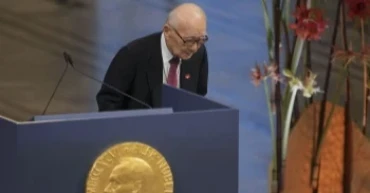
Japan’s atomic bomb victim recalls its horrors in Nobel Peace Prize event
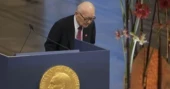
A 92-year-old survivor of the 1945 Nagasaki atomic bombing delivered a powerful speech recounting the horrors of nuclear war as he accepted the Nobel Peace Prize on behalf of Nihon Hidankyo, a group dedicated to nuclear disarmament. Terumi Tanaka, speaking in Oslo, detailed the devastation he witnessed, including the deaths of five family members and the charred ruins of his city, while urging the world to uphold the taboo against using nuclear weapons.
Nihon Hidankyo, a grassroots organization of Japanese atomic bomb survivors, received the award for nearly 70 years of advocacy against nuclear weapons. Their work gains urgency as geopolitical tensions rise, with nuclear powers like Russia and Israel hinting at the possibility of using such weapons. Tanaka expressed his sorrow and anger over the weakening of the nuclear taboo, which the Norwegian Nobel Committee also emphasized in its decision.
Committee chair Jørgen Watne Frydnes highlighted the increasing dangers posed by nuclear weapons, as none of the nine nuclear-armed states show significant interest in disarmament. Instead, many are modernizing their arsenals, a trend Frydnes described as a threat to global security. He called on nations, especially those bound by the Treaty on the Non-Proliferation of Nuclear Weapons, to fulfill their commitments to reduce nuclear stockpiles.
Read: Nobel Peace Prize awarded to Japanese organization of atomic bombing survivors Nihon Hidankyo
Tanaka’s vivid recollections of the Nagasaki bombing underscored the devastating human toll of nuclear warfare. He described the blinding flash, the ensuing shock wave, and the heartbreaking aftermath of finding his loved ones’ charred remains. Reflecting on decades of survivor-led efforts for nuclear abolition and justice, he called for global citizens to reject nuclear weapons and pressure their governments to change policies.
“The belief that nuclear weapons cannot—and must not—coexist with humanity must inspire change,” Tanaka said, urging action to prevent a repeat of such tragedies.
Source: With inputs from agencies
1 year ago

Nobel Peace Prize laureate Narges Mohammadi gets 3-week reprieve from prison in Iran after surgery
Nobel Peace Prize laureate Narges Mohammadi was granted a temporary release from an Iranian prison on Wednesday following a complex surgery to address cancer concerns, during which part of a bone in her right leg was removed, her supporters reported.
Footage from Tehran showed Mohammadi stepping out of an ambulance with her black hair uncovered by a hijab and her right leg encased in a fabric cast. Calling into the street, she exclaimed, “Hello freedom! Women, life, freedom! Freedom is our right! Long live freedom!”
Iran’s imprisoned Nobel Peace Prize laureate hospitalized with severe health issues
According to a campaign advocating for Mohammadi, the temporary release will last 21 days, after which she is expected to return to prison to serve the remainder of her sentence. The Iranian government has not officially acknowledged her medical furlough, despite calls from her supporters for her permanent release. They argue that Mohammadi, 52, requires at least three months of recovery in a safe and sanitary environment to heal properly, emphasizing that her imprisonment for peaceful activism was unjust.
Mohammadi is currently serving a combined prison sentence of 13 years and nine months on charges of colluding against state security and spreading propaganda. Despite repeated arrests and prolonged incarceration, she has continued to advocate for human and women’s rights, including supporting the 2022 women-led protests following the death of Mahsa Amini, during which many women defied Iran's hijab mandate.
Mohammadi's health has been a major concern during her imprisonment, with her supporters reporting multiple heart attacks and emergency surgery in 2022. A bone lesion suspected to be cancerous led to her recent operation, her lawyer revealed earlier this month.
Nobel Prize in Economics awarded for groundbreaking research on why nations succeed or fail
Rebecca Vincent of Reporters Sans Frontières expressed relief over Mohammadi's temporary release, describing it as a positive step but stressing the need for sufficient recovery time at home. “We remain deeply concerned about her health and urge the Iranian authorities to ensure her proper recovery,” Vincent said.
Mohammadi’s release coincides with growing domestic discontent in Iran, where economic struggles fueled by sanctions over its nuclear program have led to protests and government crackdowns. The impending return of U.S. President-elect Donald Trump has raised concerns about the potential resumption of a "maximum pressure" policy against Iran, further complicating the country’s challenges.
1 year ago
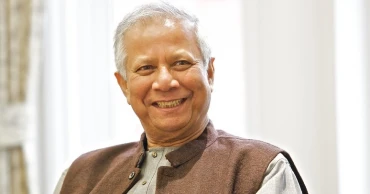
Prof Yunus congratulates Nobel Peace Prize 2024 laureates Nihon Hidankyo
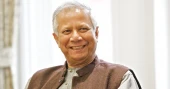
Chief Adviser Professor Muhammad Yunus congratulated Nihon Hidankyo, the Japanese atomic bomb survivors' group, on its winning of the Nobel Peace Prize for 2024.
"Congratulations to Nihon Hidankyo on being awarded the Nobel Peace Prize for 2024. Your unwavering commitment to nuclear disarmament and peace is an inspiration to us all," Prof Yunus said in a message.
Prof Yunus, also Nobel Peace Laureate, said: "Your advocacy and tireless efforts to ensure that the horrors of Hiroshima and Nagasaki are never forgotten resonate deeply in our quest for a safer world".
Nobel Peace Prize awarded to Japanese organization of atomic bombing survivors Nihon Hidankyo
"Thank you for your courage and dedication. Warmest congratulations once again," the message read.
Nihon Hidankyo has been awarded the 2024 Nobel Peace Prize for its dedication to creating a world free from nuclear weapons.
1 year ago