Study

Bicycling could cut emissions in Global South with policy support: Study
After collecting feedback from bicyclists and other stakeholders across four cities in Bangladesh, India and Ghana, a new study shows policymakers devising ways to cut emissions in their countries must meet people where they are and not rely on the same policies that have worked in richer countries.
In many high-income countries, bicycling on city streets is becoming more common— being promoted and invested in both for its health benefits and its benefits to our environment and climate.
The new study published in Nature Cities shows that policies that address the needs of bicyclists are far less common in low- and middle-income countries.
Read More: Europa likely unsuitable for life despite hidden ocean, study finds
This, despite the fact that 49 of the top 50 countries with the most polluted air are located in the Global South and 82 percent of CO2 emissions over the remainder of the century are projected to occur there.
The study evaluates the current state of bicycling in the Global South and what can be done to increase its use as a tool for reducing emissions and improving air quality.
“There is enormous potential for bicycling to be used as a way to reduce harmful pollution and greenhouse gas emissions from the transportation sector in low- and middle-income countries,” says Kavi Bhalla, one of the study’s co-authors and an Associate Professor in the Department of Public Health Sciences at the University of Chicago’s Biological Sciences Division.
“But just because certain policies work to boost bicycling in cities in the United States or Europe doesn’t mean the same policies will be successful in countries in the Global South, where the context is much different. Our study digs into that local context so policymakers can better design policies to fit their local needs.”
Read More: Rising medicine prices threaten healthcare for marginalised communities, warns study
Bhalla and his co-authors including those from Bangladesh studied bicycling in four similar low- and middle-income cities: Delhi and Chennai (India), Dhaka (Bangladesh), and Accra (Ghana).
The locations they chose are all rapidly densifying and expanding cities with flat terrain, heterogeneous traffic, and marked by very hot summers and seasonal flooding. The authors gathered both “in the moment” feedback and interview testimony from more than 550 bicyclists and other stakeholders.
They discovered that bicycling is a mode of everyday transportation for some. But the typical rider was a low-income man cycling a long distance to work each day, with fewer low-income women also riding bicycles to travel shorter distances and on quieter neighborhood roads.
But the conventional belief was, once someone could afford an automobile, they would no longer use a bicycle.
Those who did bicycle faced harsh and risky road conditions. Along with needing to cope with extreme heat, heavy rains and flooding, they also needed to navigate roads that were built to accommodate high-speed automobiles.
In the few areas where separated bicycle lanes existed, they were often either blocked by parked cars or vendors, taken over by motorcyclists escaping roadway traffic, or built in affluent neighborhoods where few people actually bicycle.
It is of little surprise that roadways were built without bicyclists in mind. Planning documents rarely acknowledged that people bicycled at all, and when they did it was often in reference to recreational use within beautification projects.
Additionally, the responsibility of bicycling infrastructure is spread among many different agencies, while bicycle distribution policies were aimed at improving access to school for low-income girls.
Bicycling cultures persist despite these barriers, sustained by informal and precarious support systems. Non-profit organizations provide tools like air pumps and water at basic public comfort stations. Meanwhile, small street-side bicycle repair shops, often no more than footpath stalls, provide maintenance and sell second-hand bicycles.
Yet, many have downsized over the past decade and must regularly negotiate with police and regulatory authorities simply to continue occupying public space.
“What we saw was not a lack of bicycling, but a lack of institutional support,” says Rahul Goel, one of the study’s co-authors and an assistant professor at the Indian Institute of Technology (IIT), Delhi.
“Bicycling continues largely because of informal systems that keep bicycling viable from day to day. These systems are essential, yet they are increasingly fragile and invisible to policymakers, even as motorized traffic and regulatory pressures make cycling harder to sustain.”
Drawing on this analysis, the study concludes that large-scale increases in bicycling could meaningfully reduce greenhouse gas emissions and other pollution from the transport sector in low- and middle-income countries.
However, rather than importing models from high-income settings, the authors argue that policies should start by addressing the everyday needs, constraints, and risks experienced by current bicyclists.
“If we begin by making bicycling safer and more workable for those who already rely on it, we can create conditions that make bicycles a viable option for many more people and help prevent a shift toward private motor vehicles as incomes rise,” says Smruthi Bala Kannan, who led the work as a post-doctoral researcher at the University of Chicago before joining the Madras Institute of Development Studies as an Assistant Professor.
Read More: Bangladesh solar power projects fail to draw investors for rigid terms: Study
7 months ago

New Eye Drops May Eliminate Need for Reading Glasses, Study Finds
Scientists have developed eye drops that could potentially restore near vision in people with presbyopia, a common form of long-sightedness, raising hopes that reading glasses may no longer be necessary.
A study presented at the European Society of Cataract and Refractive Surgeons (ESCRS) in Copenhagen revealed that participants who used the drops were able to read additional lines on eye test charts, with improvements sustained for up to two years.
Presbyopia, typically affecting people in their 40s and older, occurs when the eye’s lens loses flexibility, making it difficult to focus on close objects. Glasses or surgery can address the condition, but glasses are often inconvenient and surgery remains costly. Researchers say the new drops could offer a simpler, more affordable alternative.
The study, involving 766 participants, tested drops containing pilocarpine and diclofenac, taken twice daily. The patients were divided into three groups, each receiving the same diclofenac dose but different pilocarpine concentrations.
Results showed an average improvement of 3.45 lines on the Jaeger chart, which measures near visual acuity, within an hour of application. “Our most significant result showed rapid and sustained improvements in near vision for all three concentrations,” said Dr Giovanna Benozzi, director of the Centre for Advanced Research for Presbyopia in Buenos Aires.
Notably, 99 percent of patients in the 1% pilocarpine group achieved optimal near vision, while 69 percent in the 2% group and 84 percent in the 3% group could read three or more additional lines.
Common side effects included temporary dim vision, irritation, and headaches, but researchers said the drops were safe, effective, and well tolerated.
Experts welcomed the findings, though they stressed the need for larger, long-term, multi-centre trials to confirm safety and effectiveness before the treatment can be widely adopted.
1 year ago

Octopuses favor front arms for most tasks, study finds
Unlike humans, who may be right-handed or left-handed, octopuses do not have a dominant arm. But new study shows they tend to rely more on their front arms when carrying out everyday tasks.
Scientists analyzed hundreds of short video clips of wild octopuses crawling, swimming, standing, fetching, and groping to understand how their eight limbs work in the wild.
“All of the arms can do all of this stuff – that’s really amazing,” said Roger Hanlon, co-author of the study and a marine biologist at the Marine Biological Laboratory in Woods Hole, Massachusetts.
Unlike many mammals, octopus limbs are not specialized. However, the study found that three octopus species showed a clear preference for using their four front arms about 60 percent of the time. The rear arms were more often deployed for walking, stilting, and rolling.
“The forward arms do most of the exploring, the rear arms are mostly for walking,” said Mike Vecchione, a zoologist at the Smithsonian National Museum of Natural History who was not involved in the study.
The research, based on video footage collected between 2007 and 2015 in the Atlantic Ocean and the Caribbean Sea, is the first large-scale analysis of octopus limb use in the wild. Unlike lab-based studies, it showed no preference for right or left arms.
Results were published Thursday in the journal Scientific Reports.
“I’m in awe that the researchers managed to do this,” said Janet Voight, an octopus biologist at the Field Museum of Natural History in Chicago, who was not part of the study.
Octopuses are notoriously shy and elusive, spending much of their time hidden in dens. Capturing their behavior on camera required years of patience and persistence.
Each octopus arm is highly complex, equipped with 100 to 200 suckers that serve as sensory organs “equivalent to the human nose, lips, and tongue,” said Hanlon.
And in the wild, where losing arms to predators is common, redundancy comes naturally.
“When you’ve got eight arms and they’re all capable,” Hanlon said, “there’s a lot of redundancy.”
1 year ago

How to Write a Book Review
Writing a book review is a rewarding task that allows you to share your thoughts on a book while helping others decide if it is worth their time. A well-crafted review can influence a reader’s decision to pick up or skip a book. But Writing a book review is a rewarding task that allows you to share your thoughts on a book while helping others decide if it is worth their time. A well-crafted review can influence a reader’s decision to pick up or skip a book. But how can you write a compelling book review? Let’s break down the process step by step.? Let’s break down the process step by step.
Steps of Writing Book Reviews
Read the Book Thoroughly
The first and most crucial step in writing a book review is to read the book from cover to cover. Skimming or relying on summaries will not give you the depth of understanding needed to write a meaningful review. As you read, take notes on key points, interesting quotes, and your initial reactions. These notes will prove extremely helpful when you begin writing your review.
Read more: Top Bookstore Cafés in Dhaka: 6 Places Bringing Back the Joy of Reading
Reflect on Your Reading Experience
Once you have finished the book, you should take some time to reflect on your reading experience. How did the book make you feel? Did it challenge your thinking or inspire you in some way? What were the main themes or messages? Reflecting on these questions will help you form a clear opinion about the book. It is essential for writing a balanced review.
Research the Book’s Background
To add depth to your review, research the book’s background. Try to look into the author’s other works, their writing style, and the historical or cultural context in which the book was written. Understanding the genre and its conventions can also help you better appreciate the book’s place within its literary tradition. This background information will enable you to provide a more informed critique.
Outline Your Review
Before you start writing, it is constructive to outline your review. You should decide on the main points you want to cover, such as the book’s strengths, weaknesses, and overall impact. Structuring your review in advance will ensure it flows logically and covers all the essential aspects.
Read more: Best Online Book Selling Websites in Bangladesh
Start with a Strong Introduction
Your review’s introduction should be engaging and to the point. You may start by mentioning the book’s title, author, and genre. You can also include a brief statement about what drew you to the book. Then, state the purpose of your review—whether you aim to recommend the book, critique it, or simply share your thoughts.
Summarise the Book’s Content
Next, provide a concise summary of the book’s content. Focus on the main plot points, the central characters, and the setting. Be careful not to reveal any spoilers, as this could ruin the experience for potential readers. Your summary should give enough information for the reader to understand what the book is about without giving away any surprises.
Analyse the Book’s Strengths and Weaknesses
In this section, you need to delve into what the book does well. Does the author excel in character development? Is the plot engaging and well-paced? Also, be honest about any weaknesses you noticed. Perhaps the book was too slow in parts, or the ending felt rushed. By balancing your praise with constructive criticism, you will provide a fair and helpful review.
Read more: Benefits of Reading Habit for Mind and Body
Evaluate the Author’s Writing Style
The author’s writing style plays a significant role in how the book is received. Comment on the tone, style, and language used throughout the book. Was the writing vivid and descriptive, or did it feel overly complicated? Consider how the style either enhances or detracts from the overall story. This evaluation will give readers a sense of what to expect in terms of readability and enjoyment.
Discuss the Book’s Themes and Messages
Books often explore deeper themes and messages that resonate with readers long after they have turned the last page. Identify the book's central themes and discuss how effectively they were conveyed. Whether the book tackles social issues, explores human emotions, or presents a philosophical viewpoint, your analysis of these themes will provide readers with a deeper understanding of the book’s significance.
Conclude Your Review
Your conclusion should sum up your overall impression of the book. Did it meet your expectations? Would you recommend it to others? Offer a final verdict that encapsulates your thoughts, and suggests who might enjoy the book. This conclusion will help readers decide if the book is a good fit for their interests.
Read more: Some Popular Bookstore and Reading Cafes in Dhaka
Ultimately, your critique should address this key question: would you recommend this book to others or not? You could conclude by comparing it to other works in the same genre or to authors with a similar style, perhaps saying, "Readers who enjoy so-and-so will likely appreciate this book."
Edit and Revise Your Review
Before you hit publish, take the time to edit and revise your review. Check for clarity, grammar, and coherence. Make sure your review is balanced, offering both positive and negative points where appropriate. A well-edited review not only reflects well on you as a writer but also ensures that your review is as helpful as possible to potential readers.
Takeaways
Writing a book review is not just about sharing your opinion—it is about guiding other readers in their literary choices. By following these steps, you can craft a thoughtful, well-structured review that offers value to both readers and authors. So next time you finish a book, take a moment to reflect and share your thoughts in a review. Your insights could be just what someone needs to find their next great read.
Read more: 10 Best eBook Reader Apps for Android, iOS in 2024
2 years ago

Study concludes whether money can buy happiness
A joint study by two researchers from Princeton University and University of Pennsylvania seems to have answered one of the most asked timeless questions: can money buy happiness?
The research conducted by Daniel Kahneman and Matthew Killingsworth, published in the Proceedings of the National Academy of Sciences, reached a conclusion: happiness tends to rise with increase in income and earnings.
The latest study on the correlation between money and happiness refutes the previously reached conclusion that happiness levels off for people when their income reaches $75,000, The Washington Post reports.
In 2010, Nobel Prize-winning economist and psychologist Daniel Kahneman first proposed this threshold in a study that found that "emotional well-being [also] improves with log income, but there is no further growth beyond a yearly income of $75,000."
Read More: Happiness Hormone: Ways to Boost Dopamine
However, a research conducted by Matthew Killingsworth, a happiness researcher and senior fellow at the University of Pennsylvania’s Wharton School, found that happiness does not level out after hitting $75,000, rather continues to rise with “income well beyond $200,000,” the report adds.
In their latest study, both researchers came together and pitted their theories against each other with the help of an arbiter.
The study was adjusted for inflation, they told The Washington Post.
The two researchers surveyed 33,391 people in the US — aged between 18 and 65 — with a household income of at least $100,000 a year.
Read More: From coffee to yoga to happiness: Offbeat ministries from around the world!
Killingsworth developed a smartphone app called ‘Track Your Happiness’ to measure their happiness. The app required participants to report their feelings at random intervals throughout the day.
“The data came from repeatedly pinging people at randomly-timed moments during daily life, and asking about their happiness at that moment in real-time,” he told The Washington Post via email.
They were specifically asked questions like “How do you feel right now?” on a scale ranging from “very bad” to “very good.”
The study found that happiness continues to rise with “income even in the high range of incomes” for the majority of people, reaching a conclusion that for many, earning more can mean increased happiness.
Read More: Eid for Introverts: Finding Happiness and Fulfillment on Your Own
However, for about 20% of the respondents, the case is a bit different. For them, the unhappiness diminishes with rising income up to a certain threshold, the report says citing the research.
These people usually experience “negative miseries” that can’t be alleviated by making more money, according to the study.
“In the simplest terms, the findings suggest that for most people larger incomes are associated with greater happiness,” Killingsworth said about the final conclusion of the study.
However, he cautioned that money isn’t everything — “just one of the many determinants of happiness.”
Read More: Spending Money for Happiness: 10 Effective Ways
“For instance, if you’re rich and miserable, more money won’t help,” The Washington Post quoted him as saying.
3 years ago

New study shows a single two-gram oral dose of azithromycin at normal birth can reduce 33% maternal sepsis, deaths
A recent multicountry study called Azithromycin Prophylaxis in Labor Use Study (A-PLUS) has found that a single dose of two-gram azithromycin antibiotic taken orally during vaginal delivery, commonly known as normal delivery, can significantly reduce the risk of maternal sepsis or death.
Sepsis is a severe medical condition that occurs when the body responds excessively to an infection, which can result in multiple organ failures and death.
The findings of the study have recently been published in the New England Journal of Medicine.
The study was conducted by the Global Network for Women's and Children's Health Research of the Eunice Kennedy Shriver National Institute of Child Health and Human Development (NICHD) of which icddr,b is a partner.
The A-PLUS trial enrolled women in labour from Bangladesh, the Democratic Republic of the Congo, Guatemala, India, Kenya, Pakistan, and Zambia.
Between September 2020 and August 2022, 29,278 women were randomised to receive either azithromycin or a placebo.
The risk of maternal sepsis or death was 33% lower in the azithromycin group compared to the placebo (look-alike dummy, which does not contain the study drug) group.
The difference in the outcome was mainly due to the lower occurrence of sepsis in the azithromycin group than in the placebo group.
Additionally, women receiving azithromycin were less likely to develop infections, including endometritis (infection of the lining of the womb), wound infections, and urine infections.
Women receiving azithromycin also had fewer hospital readmissions and unscheduled healthcare visits compared to the placebo group.
The findings from interim analysis of the study were so impactful that one of the trial sites (Democratic Republic of the Congo) stopped enrolling new participants early to ensure that as many women as possible could benefit as soon as possible.
However, the study could not find azithromycin to have any impact on neonatal sepsis or death. It is also to be noted that azithromycin has been in use for caesarean delivery to prevent and manage infections.
The Bangladesh site of the study was co-led by Dr Rashidul Haque, an Emeritus Scientist and Sk Masum Billah, an Associate Scientist at icddr,b and Dr William Petri at the University of Virginia, USA.
Commenting on the implication of the study Dr Haque said that in Bangladesh, where about two out of three deliveries are normal, a single dose of two-gram azithromycin given during labour as a preventive measure can help saving many lives.
He hopes that healthcare providers and policymakers will consider using azithromycin as a preventive measure during vaginal deliveries.
These findings have the potential to change clinical practice by providing a safe, effective and low-cost approach to reduce the global burden of maternal sepsis and death, said Diana W. Bianchi, M.D., director of NIH’s Eunice Kennedy Shriver National Institute of Child Health and Human Development (NICHD), the primary funder of the trial.
“We urgently need effective strategies to prevent pregnancy-related infections, which account for roughly 10% of maternal deaths worldwide.”
The study also found that azithromycin was not associated with an increased risk of adverse events. The researchers hope that their findings will inform the development of new strategies to prevent maternal sepsis and death.
This multi-site study was conducted by NICHD's Global Network for Women's and Children's Health Research and was co-funded by NICHD and the FNIH, with support to FNIH provided by a grant from the Bill & Melinda Gates Foundation.
3 years ago

Study: 15 million people live under threat of glacial floods
As glaciers melt and pour massive amounts of water into nearby lakes, 15 million people across the globe live under the threat of a sudden and deadly outburst flood, a new study finds.
More than half of those living in the shadow of the disaster called glacial lake outburst floods are in just four countries: India, Pakistan, Peru and China, according to a study in Tuesday’s Nature Communications. A second study, awaiting publication in a peer-reviewed journal, catalogs more than 150 glacial flood outbursts in history and recent times.
It’s a threat Americans and Europeans rarely think about, but 1 million people live within just 6 miles (10 kilometers) of potentially unstable glacial-fed lakes, the study calculated.
One of the more devastating floods was in Peru in 1941 and it killed between 1,800 and 6,000 people. A 2020 glacial lake outburst flood in British Columbia, Canada, caused a tsunami of water about 330 feet (100 meters) high, but no one was hurt. A 2017 glacial outburst flood in Nepal, triggered by a landslide, was captured on video by German climbers. Alaska’s Mendenhall glacier has had annual small glacial outburst floods in what the National Weather Service calls “suicide basin,” since 2011, according to study lead author Caroline Taylor, a researcher at Newcastle University in the United Kingdom.
Heavy rains and a glacial lake outburst flood combined in 2013 in India to kill thousands of people. A 2021 deadly flood in India that was initially attributed to a glacial lake outburst wasn’t caused by one, studies later found.
Scientists say so far it doesn’t seem like climate change has made those floods more frequent, but as glaciers shrink with warming, the amount of water in the lakes grows, making them more dangerous in those rare situations when dams burst.
“We had glacier lake outburst floods in the past that have killed many many thousands of people in a single catastrophic flooding event,” said study co-author Tom Robinson, a disaster risk scientist at the University of Canterbury in New Zealand. “And with climate change glaciers are melting so these lakes are getting bigger, potentially getting more unstable.”
Dan Shugar, a geoscientist at the University of Calgary who wasn’t part of the two studies, said much of the threat depends simply on how many people live in a glacial flood zone.
“In a warming world we certainly expect more and larger glacial lakes,” Shugar said in an email. “But the threat that these lakes might pose critically depends on where people are living and what their vulnerabilities might be.”
Robinson said what’s different about his study is that it’s the first to look at the climate, geography, population, vulnerability and all these factors to get “a good overview of where in the world is the most dangerous places″ for all 1,089 glacial basins.
At the top of the list is Khyber Pakhtunkhwa basin in Pakistan, north of Islamabad.
“That’s particularly bad,” Robinson said. “Lots of people and they’re very, very vulnerable” because they live in a valley below the lake.
The trouble is that scientists are focusing too much attention on the Pakistan, India, China and the Himalayas, often called High Mountain Asia, and somewhat ignoring the Andes, Robinson said. The second and third highest risk basins are in Peru’s Santa basin, and Bolivia’s Beni basin, the paper said.
After the deadly Andes flood in the 1940s that region “was sort of a leader” in working on glacial flood outburst threats, but in the last decade or so, High Mountain Asia has taken over because of the high population, said University of Dayton geology professor Umesh Haritashya, who wasn’t part of the studies.
India ranks high in the threat list not so much because of the physical setup but because of “a huge number of people downstream.”
Three lake basins in the United States and Canada rank high for threats, from the Pacific Northwest to Alaska, but aren’t nearly as high as areas in Asia and the Andes with few people in the danger zone. They are in Alaska’s Kenai Peninsula — distinct from the Mendenhall glacier near Juneau — northeast Washington and west central British Columbia.
“This ranking is a good checklist for further research,” said Oliver Korup of the University of Potsdam in Germany, who co-authored the list of glacial lake outburst floods.
3 years ago

Arsenic-contaminated water linked to drug resistance in children: Study
A new study conducted in rural Bangladesh has found that areas with high levels of groundwater arsenic contamination that children drink regularly have a greater prevalence of antibiotic-resistant Escherichia coli compared to areas with lower contamination levels.
Escherichia coli is a bacteria that is commonly found in the lower intestine of warm-blooded organisms and often causes diarrhoea.
Antibiotic resistance is one of the leading causes of death and hospitalisation worldwide. While the significant drivers of antibiotic resistance are the overuse and misuse of antibiotics, natural elements such as heavy metals could also promote antibiotic resistance.
The study by icddr,b scientists and partners was recently published in the journal PLOS Pathogens.
Researchers collected water and stool samples from mothers and children of 100 families in two upazila's – Hajiganj and Matlab of Chandpur. Families in Hajiganj use drinking water from shallow tube wells, which are found to have a high concentration of arsenic.
However, families in Matlab collect their drinking water from arsenic-free deep tube wells.
Read more: 360cr people face inadequate access to water: UN agency
"A positive association between arsenic exposure and antibiotic resistance among children in arsenic-affected areas in Bangladesh is an important public health concern. That warrants redoubling efforts to reduce arsenic exposure," the authors said.
The study's lead researcher, Mohammad Aminul Islam, adjunct scientist at icddr,b and Assistant Professor at the Washington State University of the US said: "Heavy metals such as arsenic are more stable than antibiotics in the environment. They continue to exert selective pressure on bacteria over a more extended period driving the evolution and expansion of antimicrobial resistance in the community."
"It is likely that antibiotic-resistant organisms may colonise humans and animals exposed to heavy metals even without being exposed to antibiotics," Aminul said.
"The extent to which this phenomenon drives the observed higher rates of antimicrobial resistance, as opposed to other confounders, would benefit from further study; nevertheless, it is critical to contain this environmental driver of antimicrobial resistance along with responsible antimicrobial usage in medicine and agriculture."
Read more: Arsenic problem in Khulna worsens; 589 patients detected
3 years ago
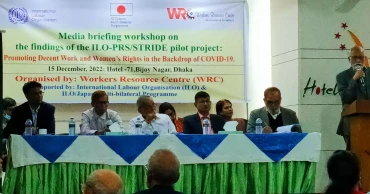
'Informal sector workers, women hit hardest during pandemic'
Speakers at a workshop Thursday said informal sector workers, mostly domestic workers, were the ones to lose their jobs first during the pandemic as no households allowed them to work over the fear of the spread of the virus.
Also, people working in the services sector, including construction and the ones working independently, lost their work opportunities due lockdown, they said.
The speakers made the observations at the workshop on "Promoting decent work and women's rights in the backdrop of Covid-19" which revealed the findings of a study on the job situation in the informal sector during the pandemic.
Read: Bangladesh to finish amending labour law by mid-2023, Law Minister tells ILO
The study report was conducted by the Workers Resource Centre (WRC), a labour rights organisation with the support of the International Labour Organisation (ILO) and Japan.
"Support from the government and others from social organisations did not reach these poor and most vulnerable groups. Also, they were deprived of relief support from their local authorities," the study said.
Read: Bangladesh considers labour rights related recommendations from US, EU, ILO with due importance: PM's Adviser
"Women workers had to suffer from more hardship and insecurities at the workplace than male workers during the pandemic. At that time, many incidents of violence and harassment were reported," it added.
Md Moslem Uddin Sadeque, consultant of the International Labour Organization (ILO), Shusuk Oyobe, programme manager of PRS, Gunjan D Dallakoti, ILO official, Saif Mohammad Moinul Islam, senior program officer at ILO Dhaka office, spoke at the programme.
3 years ago

Self-Funded Study Opportunity in France for International Students
The western European country France presents a unique mix of tradition, modernity, art, and culture. With world-renowned philosophers and artists gracing its lands, France has a history that dates back several thousand years.
Over the last few decades, France has established itself as a prestigious European hub for higher education in streams beyond art and literature. Whether it's engineering, life sciences, or world-renowned business degrees, the country has something for every aspirant.
In this article, we take a deep dive into higher studies in France. Let's take a look at whether France is a great study-abroad destination for international students including Bangladesh.
Read More: Best Countries for Bachelor's Degree in 2023
Why Study in France?
France hosts some of the highest numbers of international students in the entire European region. Currently, the country is home to 300,000 students from all over the world pursuing a degree in multilateral streams.
France offers a robust and dynamic culture that will enthrall many, whether it’s the picturesque prefectures or the fast-paced city life. Of the 71 accredited universities in France, 57 make it to the global top 1000 institutions for higher education. And the trend has been upward for several years now.
France also has some of the lowest tuition fees in all of Europe. As a result, it can also be a great opportunity for self-funded students, as most streams fall within an affordable limit. But that doesn’t mean there aren’t scholarship opportunities in France.
Read More: Study in Denmark: Costs, opportunities for international students
In this article, we’ll go over the application process, admission requirements, and the associated cost of studying in France as a self-funded student.
How to Apply for Higher Studies in France
Required Documents for Higher Studies in France
The documents required for application are standard and are in line with other European countries. If you are opting for bachelors, you should provide your LSAT scores based on the stream. The same goes for masters and MBA, which might require a GMAT or a GRE score.
These are circumstantial, and several institutes don’t even require them. However, there are a few key documents that you will need to prepare beforehand.
Read More: Study in Japan: Scholarships, Tuitions, Application Process for Bangladeshi Students
The required documents include –
-High School transcript certified by the appropriate authority ( For bachelors)-Bachelor’s transcripts certified by the issuing university (For masters and Ph.D.)-Campus France authorization-Passport-Language proficiency score (IELTS/TOEFL iBT/ DELF/DALF)-SOP-Letter of Recommendation-Application fee payment receipt.
Additional documents might be required, depending on the application process. For example, if you are opting for a thesis-based masters, you might want to contact a professor beforehand in your desired university with whom your research interest matches. In that case, you might need to prepare a research plan along with other documents.
Read More: Study in Belgium: Bachelor's, Masters and PhD options for Bangladeshi students
What Documents are Required for Campus France Authorization?
For non-EU citizens, the process of studying in France starts with obtaining a Campus France authorization. This essentially allows a prospective student to be eligible for “Etudes en France” or study in France.
Campus France authority even has a separate web portal where a prospect needs to register to obtain an authorization letter.
The required documents for the authorization include –
-Passport-Proof of funding for the studies and accommodation-Letter of application-Proof of accommodation-Medical insurance-Air ticket.
Read More: Cheapest countries for Bangladeshi students for higher studies
Once you’ve got all that, you’re all set for the Campus France authorization. It is to be noted that Campus France authorization isn't required for the application to the universities themselves. Rather it's required to get a student visa after acceptance into a French university.
Application Period
There are two main intakes on the French higher education curriculum – fall and spring. The fall intake generally has a deadline of September 15th of the previous year, with the classes expected to commence in the first week of January.
For the fall session, early enrolment can start as early as January 17th and last till April first based on the rolling admission process. Classes are expected to start in the first week of September.
Read More: SoP for Higher Studies: How to write an unfailing Statement of Purpose?
Application Process
The application process is pretty simple. Each French university has its application process, which you need to go through individually. The application process starts with selecting the desired major. Students can visit Campus France to explore all the different streams and majors available at the bachelors, masters, and P levels.
After that, check whether you meet the admission criteria and simply follow the guidelines to complete the application process.
Cost of Studying in France
As we already mentioned, the cost of higher studies in France is fairly reasonable. The cost can be broken down into three different types based on bachelors, masters, and Ph.D.
Read More: Student Loans in Bangladesh: Banks Offering Education Loans for Higher Studies
The cost of bachelors is actually pretty low at about 170 to 600 Euros per year. But that’s only limited to EU, EEA countries, and Switzerland. If you’re from anywhere other than these places, you would have to pay around 2700s euros or 288,035 BDT per year (1 EUR = 106 BDT).
The story is somewhat similar with masters too as the cost may run up to 3700 Euros or 394,714 BDT per year. The cost of a Ph.D. is fairly nominal at around 380 Euros or 40,538 BDT per year.
But these are estimates in public universities. If you opt for a private one, the cost might go as high as 20,000 Euros or 21,33,594 BDT per year.
Read More: Overcoming Study Gap: How to Start Studying after a Long Break
Living and Work Opportunities in France
The cost of living, however, is far greater than the students' tuition. The annual cost of living may range from 10,000 and 15,000 euros, depending on the cities. The price may even go up if the student resides in Paris. A Bangladeshi student should be able to afford around Tk106500 to 16,00,000 each year.
The French government requires the students to demonstrate their ability to pay for their study and remain in France without the aid of a job or scholarship. The amount is close to at least 1000 euros or Tk106500 per month.
In short, a student will roughly require 800 to 1000 Euros or Tk85,000 to 1,06,500 per month as living expenses depending on where they are staying.
Read More: Higher Study in China: Scholarship Opportunities for Bangladeshi Students
The work opportunities are also ample with high wages being available in big cities. Generally, a student can expect to make 7900 Euros or 842,769 BDT annually based on working hours. There are also many on-campus jobs available including GTA and GRA positions.
Final Words
France has been one of those countries that have been disseminating knowledge for centuries. Their rich culture, history, conspicuous mannerisms, globalization, and unique education system made France one of the best destinations in the world for higher studies.
So far we have discussed how to study in France from Bangladesh with self-funding. Whether France is a good study destination for international students depends on many factors. Overall, studying in France would be a wonderful opportunity for international students including Bangladesh. It will not only provide the students with global perspectives but also provide hands-on experience in problem-solving, critical thinking, and being a global citizen with an illustrative career.
Read More: Study in the Netherlands: Scholarship Opportunities for Bangladeshi Students
3 years ago