pharmaceutical companies
Govt to cap prices of 295 essential medicines to ease healthcare costs
The interim government on Thursday (January 08, 2026) decided to fix the prices of 295 essential medicines in Bangladesh, making it mandatory for all pharmaceutical companies to sell these drugs at government-determined rates.
The decision was taken at a meeting of the Council of Advisers, aimed at ensuring affordable access to medicines for the majority of the population.
“Prices of 295 essential medicines will be fixed by the government, and all companies will have to comply with these rates. The decision will be implemented very soon,” said Professor Dr Md Sayedur Rahman, Special Assistant to the Chief Adviser for the Ministry of Health and Family Welfare, while briefing reporters at the Foreign Service Academy after the meeting.
He said the list of essential medicines covers treatments for diseases affecting nearly 80 percent of the country’s population.
Read more: Rising medicine prices threaten healthcare for marginalised communities, warns study
“Once prices are fixed by the government, access to these medicines for a large segment of people will be ensured. This decision has been taken so that the cost of medicines does not become a barrier to healthcare for ordinary citizens,” Sayedur Rahman added.
Describing the move by the interim government as a landmark step, he said companies currently selling medicines at prices higher than the government-fixed rates will have to reduce their prices accordingly.
“Those selling at lower prices may continue to do so, or they can adjust to the government-fixed rates if they wish,” Dr Sayedur Rahman said.
Explaining the pricing mechanism for foreign pharmaceutical companies, he said the government will assess company proposals by considering purchasing power parity (PPP). Separate categories will be maintained for under-patent and off-patent medicines.
“A taskforce was formed which held discussions with all stakeholders involved in drug manufacturing and marketing. Initially, it will function as a Drug Price Authority and gradually evolve into a full-fledged authority. This will help remove existing barriers to access to medicines,” he added.
Dr Sayedur Rahman also said the government plans to establish a dedicated Drug Pricing Authority in the future, responsible solely for determining medicine prices. “Considering global market trends and all relevant factors, medicine prices in the local market will then be more rational.”
Read more: Availability of anti-hypertensive medicine at the grassroots level crucial to lower NCD risk
Addressing concerns about substandard medicines, he said there is no such thing as a ‘low-quality medicine’. “If a product lacks quality, it ceases to be a medicine and becomes a chemical substance. The government is fully committed to ensuring quality from every aspect.”
9 months ago
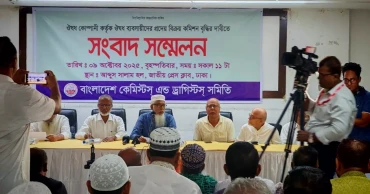
Chemists, druggists demand 25% commission hike from pharmaceutical companies
Bangladesh Chemists and Druggists Association (BCDA) has demanded that pharmaceutical companies increase the sales commission for drug retailers by 25 percent and warned of tougher programmes if their demand is not met within 15 days.
The association’s central executive committee came up with the demand at a press conference at the Jatiya Press Club in Dhaka on Thursday.
Reading out a written statement, BCDA President Moinul Haque Chowdhury said they have already held several meetings with the Bangladesh Association of Pharmaceutical Industries and the Directorate General of Drug Administration (DGDA) regarding the demand.
“We also staged human chains across the country on May 22, 2025 to press home our logical demand, but no effective measures have been taken yet,” he said.
Discounts on medicine, tests, checkup on bKash payment
Moinul said there are around five lakh drug traders in Bangladesh and they do not produce medicines themselves.
He further alleged that despite 85 years passing, the sales commission has not increased but rather decreased while neighboring countries like India and Pakistan offer commissions above 30% to their medicine retailers.
The BCDA president said, “During the Covid-19 crisis, medicine retailers risked their lives to serve patients when the entire nation was struggling. Yet, their contributions remain undervalued.”
He added that government fees and business expenses—including trade license renewal, drug license fees, pharmacy course costs, VAT, shop rent, pharmacist salary, and electricity bills—have all risen sharply.
“Given the soaring costs of living and doing business, continuing pharmacy operations under the current commission rate has become extremely difficult,” he said.
1 year ago
Perks for Prescriptions: A growing concern in Bangladesh
Pharmaceutical companies in Bangladesh increasingly influence medical prescriptions by offering incentives to doctors, raising ethical and medical concerns that largely go unchecked.
Sales representatives from pharmaceutical companies are often seen waiting outside clinics and hospitals, eager for a moment to speak with doctors. In many cases, they even monitor prescriptions as patients leave, taking photographs to ensure their drugs are being recommended.
Sirajul Rabi, a patient at a leading private hospital in Dhaka, experienced this first-hand. "As soon as I stepped out of the doctor’s office, I was surrounded by sales representatives. They bombarded me with questions, eager to know which medications had been prescribed. It happens every time I visit a doctor, whether in a private or government hospital. Medical representatives always ask for photos of the prescription. Once, a doctor even insisted that I purchase a specific brand of medicine from a particular company."
Dipa Kabir (not her real name), a resident of Dhaka's Dhanmondi area, faced a similar situation. Visiting a renowned private hospital for a cold-related issue, she was prescribed multiple medications, including an inhaler.
Suspicious of the extensive prescription, she consulted two other doctors, who assured her that only two of the prescribed medicines were necessary, while the inhaler was not required at all.
Despite some hospitals restricting the entry of pharmaceutical representatives, many still allow them access, exacerbating the problem.
Expert Opinions on Ethical Concerns
Medical professionals have expressed discomfort regarding the practice of prescribing medications in exchange for incentives.
Dr Gazi Nazrul Islam, Director of Ispahani Eye Hospital, acknowledged the issue but noted that hospitals could do little to prevent unethical practices by individual doctors.
"We do permit representatives from selected companies to enter, provided they carry identification. This allows doctors to stay informed about new medications, improving their knowledge. However, if this system is abused, it is unacceptable," he said.
No sale of antibiotics without prescription: Cabinet clears draft law
Many doctors, reluctant to speak publicly on the matter, admit that the practice has become deeply ingrained in the medical community. The fear of alienating colleagues who engage in such activities discourages open opposition.
Pharmaceutical marketing professionals, on the other hand, justify their actions by citing the pressures of the industry.
A medical promotion officer from an unnamed company shared, "We have strict monthly targets for prescriptions featuring our medicines. Meeting these targets is crucial for us to receive bonuses, as our basic salary is quite low."
He added that collecting photographs of prescriptions helps companies assess their market position against competitors and develop effective marketing strategies.
Unethical Practices in Medical Profession
Dr Shamsujjaman, former Professor of Microbiology at Dhaka Medical College, raised concerns about doctors prioritising incentives over patient health. "Doctors should prescribe only the necessary medications based on a patient's condition. Writing unnecessary prescriptions in exchange for gifts could endanger the patient’s health," he warned.
While acknowledging that pharmaceutical representatives provide valuable insights into new medications, he emphasised that any exchange involving gifts is unethical.
A senior professor, who requested anonymity, revealed that incentives extended beyond small gifts. "Some doctors receive expensive rewards, including cash, overseas trips, and even financial support for personal expenses such as wedding costs for their children. Despite official guidelines against such practices, they continue behind the scenes."
Regulatory Challenges
A former health secretary from the Directorate General of Health Services (DGHS) admitted that no specific law currently prohibits pharmaceutical companies from offering gifts to doctors. "While giving gifts is undoubtedly unethical, there is no concrete legal framework to prevent it."
Doctor admits to writing fake prescriptions for black market
He suggested that the Drug Authority, which licenses pharmaceutical companies, could play a key role in addressing the issue.
A former director of the Drug Administration echoed this sentiment, saying, "Although a law is supposed to be passed, it has not happened yet. Any regulatory measures should ideally come from the Bangladesh Medical & Dental Council (BMDC)."
Meanwhile, current Director of Drug Administration Dr Md Akter acknowledged the ongoing concerns but emphasised that regulation alone would not solve the problem. "There hasn't been any significant regulation yet. However, this practice must stop. Doctors should adhere to ethical principles. Awareness is more important than legislation."
Need for Reform
Despite growing awareness, the influence of pharmaceutical companies on medical prescriptions remains widespread.
Stop antibiotic sale without prescription: HC to govt
Patients are left uncertain about whether their prescribed medications are truly necessary or simply a result of industry incentives. Until stricter regulations and ethical commitments are enforced, the integrity of the healthcare system will continue to be questioned.
1 year ago
.jpg)
Bangladesh seeks US partnership in vaccine production
PM’s Adviser for Private Industry and Investment Salman F Rahman has sought the assistance from the US government to encourage their vaccine-producing companies to partner with capable pharmaceutical companies in Bangladesh.
Recalling the two countries’ close cooperation in combating Covid-19 since the early days of the pandemic, Adviser Rahman stressed scaling up of the global production of the Covid-19 vaccines and other pandemic management equipment to tackle the virus.
He also stated that Bangladesh is ready to make necessary investments for the capacity enhancement of pharmaceutical companies for such partnerships.
Adviser Rahman and Senior Official for Economic Growth, Energy, and the Environment of the US Department of State Ambassador Marcia Bernicat discussed ways to have stronger collaboration on Covid-19 front.
Bangladesh and the US have expressed willingness to work more closely to fight against the Covid-19 pandemic, including partnership, in vaccine production.
Read: Countries like Bangladesh need support for vaccine production: FM
5 years ago
.jpg)
Covid-19: Vaccines, tests, treatment should be patent-free
Oxfam has urged governments and pharmaceutical companies to guarantee that vaccines, tests, and treatments will be patent-free and equitably distributed to all nations and people.
The agency made the call on Thursday, ahead of the World Health Assembly next week. The virtual meeting on Monday will be attended by health ministers from 194 countries.
Vaccinating the poorest half of humanity – 3.7 billion people - could cost less than the 10 biggest pharmaceutical companies make in four months, Oxfam said on Thursday.
The Gates Foundation has estimated that the cost of procuring and delivering a safe and effective vaccine to the world’s poorest people is $25 billion.
Last year, the top ten pharmaceutical companies made $89 billion in profits – an average of just under $30 billion every four months.
Oxfam warned that rich countries and huge pharmaceutical companies – driven by national or private interests – could prevent or delay the vaccine from reaching vulnerable people, especially those living in developing countries.
The EU has proposed the voluntary pooling of patents for coronavirus vaccines, treatments, and tests in their draft resolution for the World Health Assembly.
If made mandatory and worldwide, this would ensure that all countries could produce, or import low cost versions, of any available vaccines, treatments, and tests.
Leaked Documents
Oxfam said leaked documents reveal that the Trump administration is trying to delete references to pooled patents and insert strong language on respecting the patents of the pharmaceutical industry.
This would give pharmaceutical companies exclusive rights to produce, and set prices for any vaccines, treatments and tests they develop – even if taxpayer money has been used to fund their research and development.
Jose Maria Vera, Oxfam International Interim Executive Director, said providing a vaccine to 3.7 billion people could cost less than what the ten biggest pharmaceutical companies make in four months.
Anything less than guaranteeing that a vaccine is made available free of charge to all people would be obscene.
“Vaccines, tests and treatments should be distributed according to need, not auctioned off to the highest bidder. We need safe, patent-free vaccines, treatments and tests that can be mass produced worldwide, and a clear and fair plan for how they will be distributed.”
Once vaccines or treatments are developed, there is also a high risk that rich and powerful governments will outbid poorer nations and force their way to the front of the queue, as they did in the scramble for other essential medical supplies such as personal protective equipment and oxygen.
In March, drug manufacturer Gilead moved to extend the monopoly on a potential treatment for the virus, and only withdrew it after a public outcry.
Gilead has now donated a significant portion of its current supply of remdesivir to the US government, but news reports suggest the company could make significant profits from subsequent production.
Some Wall Street analysts expect Gilead to charge more than $4,000 per patient for the drug, even though the cost of remdesivir can be as low as $9 per patient.
Poor Countries
Many poor countries are unable to access essential vaccines and medicines due to patent rules which give pharmaceutical companies monopoly rights and the power to set prices well above what they can afford.
Pneumonia is the biggest killer of children under the age of five, with 2,000 children dying every day. For over a decade, millions of children have not had access to patented pneumonia vaccines manufactured by Pfizer and GlaxoSmithKline due to its high cost.
After years of campaigning by Médecins San Frontieres, both companies reduced their prices in 2016, but only for the very poorest countries, leaving millions of children still without access to their vaccine.
Oxfam is proposing a four-point global plan that calls for:
a) Mandatory sharing of all Covid-19 related knowledge, data and intellectual property, and a commitment to make all public funding conditional on treatments or vaccines being made patent-free and accessible to all.
b) A commitment to deliver additional global vaccine manufacturing and distribution capacity with funding from rich country governments.
This means building factories in countries willing to share and investing now in the millions of additional health workers needed to deliver prevention, treatment, and care both now and in the future.
c) A globally agreed, equitable distribution plan with a locked-in fairness formula so that supply is based on need, not ability to pay.
Vaccines, treatments, and tests should be produced and supplied at the lowest cost possible to governments and agencies, ideally no more than $2 a dose for a vaccine, and provided free at the point of delivery to everyone that needs it.
d) A commitment to fix the broken system for the research and development of new medicines. The current system puts pharmaceutical profit above the health of people across the world meaning many needed put unprofitable medicines never get developed, and those that do are too often priced out of reach for the poorest countries and people.
Vera said, “Delivering an affordable vaccine for everyone will require unprecedented global cooperation. Governments must rip up the rulebook and prioritise the health of people everywhere, over the patents and profits of pharmaceutical corporations. Governments must ensure that no one is left behind.”
The Gates Foundation estimated the cost of producing and distributing a vaccine and has confirmed that this cost relates to the production and distribution in low and lower middle income countries only.
Oxfam believes that vaccines should ideally be produced and supplied for no more than $2 per dose.
This is a reasonable challenge to set given that new complex vaccines for big killers like pneumonia are already available for this price.
6 years ago