Bangladesh Economic Association
Politicians, bureaucrats unwilling to end corruption: Energy Adviser
Emphasising the need for good governance, Energy Adviser Muhammad Fouzul Kabir Khan said on Saturday that neither politicians nor bureaucrats in Bangladesh are truly committed to eradicating corruption.
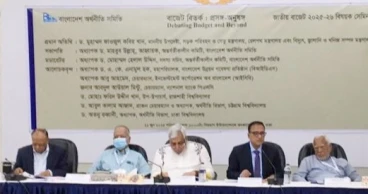
He made the remarks while speaking at a seminar on budget policy debate organised by the Bangladesh Economic Association (BEA) at CIRDAP Auditorium in Dhaka.
The seminar, presided over by BEA Convener Mahbub Ullah, brought together leading economists for an in-depth discussion on the national budget.
The Adviser highlighted the widespread wastage of resources, stressing the interim government's commitment to preventing such occurrences in the future. “Waste, corruption and inefficiency are major obstacles to Bangladesh's economic progress.”
Fouzul Kabir cited examples, such as the construction of a power plant six kilometres from its water source solely for the convenience of a minister, unnecessary road development and the mismanagement of state funds.
Regarding the interim government's mandate, Fouzul Kabir emphasised their aim to set a positive precedent for the future. "We want to leave behind an example where we do not appoint relatives or grant business favours," he said, underscoring a commitment to good governance.
Focusing on the power sector, he noted the growing reliance on imported LNG due to declining domestic gas reserves, which requires significant government subsidies.
To address this, he said, an initiative has been launched to install solar panels on all government buildings, with the electricity generated intended for the national grid.
He also pointed out the potential for the private sector to contribute at least 2,000MW of electricity by installing solar panels on rooftops.
Budget utilisation in social protection sees steady growth: Report
The seminar featured presentations on nine key budget issues by renowned experts. Sajjad Zahir, Executive Director of the Economic Research Group, underscored the importance of short and medium-term sustainable development, advocating for greater transparency in the government's domestic and foreign borrowing to address the budget deficit.
Md Gulzar Nabi, Research Director at Bangladesh Bank, expressed strong optimism for the medium and long-term stability of the country’s macroeconomy, citing Bangladesh's current GDP of $467 billion.
He highlighted self-sufficiency in food production, strong remittance inflows, and the significant contribution of the ready-made garment sector as key drivers.
Professor Saima Haque Bidisha, Pro-Vice-Chancellor and Professor of Economics at Dhaka University, said contractionary monetary and fiscal policies in certain budget sectors could hamper the creation of new jobs.
She also raised concerns about persistently high inflation and its potential to obstruct youth employment in the private sector.
Addressing the health sector, Professor Shafiun Nahin Shimul of Dhaka University's Institute of Health Economics drew on examples from Thailand, Sri Lanka, and the Philippines, urging a shift in perception from health budget as merely sectoral expenditure to a smart investment in human resource development.
He described the allocated 1.7 percent of GDP for health in the proposed budget as inadequate.
Chittagong Port should be run with domestic resources: GOC
On the education front, Zulfiqar Ali, Research Director at BIDS, emphasised the need for increased investment in science, technology, and technical education to bridge the existing gap between the education and employment sectors.
Referring to India, Nepal and Malaysia, he noted with concern the declining trend in education budget allocations in Bangladesh and called for more funds for teachers and educational resources.
He also expressed disappointment at the government’s ‘failure’ to establish an education commission.
Dr Munshi Sulaiman, Research Director at the BRAC Institute of Governance and Development (BIGD), criticised the insufficient allocation for the social safety net in the budget, particularly in relation to poverty alleviation and income inequality.
He proposed implementing productive social safety net programmes supported by modern technologies.
Professor Sharmind Nilormi of Jahangirnagar University's Economics Department pointed out a reduction in budget allocation for women's safety, workplaces and access to government services, suggesting that even a token allocation would have been appropriate.
Kazi Iqbal, Research Director of the Industrial Division at BIDS, criticised the national industrial policy for failing to reflect global trends of deglobalisation and the growing inclination of global economic powers towards domestic industrialisation.
He argued that tariff reduction without specific targets and long-term strategies for export-oriented industries would be ineffective.
Professor Rashed Al Mahmud Titumir of Dhaka University's Department of Development Studies characterised the national budget as a product of political struggle and advocated for the re-establishment of public ownership over public funds.
Abdul Awal Mintoo, Chairman of National Bank PLC, highlighted the destructive subculture of vested interests capturing and exploiting constitutional, social, and economic institutions.
He stressed the political nature of the budget and warned that investment growth would be unachievable without meeting key preconditions, particularly in light of the tightened monetary policy.
Leading researchers, economists and policy analysts attended the event.
1 year ago

Bangladesh Economic Association proposes 70 percent tax on cigarettes, tobacco
The Bangladesh Economic Association (BEA) has proposed a 70 percent tax on all types of cigarettes and tobacco in the next budget.
The association reckons that doing so will reduce smoking by about 66 percent, alongside generating revenue of Tk1,700 crore for state coffers.
The proposal was submitted to the National Board of Revenue (NBR) during the pre-budget discussion held at the NBR Building on Sunday (February 18).
The General Secretary of the BEA Professor Dr. Md. Aynul Islam presented the budget proposal. Vice President of the association Professor Hannana Begum was present.
Read more: Govt cut VAT, duty on import of 4 essential items ahead of Ramadan
According to the BEA's proposal, imposing a single supplementary duty of 70 percent on all types of cigarettes would increase the price of cigarettes by an average of 130 percent.
Smoking will be reduced by 66 percent. About 70 lakh smokers will quit smoking, and about 71 lakh young people will stop habituating to smoking. Also, the additional tax revenue of the government will be earned at least Tk1700 crores, the proposal stated.
Similarly, the BEA demanded to impose a tax of 70 percent on all types of tobacco products including smokeless tobacco such as jorda, gul, sadapata, etc.
On the other hand, in the case of bidi, if the tax is imposed at the rate of Tk 4.90 on the retail price of every 25 shalak (piece) packet, the government will be able to collect additional revenue of Tk 800 crore.
Read more: ICMAB delegation takes part in pre-budget discussion with NBR
The BEA thinks with such a tax increase; revenue earning will be raised and it would help to revive the economy from the ongoing economic crisis. The BEA has a total of 27 new sources of revenue income.
At this time, Prof Aynul said, as a method of gathering resources for the upcoming budget, no pressure can be applied on the general population, such as the poor, lower class, lower middle class, and middle class.
Due to various reasons, this class of people is now in a severe economic crisis. It would be unfair at this moment to rely completely on them as in the past for tax collection.
In that case, the imposition of additional income tax on these three groups – the super-rich, the rich, and the upper-middle class – can be considered, said Prof Aynul.
Read more: PROGGA, ATMA for imposing specific taxes on tobacco products
2 years ago

Economists emphasise agro-based infrastructure
Three of the country's leading economists urged to put emphasis on agro-based industrialization in the wake of the global economic downturn and coronavirus epidemic.
They made the call while participating in a web seminar titled 'Industrialization: In Search of a Decent Bangladesh' organized by the Bangladesh Economic Association on Saturday afternoon.
The economists participating in the seminar were: Dr Kazi Khaliquzzaman, Chairman of PKSF Palli Karma Sahayak Foundation and Dhaka School of Economics, Dr. Shafique uz Zaman, former chairman of the Department of Economics at Dhaka University and Prof M Moazzem Hossain Khan, former chairman of economics department of Rajshahi University.
The sixth part of the 13-part discussion session was held on the theme of Professor Abul Barakat's recently published research book 'Socio-Economy-State on the big screen: In search of a better Bangladesh from the catastrophe of the virus'.
Also read: Speakers for tapping potential for FDI in agro processing, light engineering, blue economy, education sectors
Dr Kazi Khaliquzzaman said that, "I agree with what Abul Barakat has said in his book that everyone will have equal ownership of natural resources. We need to go back to agro-based industrialization to maintain the balance of nature to avoid the adverse effects of climate change. ”
Referring to the benefits of agro-based industrialization, Professor Shafiq-uz Zaman said, “It will increase the prices of agricultural products. Farmers will get more money. Farmers' purchasing power will increase. We have to remember that farmers are both producers and buyers of industrial products. ”
He also added, “High growth and employment do not go together. We have to think about how to increase production without cutting workers. We need to expand the internal market, create diversified agricultural products and increase investment in agricultural research.”
Referring to Professor Abul Barakat as an 'unconventional economist', Moazzem Hossain Khan said, "He termed the current industrialisation in the country as catastrophic and recommended 15 solutions to get out of it."
5 years ago

Proposed budget hardly prioritises pvt sector: Economists
The private sector, affected during the COVID-19 induced shutdown, did not get priority for sustainable recovery in the proposed budget, economists say.
6 years ago