Dr Hossain Zillur Rahman
Not emotion-driven politics, Bangladesh needs evidence-based constructive civic engagement: Webinar
Power and Participation Research Centre (PPRC) Chair Dr Hossain Zillur Rahman on Saturday said Bangladesh’s civic discourse must move beyond emotion-driven politics toward careful, evidence-based analysis and constructive public engagement.
Speaking at the PPRC’s flagship webinar series ‘Ajker Agenda’, he warned against an entrenched “tag culture,” where political opponents are labeled for cynical purposes, noting that such practices continue to poison public life and obstruct honest assessments of governance and policy performance.
Reflecting on the broader national context, the economist and social thinker said if their elected government succeeds, that is ultimately good for all of them as citizens.
“We must learn from the mistakes of the past while taking responsibility for improving the present. Building consensus within society cannot be the responsibility of the state alone,” he said, noting that civic and business actors have to bring evidence-based accountability pressures on the government while strengthening national unity through credible public discourse.
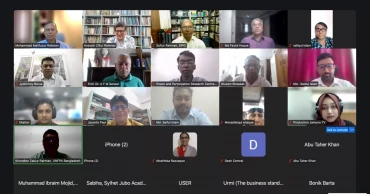
Policy analysts, legal experts, private sector leaders, security and geopolitical strategists came together to examine the early governance signals and medium-term implications of the new administration at the event titled “3 Months of the New Government: A Preliminary Review.”
The session was moderated by PPRC Chair Hossain Zillur Rahman and included panelists Bangladesh Supreme Court advocate Jyotirmoy Barua, former President of Bangladesh Knitwear Manufacturers and Exporters Association (BKMEA) Fazlul Haque, Chairman of Osmani Center for Peace and Security Studies Lieutenant General (Retired) Dr Mohammad Mahfuzur Rahman and former Ambassador Sufiur Rahman.
Stronger Policy Direction
While participants acknowledged the difficult context in which the government assumed office, they also emphasised the importance of moving beyond blame politics toward practical reforms, institutional accountability, meritocracy, and stronger policy direction in the coming months.
Focusing on the institutional dimension of governance, Barrister Jyotirmoy Barua spoke on institutional reform, politicisation within state institutions, and the continued weaknesses in administrative and judicial culture.
“The key question for these three months is whether we have moved away from the politicization of institutions. Progress has not so far been visible. Civil administration appointments have signaled old patterns and police morale remains to recover fully. Mob violence and weak law and order continue to be serious concerns,” he said.
Former BKMEA President Fazlul Haque said the government has had to absorb the failures of the interim administration, while also confronting the added pressure of the Middle East crisis.
He stressed that with private sector credit at its lowest level, exports declining, and an investment-friendly environment yet to be fully established, Bangladesh urgently needs a bold contractionary budget and decisive measures to capitalize on the country’s $800 billion garments market opportunity.
“The effects of the war are not limited to rising oil prices alone. Multiple markets and the tourism sector have also been affected, leading to significant cost-cutting at the consumer level. As a result, we are gradually losing market share of our products as well,” he said, adding that the impact of the war has therefore been multilayered and has added considerable pressure on the government from the very beginning.
Bangladesh’s Strategic Environment
Chairman of Osmani Center for Peace and Security Studies Lieutenant General (Retired) Dr Mohammad Mahfuzur Rahman said with the shifting regional landscape marked by intensifying great power rivalry, Bangladesh’s strategic environment is increasingly shaped by forces that are no longer distant but directly embedded in its immediate neighborhood.
He talked about competing influences from India and China, a deepening US presence in the Bay of Bengal, and the growing securitisation of shared resources such as water are compounding national anxieties, alongside the unresolved Rohingya crisis and uneven patterns of international burden-sharing.
“Bangladesh must master the art of adversarial cooperation with meritocracy, balancing ambiguous relationships across the India-US-Bangladesh and China-Pakistan-Bangladesh axes to survive and secure its interests,” Mahfuzur said.
Participants noted that while the change of government generated public hope, visible progress on institutional depoliticization, law and order reform, investment climate improvement, and strategic geopolitical positioning remains uneven.
The challenge of inherited structural burdens - fiscal, institutional, and diplomatic - was acknowledged, but panelists stressed these cannot indefinitely serve as justification for delayed action.
Former Ambassador Sufiur Rahman emphasised that national unity is essential for strengthening Bangladesh’s position in both multilateral and bilateral negotiations and cautioned against the tendency to dismiss all previous initiatives solely for political reasons.
He noted that deeper engagement with ASEAN remains strategically important for long-term economic and diplomatic gains, while also cautioning that China’s regional dominance continues to be a critical factor shaping the country’s policy space.
Sufiur argued that meaningful progress requires recognizing valuable past experiences and building upon them where necessary.
3 months ago

Govt forms taskforce to review BBS data quality
The government has constituted an eight-member expert taskforce to assess the quality, transparency and accessibility of statistics produced by the Bangladesh Bureau of Statistics (BBS).
Chaired by Dr Hossain Zillur Rahman, Executive Chairman of the Power and Participation Research Centre (PPRC), the taskforce will consult relevant stakeholders to devise specific, actionable recommendations aimed at strengthening the institution.
The other members are: Former Director General of the Bangladesh Bureau of Statistics Dr. Mohammad Abdul Wazed, Executive Director of the Center for Policy Dialogue (CPD) Dr. Fahmida Khatun, Chairman of the Research and Policy Integration for Development (RAPID) Dr. Mohammad Abdur Razzak, Professor of the ISRT of Dhaka University and President of the Bangladesh Statistical Association Dr. Syed Shahadat Hossain, Professor of the Department of Population Sciences of Dhaka University Dr. Mohammad Moinul Islam, Professor of the Department of Economics of University of Dhaka Dr. Atanu Rabbani And Research Director of Bangladesh Institute of Development Studies (BIDS) Dr. Mohammad Yunus.
The taskforce will formulate recommendations on the quality, accounting system and transparency of all statistical activities of the BBS.
Inflation increases slightly in March as non-food prices rise: BBS
It will review the following issues in order to establish the survey management of the Bangladesh Bureau of Statistics on specific work rules:
a. To establish a core survey list, the cost of which will be covered from the revenue sector;
b. To formulate mandatory periodicity and pre-determined release calendar for these surveys;
c. To determine the process for forming an advisory committee with national-level experts on relevant subjects in conducting various surveys, preparing accounts of national income and inflation, etc.;
d. To entrust the head of the institution with the authority to publish regular reports on the results of various surveys, especially inflation and national income growth, etc.
The taskforce will formulate recommendations for coordinating and harmonising the surveys and publications of BBS with the surveys and statistical publications conducted by various organisations under other ministries.
It will formulate recommendations to systematically facilitate citizens' access to the statistical repository produced by the Bangladesh Bureau of Statistics in order to transform statistics into a Public Good.
Inflation drops to 9.32pc in February: BBS
It will also Review the draft prepared for the amendment of the Statistics Act, 2013, review the existing organisational structure and human resources of the Bangladesh Bureau of Statistics and formulate recommendations to upgrade the institution to a strong and effective national statistical agency.
The taskforce will submit a full report to the Planning Advisor within 90 days. The taskforce chairman will inform the Advisor about the progress of the work from time to time.
The Statistics and Information Management Division will provide the necessary secretarial and infrastructural support to the taskforce in the performance of the described work.
1 year ago
.jpg)
'Internal migrants need same policy attention as international migrants'
The internal migrants now need to have the same policy attention as international migrants, said Dr Hossain Zillur Rahman, former adviser to the caretaker government, Wednesday.
Before the pandemic expenditure growth was very strong across all household groups. The share of food in the expenditure bundle was decreasing, while the share of non-food items was increasing rapidly. These trends reversed during the pandemic, Dr C Rashaad Shabab, senior lecturer at the Department of Economics, the University of Sussex Business School, said.
However, internal migrant households were best able to protect expenditure from adverse shocks. The expenditure of non-migrant households was the worst affected by adverse shocks during this period, he added.
By 2020, the poverty rate among internal migrant households is very similar to non-migrant households. Thus migration has reduced inequality through social mobility.
"Migration, especially internal migration, appears to enable households to protect expenditure against shortfalls and to prevent them from falling into poverty. It enhances social mobility and so is an important tool to reduce inequalities," Rashaad said.
"Compared to 2017, the volume of remittance fell by 8 percent per household in nominal terms in 2020. When 5 percent inflation per year is added then the reduction in remittance in real terms is at 23 percent," said Refugee and Migratory Movements Research Unit Chairperson Professor Tasneem Siddiqui.
The amount of remittances sent by female migrants increased by 16 percent in nominal terms, in real terms it reduced by 1.6 percent.
Female internal and international migrants come from more disadvantaged backgrounds. They are more likely to be widowed and divorced and more likely to have lower levels of education, said Professor Tasneem.
The experts were addressing the workshop "Impact of Migration on Transformation to Sustainability: Poverty and Development in Bangladesh" at a Dhaka hotel Wednesday.
RMMRU presented the findings of a long-running panel survey of over 6,000 households, spanning 20 districts of Bangladesh, at the event.
Md Shahidul Haque, former foreign secretary, commended the research for bringing internal migration so strongly to the policy arena for the first time.
The research compared the economic sustainability of internal migrant, international migrant and non-migrant households. It found that among these groups internal migrant households are best able to protect expenditure against adverse climate and health shocks.
4 years ago

Dr Hossain Zillur Rahman’s mother passes away
Zohura Begum, Ratnagarbha mother of academic, economist and policy maker Dr Hossain Zillur Rahman, passed away early Wednesday. He was 87.
6 years ago