fundamental rights
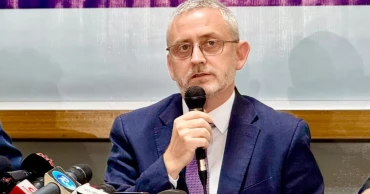
‘Your prosperity is our prosperity; your stability is also ours’: Ambassador Miller
Ambassador and Head of Delegation of the European Union to Bangladesh Michael Miller on Monday said they need to deepen and widen the partnership with Bangladesh and for them the relationship is a strategic choice with respect for fundamental rights and the creation of economic opportunity.
“And in saying this, I spoke about the fact that your prosperity is our prosperity, but your stability is also our stability. This is a highly interconnected world in which we live. So it's a partnership we are building,” he said while speaking at the “DCAB Talk” held at Jatiya Press Club.
Diplomatic Correspondents Association, Bangladesh (DCAB) hosted the event where DCAB President AKM Moinuddin and General Secretary Md Arifuzzaman Mamun also spoke.
Ambassador Miller said they are far and above partnering with countries which are in the process of developing because they believe that “your prosperity is our prosperity, too.”
Noting that the world is an unstable place, the Ambassador said they are in the business of looking for partners everywhere, including in Bangladesh, for sharing the leadership on issues including on climate change.
“I find this presents a moment of opportunity for the European Union to deepen and widen its partnership with Bangladesh,” he said.
EU wants fair polls, says election timing an issue for Bangladesh to decide
“We look to our partners, including here in Dhaka, to speak up vocally alongside us in defense of rules that protect us all. We are still building bridges with those who like us care about fair and rules-based trade as the basis for the creation of wealth and jobs for our citizens,” he mentioned.
Sitting here as an observer eight months into his job, the Ambassador said Bangladesh’s political transition is a unique opportunity for the country to underpin respect for fundamental rights in Bangladesh to restore democracy and to let civil society breathe. “And in civil society, I include the media, of course.”
The Ambassador said they are working on port safety with Bangladesh and on maritime security as well. “But given the level of insecurity in this world, we want to also see military to military cooperation between the EU military staff and the military here in Bangladesh.”
He said they are working also on countering terrorism and countering violent extremism across the region, and that is equally an important area for them to continue to cooperate upon.
On migration issues, he said they support safe, dignified and regular migration but unfortunately, migration can be irregular, undignified and extremely dangerous.
“We prefer to look for legal pathways for migration, even if this is on a small scale, because what happens currently, regrettably, is that poor migrants try to reach Europe with a dream of prosperity, which we can all understand. But they are, in fact, exploited by traffickers and smugglers along the way, and they even lose their lives,” he said.
And this is something that they need to put order into, said the Ambassador, adding that it is a shared interest.
“I think, between the EU and Bangladesh, informing migrants about the risks or about the opportunities, is something that is extremely important to us,” he said.
Ambassador Miller said they will continue to work towards ensuring a smooth graduation from LDC status for Bangladesh.
UAE expedites visa Issuance for Bangladeshis following talks
“You need a more complex value chain, in our view where you are building wealth for your citizens who are very talented individuals. We are, in return, expecting a level playing field for our trade and our investment,” he said, adding that Bangladesh needs to open up its economy in sectors where the private sector can bring world class technology.
The Ambassador said they do want to see greater trade and investment between the EU and Bangladesh going in those directions.
1 year ago

Israeli surveillance tools: TIB says without policies such move violates fundamental rights
Transparency International Bangladesh (TIB) on Thursday expressed its concern over an international media report on the Bangladesh government's purchase of highly controversial surveillance technology from Israel.
In the absence of specific policies, the use of such technology will pose a serious risk of undermining several fundamental constitutional rights, the graft watchdog body said in a statement on Thursday.
Read more: Govt on track to introduce ‘lawful interception system’ to monitor social media, thwart anti-state activities: Home Minister tells JS
People have the right to know the answer to the fundamental question that such a terrible tool was bought with public tax money according to which specific law and policy, for what purpose, in what context, in whose interest it will be used, it said.
According to a report by the Israeli media Haaretz, Bangladesh bought surveillance technology from a company run by a former Israeli intelligence commander, which arrived here in June last year.
In this regard, TIB Executive Director Iftekharuzzaman said people have the right to know the government's precise explanation regarding the purchase and use of technology that undermines the privacy, security, freedom of speech and expression of people's personal information and communications and, above all, threatens the lives and livelihoods of individuals.
“Nothing was purchased directly from Israel’ -- the government's interpretation does not mean that this Israeli technology was not imported,” he said.
The published news clearly mentions that the purchase was made through intermediaries in Cyprus at a cost of around Tk 60 crore due to the lack of diplomatic relations between Israel and Bangladesh, he added.
The National Telecommunication Monitoring Centre (NTMC) commander and other senior officials even visited Greece in 2021 and 2022 to learn how to operate this technology, Iftekharuzzaman said, referring to the Israeli media report.
Read more: Critical information infrastructure list is questionable: TIB
“If this information is false, it is the responsibility of the authorities concerned and the government to prove it. After all, there is no room for doubt that this technology has already reached the relevant agencies of the government.”
“There is no option to use this technology until a concrete policy involving all parties is formulated to ensure the constitutional rights of individuals. If not, Bangladesh will be considered as a completely surveillance-based state by trampling public interest,” he said.
3 years ago

New technologies must serve, not hinder, right to peaceful protest: UN
Michelle Bachelet on Thursday called on States and businesses to ensure that new technologies, including facial recognition and so-called ‘less-lethal weapons,’ are developed and used in ways that do not disrupt and prevent people’s ability to exercise their fundamental rights to peaceful assembly and expression, and their right to participate in public affairs.
6 years ago