Brahmaputra River
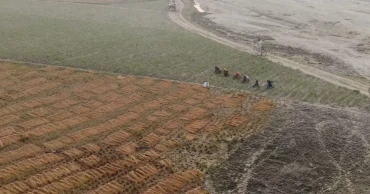
Silt-borne fertility transforms northern Bangladesh
As floodwaters receded across northern Bangladesh, the newly deposited silt has turned the sandy river islands of the Teesta, Dharla, Saniyazan and Brahmaputra—known locally as chars—into fertile land, sparking a surge in cultivation.
According to the Department of Agricultural Extension, the northern rivers contain nearly 786 char areas and communities living there have begun to rebuild their livelihoods following the recent floods.
Agriculturist Sirajul Islam, Additional Director of the Rangpur agricultural region, says this year’s cultivation target for the chars has been set at 36,911 hectares, with an expected output of 362,000 tonnes of various crops.
“Char residents are likely to recover through this year’s harvest. A single crop can sustain many families for an entire year,” he explains.
A Season of Intense Activity
Across the Teesta’s char zones in Lalmonirhat, Rangpur, Kurigram, Gaibandha and Nilphamari, farmers are working round the clock, Sirajul Islam said.
Read more: Overuse of chemical fertilisers threatens soil health in northern Bangladesh
Large tracts have already been planted with potatoes, aubergines, chillies, onions, ginger, garlic, beans, coriander, carrots, cabbages, radishes, gourds, wheat, sesame, linseed, mustard and maize, he said.
Growers say they anticipate good yields from almost all varieties this season.
In Ichli char of Gangachara, Rangpur, farmer Hossain Mia has planted potatoes on three bighas of land, aubergines on another three bighas and coriander on 20 decimals.
“If the yields are satisfactory, I expect to earn around Tk 1.5 lakh after covering costs,” he said.
Local growers Habibur, Rahim and Khairul echo similar expectations, noting that each of them could make Tk 60,000 to Tk 70,000 in profit if the season is favourable.
Storage and Market Access Remain Major Obstacles
Abdullah Al Hadi, Chairman of Lakshmitari Union Parishad, describes the Teesta’s chars as a “growing agricultural zone”, with fresh produce already reaching local markets.
Many more farmers have begun cultivating again.
Read more: Sand syndicates tighten grip on Bangladesh's northern region
He, however, highlights a persistent challenge: the lack of storage, processing facilities and proper market access.
“This is the biggest frustration for char farmers. Without cold storage, transportation and processing facilities, they are deprived of fair profits,” he said.
He believes the region requires two to three cold storages, while Gangachara currently has only one. Poor connectivity also prevents farmers from transporting goods easily to nearby markets.
Power of Nutrient-Rich Silt
Agriculture officer Tushar Kanti explains that the silt deposited on the Teesta’s chars has made the soil exceptionally fertile.
Many crops are flourishing even without chemical fertilisers. Maize, wheat, potatoes, chillies, onions, garlic, mustard, sesame, linseed and a wide range of vegetables are being grown in abundance, he said.
Read more: Hidden hands in the fields: Dealers blamed for artificial fertiliser shortage in north
Dr Tuhin Wadud, Professor at Begum Rokeya University and a long-time researcher on char lands, says that the post-flood silt left behind on these islands is “extremely fertile”.
As a result, he said, farmers in the region often witness bumper harvests following floods. But he points out that limited transport links continue to hinder farmers from securing fair prices.
He believes dredging the Teesta and other major rivers could bring long-term benefits: “If the rivers were properly excavated, more char lands would emerge, offering northern communities significant economic opportunities.”
Prospects Worth Tk 200 Crore
Agricultural officials estimate that crops from more than 786 char areas across eight northern districts could generate Tk 200 crore in revenue this season.
Field officers from the agricultural department are providing technical assistance and financial incentives, and officials say support has already been extended to char farmers affected by the floods.
Read more: Polyshade tomato farming reviving Narail’s rural economy
9 months ago
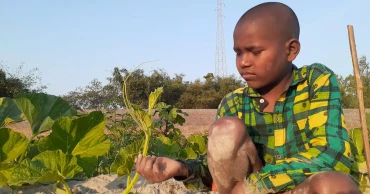
Kurigram’s Char Children: Dreaming through dust, erosion and everyday struggle
Scattered like green islands across the shifting waters of the Brahmaputra, Kurigram’s chars are places of both breathtaking beauty and heartbreaking neglect.
These remote sandbars—isolated, unstable and often invisible on development maps—are home to lives shaped by river erosion, poverty, and sheer resilience.
Here, every morning is a challenge. For the families who call these chars home, dawn does not signal a fresh start—it begins another chapter of survival.
For children growing up in these forgotten lands, childhood is not a time for dreams but for duty.
With hunger pressing and families stretched thin, little hands grasp hoes before they hold pencils.
At the break of day, tiny feet rush across muddy fields—not to schoolyards but to farmland.
They plough the soil, irrigate crops, or work side by side with adults harvesting paddy.
“They start early,” said farmer Taher Ali of Char Shoulmari. “Many work with their fathers, plowing or irrigating, while some help harvest rice.”
These children grow up not just near the land, but with it. By the time they’re barely into their teens, they’ve mastered the movements of farming: mounding soil around potatoes, harvesting rice with speed and precision. Their bond with the earth is intimate, born of necessity, grounded in survival.
Shyamal Polli Slum Fire: Dwellers watch their dreams turn into ashes
In a world where textbooks are a luxury, education becomes a rare privilege.
“My son is in Class Four,” said Selina Khatun of Kodalkati Char, “but if he doesn’t work, we won’t have food.”
School, for many, is a fragile dream—often extinguished too soon.Some carry schoolbags in the morning and farm tools in the afternoon. Others drop out entirely, crushed under the weight of responsibilities far beyond their years.
Girls often shoulder an even heavier burden. They care for siblings, cook, clean, fetch water—tasks that fill their daylight hours and steal their right to learn or play.
Yet even here, amid hardship, joy finds a way.
In the soft glow of evening, the charlands echo with the thud of a football, the shout of a goal.
A dozen boys gather barefoot in the sand—torn sandals, tattered clothes, no coaches, no gear. What they lack in equipment, they make up for in passion.
“Some boys from our chars now play football at the district level,” said Shariful Islam, a volunteer from Char Jatrapur.
Their determination is a silent protest against the poverty they were born into, against the indifference they endure.
Weaving Dreams: A Jamdani artisan’s tale of passion and perseverance in Chandpur
1 year ago

Flood situation in Netrokona’s low-lying areas may improve in 24 hours: FFWC
Flood Forecasting and Warning Centre (FFWC) predicted that the flood situation in low-lying areas of Netrokona districts may improve in 24 hours.
FFWC, in its regular bulletin, said Brahmaputra River remains unchanged but Jamuna river water is in a rising trend, which may continue in 24 hours starting from 9 am on Thursday (July 06, 2023).
Read: Rise in Teesta water may cause short-term flood in Lalmonirhat, Nilphamari in 24 hours: FFWC warns
Water in the Ganga-Padma Rivers is in a rising trend, which may continue in 72hours, it reads.
Besides, major rivers in the northeastern region of the country are in a falling trend except Khowai, Monu and Dhalai, which may continue in 48 hours, the bulletin said.
Read more: Better flood management: China offers assistance for dredging rivers in Bangladesh
3 years ago

BCL leader’s body recovered from Brahmaputra River
Police recovered the body of a Bangladesh Chhatra League (BCL) leader from Brahmaputra river in Kochandhara area of Jamalpur Sadar upazila on Saturday morning.
The deceased was identified as Zahid Faisal Fahim, 25, BCL vice-president of Nandina wing and resident of Kanil village of the upazila.
According to police, Fahim went on a boat trip to Narundi Kochandhara area of Brahmaputra with three friends on Thursday afternoon. On their way back the boat capsized. Though others managed to swim ashore, Fahim drowned.
On information, Jamalpur Fire Service divers started a rescue operation on Thursday evening. Till Friday night they were not able to recover his body.
Read: Engineer killed in Dinajpur road crash
On Saturday morning, locals spotted his body floating in the river and informed the police.
Officer-in-charge (OC) of Jamalpur Sadar Police, Kazi Shah Newaz, said Fahim's body was recovered from Brahmaputra river on Saturday morning and an unnatural death case was registered.
The family had no complaints, so the body was handed over to them without an autopsy, he said.
4 years ago

India ferry tragedy: One dead, two missing, 87 rescued
Indian authorities on Thursday stepped up rescue operations to look for survivors in Wednesday's ferry tragedy in the Brahmaputra river in the northeastern state of Assam.
The Indian Army has been called out to help in the rescue operations. So far, 87 people have been rescued, but one person has died and two others are still missing, officials said.
The accident occurred on Wednesday evening when a single-motor passenger boat, carrying 90 people, collided with a government ferry in the Brahmaputra near Nimati Ghat in Jorhat district, 350km from Assam's capital Guwahati, and capsized.
Read: 60 'missing' in India ferry accident
"Over 200 people were on board both the boats. While those on the government ferry had a narrow escape, the single-motor boat with 90 people on board capsized after the collision," a disaster management official told the media.
"Some 87 people have been rescued so far. One woman has died while two others are still missing. The Indian Army is looking for survivors," he added.
Indian Prime Minister Narendra Modi took to Twitter to say that "all possible efforts are being made to rescue the passengers".
"Saddened by the boat accident in Assam. All possible efforts are being made to rescue the passengers. I pray for everyone’s safety and well-being," the PM tweeted.
Read: Another Indian Oxygen Express arrives with 200 MT of medical oxygen
Assam Chief Minister Himanta Biswa Sarma, meanwhile, directed officials to act against all single-motor boats that often carry passengers beyond their seating capacity. "I am pained at the tragic boat accident near Nimati Ghat, Jorhat."
A probe has been ordered into the accident, the disaster management official said.
5 years ago

15,520 hectares of croplands inundated in Kurigram
About 15,520 hectares of cropland have gone underwater in Kurigram district till Monday morning as the water level in the rivers has started rising again.
The water level in Dharla river has increased by 10 cm and in Brahmaputra river by 5 cm in the last 24 hours.
Read: Flood in Kurigram getting worse
Kurigram Water Development Board Executive Engineer Md Ariful Islam said water level in the Dharla River has risen to 34 cm above the danger level and 23 cm in the Brahmaputra river’s Chilmari Point on Monday morning. However, increased water has reduced erosion.
The low-lying areas and sandbars of the district have gone under water.
Till Monday, 15,520 hectares of crops have been submerged in the district. Of these, Aman is planted 15,115 hectares, vegetables are 270 hectares and seedbed is 95 hectares.
5 years ago
.jpg)
Mymensingh to get a modern bridge over Brahmaputra
The Executive Committee of National Economic Council (Ecnec) on Tuesday cleared eight projects, including a Tk 3,263.63-crore one to construct Kewatkhali Bridge over the Brahmaputra River in Mymensingh.
The approval came from the weekly Ecnec meeting held with Ecnec Chairperson and Prime Minister Sheikh Hasina in the chair.
The PM joined the meeting virtually from her official residence Ganobhaban, while others from the NEC conference room of the Planning Commission.
Read: Govt to spend Tk 4,167cr on 10 projects, Ecnec gives nod
“Today, the meeting approved eight projects with the overall estimated cost of Tk 5,441.63 crore (only additional cost of a revised project was counted here),” said Planning Minister MA Mannan while briefing reporters after the meeting.
Of the cost, Tk 3,332.72 will come from the public coffer while Tk 2,060.98 crore from foreign sources as loans and the rest Tk 47.93 crore from the own fund of an organisation concerned, he said.
The Kewatkhali steel arch bridge will be constructed by June, 2025 in order to establish improved road connectivity of Sherpur and Netrakona with the Mymensingh headquarters and the national capital.
The main project operations include construction of a 2093-meter bridge foundation and substructure, 320-meter steel arch bridge superstructure, 1773-meter concrete bridge and construction of culverts, construction of a toll plaza, and 33.02 hectares of land acquisition and rehabilitation.
Under the project, an overpass and 6.2-lm four-lane approach roads will be constructed alongside the main bridge.
The planning minister said there would be four-lane approach roads on both sides of the bridge to be constructed with the latest technology.
In reply to a question, Member (Physical Infrastructure Division) of the Planning Commission Mamun Al Rashid said that it would be the first steel arch bridge unlike other steel bridges in Bangladesh.
“There’ll be no pillar under the main structure of the bridge so that the river navigation is not hampered,” he said.
Read: Ecnec rejects Tk 17,290-cr primary school meal project
Out of the project cost, Tk 1,353.83 crore will come from government funds, while Tk 1,909.79 crore as project assistance from the Asian Infrastructure Investment Bank (AIIB).
At the meeting, the Prime Minister directed the authorities concerned to construct an increased number of culverts in the flood-prone areas so that the usual water flow is not hindered, said MA Mannan.
She stressed the need for modernizing and improving the operation of the bio-gas plants.
Hasina put emphasis on the export of agricultural products maintaining the international standards of the goods, Mannan added.
Referring to the approval of a project designed to transform the plant quarantine laboratory to an international standard one at the central packing house with Tk 156.36 crore, State Minister Planning Dr Shamsul Alam said the export volume of agricultural products of Bangladesh is now hovering over US$ 1 billion.
So, the project has been undertaken to modernise the laboratory with the use of the latest technology and equipment in order to boost agricultural goods export.
The five other new projects are Capacity Enhancement of existing Grid Substation and Transmission Line with an estimated cost of Tk 774.86 crore; Development of Madarganj-Koira-Monsurnagar (Kazipur)-Abdullah Mor(Sarishabari)-Dhonbari Road with Tk 685.13 crore; Massive Technology-based Integrated Resource Management for Poverty Alleviation with Tk 209.17 crore; Climate Smart Agriculture and Water Management (DoF Part) (CSAWMP) involving Tk 106.25 crore; and River Protection of Dhepa, Punorbhoba and Tangon Rivers in Dinajpur District with Tk 180.05 crore.
Besides, Ecnec cleared the first revision of “Urban Resilience Project: Dhaka North City Corporation Part (DNCC Part) increasing the cost to Tk 812.23 crore from Tk 746.05 crore and extending the project deadline to April 2022 from June 2020.
5 years ago

Unidentified body recovered in Kurigram
Police recovered the body of an unidentified man from the Chitna Bil adjacent to Brahmaputra River on Friday.
5 years ago

Turbulent Teesta wreaking havoc in Kurigram, Gaibndha
Several hundred houses, important establishments and educational institutions have been gobbled up by the Teesta River as its bank erosion has taken a serious turn at Kashimbazar point in Gaibandha and Ulipur’s Bazra union point in Kurigram.
6 years ago

No Eid joy for Kurigram flood victims
When the country is celebrating Eid-ul Azha in a festive manner, flood victims in Kurigram are suffering greatly as rivers started to swell on Saturday.
6 years ago