Primary school
Primary school admission process under review, decision expected for 2027
Education Minister ANM Ehsanul Hoque Milon on Sunday said the government is reviewing the current primary school admission process and will decide on the system for 2027 after consulting stakeholders.
The admission pressure is mainly seen in urban areas particularly in Dhaka while rural schools usually do not face such competition due to relatively lower student numbers, he said responding to a supplementary question in Parliament from MP Abul Hasnat Abdullah from Cumilla.
“The lottery system was introduced earlier to address the admission pressure in city schools but I personally do not think it is a very logical system,” Milon told the House.
He said the government will hold seminars and discussions with stakeholders including parents to build public opinion before finalising the admission system for January 2027.
Hasnat Abdullah expressed concerns about the shift from merit-based admission to a lottery system at the primary level.
He argued that the change has weakened the quality of feeder institution which ultimately affects the quality of students entering universities.
The lawmaker also questioned whether an inclusive education system could be achieved while maintaining three parallel streams in the country—Bangla medium, English medium and madrasa education—which he said largely reflect economic disparities among families.
In response, the Education Minister acknowledged that Bangladesh currently has multiple streams of education and integrating them is a complex process.
He said the government has already formed a committee to bring English-medium schools under a regulatory framework aligned with national policies.
The minister added that work has also begun to reform the Ebtedayee (primary madrasha) system and explore ways to incorporate the Qawmi education stream within a broader national education framework.
“We are taking initiatives to gradually coordinate these different streams so that the education system becomes more unified in future,” he said.
6 months ago
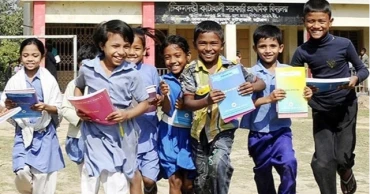
While the world embraces music education, Bangladesh seen stepping backwards
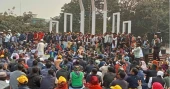
Police blocked a musical procession by Udichi Shilpigoshthi, the cultural collective, on Sunday, organized to demand reconsideration of the government’s decision to cancel recruitment of music and physical education teachers in public primary schools.
The march, which began in front of the National Press Club, was stopped by police near the Shilpakala Academy in Segunbagicha.
Udichi artists said they intended to proceed to the Chief Adviser’s residence at Jamuna Gate to present their songs. After some discussion, police initially allowed the march to continue, but stopped it again two minutes later after it crossed the Dhaka Range DIG office, preventing further progress. During this time, the artists performed songs while sitting on the road.
DU teachers, students protest abolition of music, physical-training teachers’ posts
The amended rules, published on November 2, removed the opportunity for recruitment of music and physical education teachers.
According to the Secretary-level Committee, the Ministry of Primary and Mass Education has stepped back from the plan. The committee noted that recruiting such a small number of teachers would be ineffective at the primary level and could create inequality, given that there are 65,569 primary schools nationwide. Cluster-based deployment would require a single teacher to serve 20 or more schools, making workload management impossible.
Earlier, in late August, the government issued the Government Primary School Teacher Recruitment Rules, which included positions for music and physical education teachers. Just two months later, the rules were amended.
Udichi hosts nationwide event against 'conspiracy centring national anthem'
The revised rules sparked widespread criticism. The Human Rights Forum Bangladesh (HRFB) stated that the decision is not only unreasonable but reflects succumbing to pressure from a small group, removing two important subjects from primary education. The National Rabindra Sangeet Sammilon Parishad also protested.
In a statement Parishad said, "When a small section of society opposes this using a narrow-minded, distorted interpretation of religion, the government abolished assistant teacher posts for music and physical education through a new notification.”
On Saturday afternoon, the cultural organization Chhayanaut also requested reconsideration of the cancellation by performing songs collectively.
Teachers and students of Dhaka University’s Music Department held a protest on campus on Wednesday demanding reinstatement of the posts. The rally took place in front of Aparajeyo Bangla, with participants singing the national anthem and raising placards. Dr. Priyanka Gope, Chairperson of the Music Department, read out a memorandum. Teachers from various departments—including Dance Department’s Laboni Banya and Clinical Psychology Department’s Kamal Uddin Ahmed Chowdhury—along with students, spoke at the event.
Leaders from Dhaka University Central Students’ Union (DUCSU), including the Literary and Cultural Affairs Secretary and cultural secretaries from different halls, expressed solidarity.
Students from Chittagong University protested the decision, stating that it poses a major threat to future artistic practice and cultural development in Bangladesh. Students from Jagannath University protested through music.
Two steps backwards
Globally, music education is emphasized even in countries with large Muslim populations. Saudi Arabia, the spiritual center of Islam, recently hired over 9,000 teachers to introduce music education in public schools as part of Vision 2030 reforms, led by Crown Prince Mohammed bin Salman, promoting arts, entertainment, and education. The kingdom is now qualifying thousands of kindergarten teachers in music skills. In late 2022, over 12,000 female teachers in government and private kindergartens were trained, and the new phase will train about 17,000 female teachers.
Other Muslim-majority countries, including Malaysia, Indonesia, Turkey, and Egypt, also retain music in their national curriculum.
In Malaysia, formal music education became compulsory in all elementary schools in 1983, with primary-level music as an intra-curricular subject since 1982.
In Indonesia, home to over 240 million Muslims, music has been compulsory in primary schools since the 1970s and remains under the 2022 curriculum.
In Turkey, primary school students receive one hour of music lessons from 1st to 8th grade, with additional two-hour elective lessons from 5th to 8th grade.
In Egypt, music has been part of government school curricula, including Arab and Western music, since 1931.
In the United Kingdom, comprising England, Northern Ireland, Scotland, and Wales, music is compulsory with variations in age and enforcement.
In Europe, a meNet study covering 20 countries showed music is compulsory at the primary level; secondary education often offers it optionally. Germany, Japan, Australia, and South Africa also mandate music and dance in primary schools.
In the United States, according to the NCES (January 2025), 73% of public schools require students to take at least one arts course, most commonly music (84%) and visual arts (82%).
In China, music is a compulsory subject during the nine years of mandatory education and part of the quality-oriented education push, with increased curriculum emphasis in recent standards.
But In Bangladesh, despite global trends highlighting the importance of music education, several religious organizations and political parties, including Bangladesh Jamaat-e-Islami and Islami Andolon Bangladesh, oppose music teacher recruitment. They demand religious instructors instead and have threatened street protests if the decision is not reversed, in a seminar held in September at the auditorium of the Institution of Diploma Engineers.
MIT study suggests music education
A new wave of research from the world-renowned Massachusetts Institute of Technology (MIT) scientists suggest that music lessons may do far more to boost brain development and overall intelligence.
The study reveals that learning music-whether through playing an instrument, singing, or reading musical notes, activates and strengthens areas of the brain responsible for memory, attention, problem-solving, and language skills. These neural networks overlap with those used in math and reasoning, giving children a deep cognitive workout that coding lessons can't yet match. Music education engages both hemispheres of the brain simultaneously, forging connections that sharpen focus and enhance long-term learning abilities.
Music combines creativity, pattern recognition, and emotional expression, creating a richer and more versatile mental environment. Children who play instruments or participate in music programs often show stronger academic performance, improved verbal abilities, and better emotional regulation.
Researchers also emphasize the social and emotional benefits of music. Playing in an ensemble or practicing with others fosters teamwork, patience, and communication-skills critical for success in any field, including technology. By developing these qualities early, children gain confidence and adaptability that can help them thrive in a rapidly changing world.
10 months ago
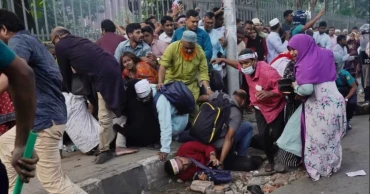
Primary teachers call off strike following govt assurance
Leaders of primary school teachers have called off their work abstention following assurances from the Ministry of Primary and Mass Education that their demands will be communicated to the Finance Ministry and resolved as soon as possible.
The decision was announced by the ministry on Sunday (Nov 9).
Read more: Primary school teachers protest at Shaheed Minar, demand implementation of 10th grade salary scale
A meeting was held between senior officials of the ministry and leaders of the Primary Teachers’ Demand Implementation Council and the Primary Assistant Teachers’ Unity Council, where the teachers’ demands were discussed in detail.
Abu Taher Md Masud Rana, Secretary of the Ministry of Primary and Mass Education chaired the meeting.
The key demands of the teachers include: upgrading the pay scale of assistant teachers from grade 13 to grade 10, resolving complications regarding higher grades after 10 and 16 years of service, and ensuring 100% departmental promotion from assistant teacher to head teacher.
Read more: Primary teachers continue protests for pay upgrade, advisers’ resignation
10 months ago
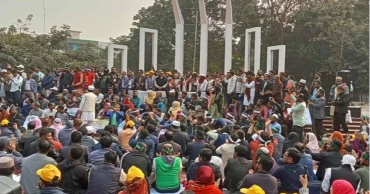
Primary teachers continue protests for pay upgrade, advisers’ resignation
Agitating government primary school teachers continued their protests for the second consecutive day on Sunday (9th November 2025) at the Central Shaheed Minar in the capital, reiterating their three-point demand.
Teachers under the banner of the Primary Teachers’ Demand Implementation Council also called for the resignation of the Advisers to the Ministries of Home Affairs, and Primary and Mass Education, in protest against Saturday’s police action on their demonstration, said Abul Kashem, president of the Bangladesh Primary Teachers’ Association.
A daylong work abstention is being observed at primary schools across the country in protest against the attack by law enforcers, Kashem said.
“Yesterday (Saturday) we went to Shahbagh for a peaceful march titled ‘Kolom Shomarpon’ (pen submission),” he said.
3-point demand: Primary school teachers stage sit-in at Shaheed Minar
“Police attacked us there, arresting five of our colleagues and injuring more than a hundred. Moreover, the Adviser to the Primary and Mass Education Ministry termed our demands irrational. We therefore demand the resignation of both advisers,” Kashem added.
He warned that the teachers would continue their sit-in and work abstention programmes simultaneously until their demands are met.
Their demands are upgrading assistant teachers to the 10th grade pay scale, removing complexities in obtaining higher grades after 10 and 16 years of service, and ensuring 100 percent departmental promotion.
Read more: Police-teacher clash at Shahbagh leaves 120 injured
10 months ago
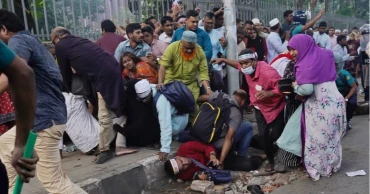
Police-teacher clash at Shahbagh leaves 120 injured
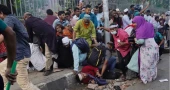
At least 120 primary school teachers were injured on Saturday afternoon (8th November 2025) when police swung into action to disperse their protest march at Shahbagh.
Witnesses said the clash broke out around 4 pm when police intercepted the teachers’ ‘Pen Surrender March’ that began from the Central Shaheed Minar towards Shahbagh, demanding implementation of their three-point charter of demand, including a 10th-grade pay scale.
“Police attacked us without any provocation. In protest, teachers across the country will observe a complete work abstention from tomorrow (Sunday, 9th November 2025),” said Rakib Hossain, an assistant teacher at Mugakathi Government Primary School in Uzirpur, Barishal.
Witnesses said police resorted to baton charge and fired water cannons and sound grenades after teachers broke through police barricades near Shahbagh Police Station.
DMP defends police action to disperse teachers’ gathering at Shahbagh
The marchers were eventually dispersed, leaving the area tense.
More than 120 injured teachers were taken to Dhaka Medical College Hospital (DMCH) for treatment, said inspector Md Faruk, in-charge of the hospital police camp. “Many have received treatment at the emergency unit, while some have already left after first aid,” he added.
10 months ago
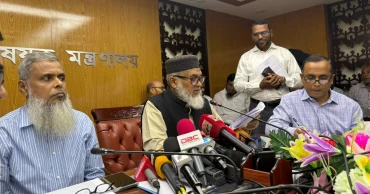
Govt reviewing Hefajat’s demand to replace music teachers with religious ones: Adviser
Religious Affairs Adviser Dr AFM Khalid Hossain on Monday said that the Ministry of Primary and Mass Education is currently reviewing Hefazat-e-Islam’s demand to appoint religious teachers in place of music teachers in primary schools.
"This generally falls outside the purview of my ministry. It is under the jurisdiction of the Ministry of Primary and Mass Education. However, I have advised the education adviser to sit and discuss the matter, considering that Hefajat and other Islamic scholars have raised objections to including music as a subject,” he said.
The adviser said this when asked about the demand of the Hefajat-e-Islam while speaking at a press briefing held at the Secretariat.
Earlier, Primary and Mass Education Adviser Prof Dr Bidhan Ranjan Roy Podder said there has never been a separate post for religious teachers in primary schools and that the assistant teachers typically cover subjects like Bangla, English, Mathematics, Social Studies and Religion.
Tk 38 crore of unspent funds of hajj agencies repatriated from KSA: Khalid
Besides, a letter has been sent to the Primary and Mass Education Adviser, recommending the appointment of ‘Dawra-e-Hadith certificate holders from Qawmi madrasahs as religious teachers in primary schools, the Religious Adviser said.
Noting that the religious education class hours have already been increased, the adviser said, “Within 6-7 months of assuming in office, I sent him a letter suggesting that Dawra Hadith graduates—whose degrees have been officially recognised by the previous government as equivalent to MA in Arabic and Islamic Studies—could effectively teach subjects like Religion and Bangla in primary schools.”
“The education adviser told me he would consider the matter. I’ve sent him a DO letter, and since it falls under his ministry, the decision is theirs. However, I will continue discussions with him. He also mentioned that the music education initiative is not being implemented immediately,” Khalid Hossain said.
He also said that the Ministry of Primary and Mass Education is reviewing Hefajat’s objections.
“The ministry is considering what steps to take in light of demands from Hefajat and other Islamic organisations. Whether or not the decision to appoint music teachers will be reversed is up to them—I cannot comment on that,” the adviser added.
11 months ago
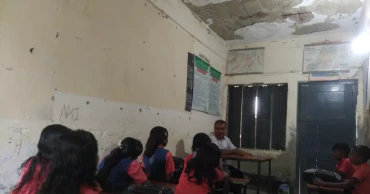
Clouds cast a shadow over learning at a primary school in Jhenaidah
At Taminagar Government Primary School in Shailkupa upazila, Jhenaidah district, the arrival of gathering clouds does not herald the promise of rain alone; it signals an abrupt end to lessons.
Here, classes are dismissed—not because of holidays or official announcements—but because the very roof above the students’ heads trembles with danger.
The school’s weary walls and fragile ceilings tell a grim tale of neglect and decay. Cracks trace their way across the single-story structure, exposing rusted iron rods and crumbling plaster that hangs perilously from beams.
Heavy rain turns Sylhet region risky for tourists; Sada Pathor site closed
Every overcast sky casts a shadow of fear over teachers and pupils alike, prompting them to scatter before the heavens open and the fragile building succumbs to collapse.
The roof, once a shelter of learning, has become a menace. Frequent incidents of falling plaster and weakening structural elements have turned classrooms into scenes of trepidation.
Students and teachers live with the constant dread that each passing storm might bring destruction, forcing hurried dismissals and disrupting education.
Local guardians, their faces etched with worry, recount a series of avoidable mishaps that have marred the school’s history.
Despite repeated pleas and warnings about the building’s unsafe condition, the authorities have remained silent, their inaction evident in every cracked beam and peeling ceiling.
Abdur Razzak Molla, Laily Khatun, Chhabiran Nesha, and Jharna Khatun—parents and community members—rushed to the school, voicing their deep concern for the children’s safety.
Their fears are not unfounded; several students have already suffered injuries from falling debris, some requiring stitches after plaster rained down upon them.
Ahad Ali, the dedicated headmaster, paints a sobering picture. “The school was founded in 1978 by the education enthusiast Siraj Uddin Molla on a 33-decimal plot of land. In 1994, the government built a three-room structure, but since then, it has steadily deteriorated.”
Today, the fragile building teeters on the edge of ruin. “A collapse could happen at any moment,” Ali warns, as some guardians linger near the teachers’ common room or within the school grounds during class hours, desperate to protect their children from harm.
Despite these daunting challenges, the school continues to shine in academics and sports, a testament to the resilience and spirit of its students and faculty.
Yet, this triumph is overshadowed by the routine emergency dismissals triggered by even the slightest change in weather. Parents now rush to fetch their children whenever dark clouds loom, turning a day of learning into a hurried scramble for safety.
Repeated verbal and written appeals to local and higher authorities have fallen on deaf ears. The pleas for renovation or a new building remain unanswered, leaving the school community trapped in a cycle of fear and uncertainty.
Adding to the adversity, the school’s only playground floods with even a light drizzle, rendering it unusable during the monsoon season. “If a new building isn’t constructed soon, classes may have to be permanently halted due to safety concerns,” warns the headmaster.
3 held in Jhenidah while entering Bangladesh from India
When approached for comment, Shailakupa Upazila Primary Education Officer Biswajit Saha assured, “The matter will be raised in the upcoming monthly coordination meeting, and necessary actions will be taken accordingly.”
For now, at Taminagar Government Primary School, every darkening sky is not just a weather forecast — it is a stark reminder of the urgent need for shelter, safety, and hope.
1 year ago

School headmistress arrested for allegedly selling new books in Habiganj; landed in jail
A headmistress of a government primary school has been arrested on charges of selling new books meant for distribution for free among students.
Ayesha Akter, the accused headmistress at Kadamtali Government Primary School in Shayestaganj upazila of the district, was sent to jail in a case over the recovery of the books on Wednesday.
Murshed Alam, inspector (investigation) of Shayestaganj police station, said a total of 394 books of several classes were recovered from a three-wheeler van in front of a fuel station in the upazila on Tuesday afternoon.
Read more: NCTB chair, member again summoned over distortion of history in textbooks
During the interrogation, the van driver Chhaid Hossain said that the headmistress gave him the books for selling, he said.
Later, a team of police led by Sub-Inspector Saidul Islam conducted a drive in the headmistress’s house and found 94 more books wrapped in a plastic sack.
During the primary questioning, the accused headmistress said she collected 752 books from a reserved godown of Railway Colony Government Primary School to distribute among students on December 27 last year.
After distributing some books, she hoarded the rest of the books on her own to sell on the market, the inspector said.
Upazila Education Officer Mohammad Ali filed a case accusing the headmistress in this connection.
Read more: NCTB gives corrections for 9 mistakes in 3 textbooks of new curriculum
3 years ago

Primary schools to have one shift from Jan 2023: Secretary
All primary schools in the country will be operated under a uniform shift from January next year, Senior Secretary to Bangladesh Primary and Mass Education Ministry Aminul Islam Khan said today (October 30, 2022).
The secretary said this during a discussion with the media, on the occasion of his last working day at the ministry.
“Ninety percent work towards introducing one shift in all primary schools has been completed. We’ll also extend the duration of classes gradually,” Aminul said.
Also read: Mustafa Jabbar wants cyber security in primary school curriculum
He added that the government has taken the decision due to its inability to construct new school buildings.
“We’ve taken the decision considering the growing number of students and teachers. Once the single shift starts, no school will be closed and no teacher will lose job. We’ll initiate pre-primary and primary education at the schools which have dual rooms, and we’ll construct new buildings where possible,” Aminul added.
Asked about the timing of classes, Aminul said that class hours will be extended to 4-5 hours from the current three hours.
Also read: 342 primary schools in Dhaka will get aesthetic reconstruction: State Minister
“There is a difference between class hours in Dhaka city and the rural areas. In Dhaka, classes start early, while in the villages, classes start late. Our aim is to ensure the presence of teachers in classrooms. We want teachers to give lessons regularly and for a longer period of time. That’s why we’ll increase the class hours,” Aminul said.
Replying to a question, Aminul added that his Ministry will complete the process of transferring and recruiting primary school teachers before the coming Victory Day.
“We could’ve published the results of the Bangladesh primary teacher recruitment exam earlier. We didn’t do it as some teachers had requested the ministry for transfer, which was pending due to the Covid-19 pandemic. We’re trying so that teachers who have been with a school for 10-12 years can be transferred after every three years,” Aminul said.
Read More: Online transfer system of govt primary teachers resumes.
3 years ago

Mustafa Jabbar wants cyber security in primary school curriculum
Minister for Posts and Telecommunications Mustafa Jabbar wants inclusion of ‘Cyber Security’ in primary school curriculum of Bangladesh.
Jabbar came up with the remarks while addressing, as chief guest, a discussion on ‘Youth workshop for safe internet-2022’ organised to create awareness on cyber security at the Conference Centre of Bangladesh Telecommunication Regulatory Commission (BTRC) on Thursday (October 13, 2022).
BTRC Chairman Shyam Sunder Sikdar presided over the programme where Cyber Crime Awareness Foundation President Kazi Mustafiz delivered welcome speech, Director General of BTRC’s System and Services Division Brigadier General Md Nasim Parvez presented the keynote speech.
Read: Workshop on digital literacy for cyber security held
Urging the Home Ministry to underscore digital crimes, Jabbar said every police station should have a cyber or digital crime unit with trained officials.
The BTRC chairman said they took an initiative to set up a cyber-observation lab to ensure security.
He said the Education Ministry should take steps to initiate class on cyber security, one day a week, to generate awareness among students.
Read Specific policy needed to ensure cyber security of power sector: Nasrul Hamid
“Though none should refrain from using technology, we should be more careful and protect our families and society from digital crime,” the BTRC chairman observed.
He said BTRC has already submitted an outline to bring owners of social media platforms under law to the ministry.
Daffodil International University’s Computer Science and Engineering department Head Prof Dr Touhid Bhuiyan, Digital Security Agency Director Tarique M Barkatullah and Additional Commissioner of Cyber Security department of police Nazmul Islam, among others spoke at the discussion on ‘Youth workshop for safe internet-2022’.
Read Cybersecurity Career Guide: How to Become a Cybersecurity Expert?
3 years ago