Accountability
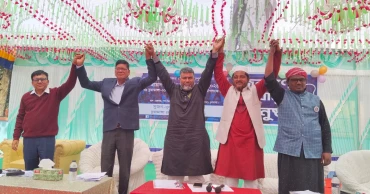
All candidates on one stage in Chuadanga: a rare vow for good governance, accountability
Breaking away from the usual combative rituals of electioneering, all contenders for Chuadanga-1 constituency came together on a single stage on Wednesday, facing voters directly and pledging accountability, transparency and corruption-free governance.
Three rival candidates -often divided by ideology and party lines—sat side by side, listened to voters’ concerns and answered pointed questions.
More strikingly, they went beyond campaign promises, jointly signing a stringent 15-point written pledge committing themselves to clean, people-centric governance if elected.
The event, titled “Face to Face with the People”, was organised by Shujan, Chuadanga district unit, at the open stage adjacent to the Water Development Board in the town.
On stage were BNP-nominated candidate Md Sharifuzzaman Sharif, also general secretary of the district BNP; Jamaat-e-Islami nominee Advocate Masud Parvez Russell, assistant secretary of the district Jamaat; and Islami Andolon Bangladesh candidate Zahurul Islam Azizi.
Despite sharp ideological differences, the three candidates spoke in one voice on several issues, promising to turn Chuadanga into a district free from terrorism, drugs and tender manipulation.
Presided over by Professor Siddiqur Rahman, former principal of Chuadanga Government College and president of Shujan’s district unit, the programme was moderated by journalist Meherabbin Sanvi, the organisation’s district facilitator.
Ignoring the winter chill, more than 450 voters from different parts of the district joined the dialogue, voicing expectations and frustrations—from unemployment and farmers’ fair prices to law and order and political intolerance.
Sharifuzzaman Sharif said he envisioned Chuadanga as a modern, secure and inclusive region. “Standing before you today, I pledge that if elected, I will work to make Chuadanga free from terrorism, drugs and extortion,” he said.
8 months ago

TIB expresses frustration as ACC Ordinance approved without key reform provision
Transparency International Bangladesh (TIB) has expressed deep disappointment and indignation over the Advisory Council’s final approval of the Anti-Corruption Commission (ACC) Ordinance ‘ignoring strategically important recommendations.’
The recommendations were essential for ensuring transparency, accountability and institutional independence of the anti-graft body, it said in a statement on Friday (November 28).
The exclusion of “Selection and Review Committee” from the final ordinance despite being included in the July Charter is not only disappointing, but also indicates that like almost all other cases of reform proposals the state reform agenda has become hostage to the conspiracies of anti-reform circles within the government, it added.
TIB also questions whether by denying the provision to make ACC accountable as much as independent, the Chief Adviser, as the head of the consensus commission and the groundbreaking decision-maker to form the 11 reform commissions, is trying to send a message to all including political parties, that ‘state reforms are just a rhetoric for the Government.’
Read more: ACC’s year of mixed outcomes: 249 cases closed, yet acquittals dominate
Noting that the ACC Reform Commission had recommended the formation of a “Selection and Review Committee” considering the experience of the past two decades, the opinions of all stakeholders, international best practices, and the political and bureaucratic context of Bangladesh in order to ensure that the ACC does not continue to function as a tool of protection of those in power and harass political or other opponents, TIB Executive Director Dr. Iftekharuzzaman said.
“This proposal was made to overcome the dire situation of ACC as the institution has been suffering from a lack of public trust since its inception, as a puppet of vested quarters, it has become a tool of protection for those in power and harassment of opponents,” he said.
It is regrettable that the government has failed to understand the strategic value of this recommendation to transform the ACC into a truly accountable, independent, and impartial institution through half-yearly reviews, public hearings, and recommendations by the proposed committee, he said.
ACC’s year of mixed outcomes: 249 cases closed, yet acquittals dominate
“For a government responsible for state reforms, this is a self-contradictory and anti-reform precedent,” he added.
Dr. Zaman further said the matter is even more disappointing because according to reliable sources, at least seven Advisors have opposed this proposal at the Cabinet meeting.
“Yet they know that all the political parties that signed the July Charter have fully agreed on this provision. Before creating such a bad precedent of violating the July Charter, why the government does not realise that through this the Government is by itself actually encouraging political parties to violate the July Charter? Why then unprecedented bloodletting sacrifices were made? What kind of state reform is it that blocks the way to effectively curb corruption?” he questioned.
The draft of the ordinance that TIB had the opportunity to review seemed to be in some ways of a higher standard than the existing law for which the organization commends the government, it said.
TIB calls for full disclosure of agreements with foreign cos on Laldia, Pangaon terminals
However, the TIB Executive Director has expressed deep disappointment and regret as according to reliable sources, in addition to the mentioned issue several other important strategic recommendations on which political consensus was achieved have been omitted.
“This can be nothing but a corruption-enabling and anti-reform stance of vested interests and influential quarters within the government,” he added.
10 months ago

Raiding retailers won’t help, real culprits must be caught: Adviser Bashir
Commerce Adviser Sk Bashir Uddin on Tuesday (11th November 2025) said that raids on retail and mid-level outlets have limited impact, as the main perpetrators behind market irregularities often escape accountability.
“Our goal is to protect consumers’ interests, not to restrict trade,” he said on Tuesday while speaking at a views-exchange meeting with edible oil delivery order (DO) traders at the commerce ministry.
The adviser emphasised that facilitating both domestic and international trade is the ministry’s core function, and it has been working sincerely to achieve that objective.
“As consumers ourselves, it’s only natural that my ministry and I will work in favour of consumer welfare,” he said, urging DO traders to cooperate and provide guidance in stabilising the market.
Warning that decisive measures will be taken to protect consumer rights, Bashir Uddin said such steps would be taken regardless of who they affect.
Read more: Govt working on Tk 100-crore fund to revive jute bags: Adviser Bashir
He said the traditional practice of controlling the edible oil market through raids at retail or mid-level shops has proven largely ineffective.
“The entire supply chain—from producers or importers to DO traders, wholesalers, and retailers—must come under regulatory oversight,” he said, adding that mill owners, DO traders, or both might be responsible for market instability.
“It’s unrealistic to think a small retailer hiding 500 bottles of oil under his counter is causing market chaos. TV channels may show dramatic footage of oil seizures, the public may applaud, but in reality, such drives achieve nothing. The small grocer is blamed while the real manipulators walk free,” the adviser said.
Bashir Uddin said the government will make sure no one can destabilise the edible oil market, and vowed to identify and act against the real offenders.
At the meeting, DO traders complained about not receiving products on time from mill owners and urged the ministry to resolve the issue.
Read more: Vitamin-fortified safe edible oil essential to protect public health: Speakers
11 months ago

Harassment, corruption shadow Begum Rokeya University
Begum Rokeya University (BRUR) in Rangpur, long hailed as a leading higher education institution in northern Bangladesh, has recently come under intense scrutiny over allegations of sexual harassment, nepotism and corruption.
Sources at the university report that since its establishment, 33 students, faculty members and staff have fallen victim to sexual misconduct, raising serious concerns among educationists and civic society leaders.
Fahkrul Anam Benju, an educationist in Rangpur and president of the Sujon Forum, voiced deep apprehension over the situation, saying, “When students in a leading university feel unsafe, words fail us. We are both angry and disappointed.”
The issue came to public attention following allegations against Dr Shakibul Islam, an associate professor in the Disaster Science and Management Department, who has been relieved of all departmental duties.
A notice issued by the department head, Professor Md Imdadul Haque, cited urgent action in response to complaints from students of the 2020–21 academic year.
Dr Islam has been barred from supervising or examining fourth-year, second-semester courses, including DSM4207 (Research Project).
Read more: BRUR Prof Rashidul Islam suspended over harassment allegation
Several victims have claimed that their pursuit of higher education has placed their personal safety at risk.
University Vice-Chancellor Prof Dr Showkat Ali described the situation as both ‘embarrassing’ and ‘shameful’.
Meanwhile, separate allegations of corruption and nepotism have resurfaced involving five former university officials, including a previous Vice-Chancellor. Two of the accused were suspended at one point, while three others remain in their positions, with no visible administrative action taken.
The Anti-Corruption Commission (ACC) had filed a case 12 years ago against former VC Prof Dr Muhammad Abdul Jalil Miah over alleged financial irregularities, recruitment malpractice, and nepotism. The university’s anti-corruption mancha first reported the VC’s alleged misconduct to the ACC on 5 March 2013, triggering an investigation.
Abdul Karim, then Deputy Director of ACC Rangpur, confirmed that a case was filed on 12 December 2013 against the former VC and two others at Kotwali Police Station. Another accused was then-Registrar Md Shahjahan Ali Mondal.
Over the course of a nearly three-year investigation, ACC Deputy Assistant Director Md Akbar Ali found further involvement of university officials, including Planning and Development Deputy Director ATGM Golam Firoz, Assistant Registrar Md Morshed Ul Alam Roni and Finance and Accounts Assistant Director Khandakar Ashraful Alam.
The investigation revealed irregularities in appointments: Golam Firoz was promoted from an ad hoc Grade-9 position to Grade-5 Deputy Director without the required experience. Md Morshed was appointed Assistant Registrar within two years of completing his postgraduate degree, falling short of the mandatory five-year experience.
Khandakar Ashraful was initially hired on an ad hoc basis and later regularised as Assistant Director (Budget) without meeting standard protocols.
Read more: Panel formed to settle BRUR teacher Mahmudul’s seniority, promotion
In July 2017, former VC Jalil and Registrar Shahjahan surrendered to the court and were sent to jail, while arrest warrants were issued for the other three officials. The university syndicate suspended Shahjahan, Firoz, Md Morshed, and Khandakar Ashraful.
However, in October 2017, the court granted temporary relief to the three officials, allowing for administrative discretion by the university in case of questionable appointments. Later, the orders were mysteriously revoked, and their positions were regularised.
The ACC appealed, and the High Court subsequently nullified the lower court’s relief, ordering the formation of charges. The case remains pending, with hearings delayed due to adjournments requested by the accused.
VC Showkat Ali said, “The administration had not informed me about these issues. After learning of them through investigations, I inquired further. No department had brought this to my notice, so I could not take action. The corruption case involving the former VC and others is extremely important.”
He added, “I am consulting with their lawyers and will act according to legal procedures. If departmental action is possible, it will be taken. I have never compromised on integrity, and any measures will be transparent.”
The ongoing controversies at BRUR, ranging from sexual harassment to allegations of nepotism and corruption, underscore the urgent need for accountability and systemic reform in one of northern Bangladesh’s flagship universities.
Read more: Rokeya University teacher Mahamud gets bail; OC transferred
11 months ago

Govt wants prompt disposal of cases to ensure transparency, accountability: PM
Prime Minister Sheikh Hasina today said the government wants to ensure justice for all with prompt disposal of cases, and ensure transparency and accountability in the country.
“We want every citizen of the country to get justice. We want prompt disposal of cases. We want to ensure transparency and accountability… we want to establish that environment,” she said.
The prime minister said this while addressing the inaugural session of the 59th Annual Council of Bangladesh Judicial Service Association at Bangabandhu International Conference Center (BICC).
Sheikh Hasina said the government is working tirelessly to ensure the wellbeing of people — for a bright and secured future for them.
“Let us ensure rule of law for the people of Bangladesh, so they can have a better life. We will establish Bangladesh that was dreamt by the Father of the Nation Bangabandhu Sheikh Mujibur Rahman,” she said.
Read more: Zia, Ershad and Khaleda Zia turned Bangladesh into a ‘nation of beggars’: PM
The prime minister said that members of the parliament have passed laws alongside making amendments to ensure security and welfare of the people while judges are ensuring justice for all.
“As long as I am in power, I will do whatever necessary for the development of the judiciary,” she said.
She said her government has formed special tribunals to dispose cases filed under the antiterrorism act.
If the trials of anti-terrorism cases end quickly, those involved in terrorism will be discouraged, she hoped.
The PM said patterns of terrorism and militancy have changed with the advent of newer technologies, and crimes are being enabled by technology.
“We have enacted a law to contain cybercrimes. Many people say many things, but the fact is that law is necessary as the number of cybercrimes has gone up immensely,” she said.
She called upon all, including parents, teachers, and religious leaders, to be involved in anti-terrorism and anti-militancy awareness campaigns across the country.
“We have to pay special attention so that no chid gets involved in militancy,” she added.
Referring to militant attacks in Jhalakathi and Gazipur courts, she said her government has taken measures so that judges can return home safely after delivering verdicts.
The PM said as many as 101 tribunals are now working across the country to deal with cases of women and children repression; seven tribunals are assigned to work on human trafficking cases.
To bring dynamism in the judiciary, she said a total of 1227 judges were appointed in the lower courts since 2009 till date, while a process is underway to recruit 200 judges more.
Read more: Anti-liberation forces and killers of Bangabandhu are always trying to make Bangladesh a ‘failed state’: PM to AL activists
Recalling the contribution of Father of the Nation Bangabandhu Sheikh Mujibur Rahman for the development of the judiciary, she said Bangabandhu had scrapped a Pakistani era law, paving the way for appointing women in the judiciary.
The prime minister urged judges to consider the situation before Awami League assumed power in 1996, saying, “You (judges) will see a complete change.”
She said her government has continued the trial of war criminals, confronting obstacles at home and abroad, adding that she had received many international phone calls, including from heads of states, when her government initiated measures to try war criminals.
The prime minister thanked Judge Golam Rasul for his bravery in delivering the judgement over the brutal assassination of Father of the Nation Bangabandhu Sheikh Mujibur Rahman, overcoming many hurdles.
She said the BNP-Jamaat alliance called hartal on the verdict day (November 8, 1998).
The BNP-Jamaat alliance government later awarded the killers of Bangabandhu by posting them in foreign missions and rehabilitated them in politics, she said.
She also said military dictator Ziaur Rahman freed 11,000 war criminals from jails to stop the trial of the anti-liberation elements that was initiated by the Father of the Nation.
The prime minister vowed to build a developed, prosperous 'Smart Bangladesh' by 2041 to give the people a better life.
Law Minister Anisul Huq, Law Secretary Md. Golam Sarwar and Bangladesh Judicial Service Association President AHM Habibur Rahman Bhuiyan also spoke at the programme. A documentary on judicial service was screened at the programme.
3 years ago

Justice, accountability must for Rohingya, speakers say in The Hague
International community and States Parties of Rome Statute need to stand resolutely with Bangladesh in securing sustainable return of the Rohingya people to their homeland, Myanmar, speakers told a discussion in the city.
They underlined it at an event during the 21st (annual) Assembly of the States Parties of the International Criminal Court (ICC) in the Hague on Friday.
The event titled ‘Justice for the Rohingyas and No Peace without Justice’ was co-hosted by the Bangladesh Embassy to the Netherlands, the Government of Gambia.
Bangladesh Ambassador to the Netherlands, M Riaz Hamidullah, Deputy Prosecutor of ICC, Nazhat Shameem Khan, President of Burma Rohingya Organisation UK, Tun Khin, former member of the Advisory Commission on Rakhine State, Amb. Laetitia Van Den Assum, and Gambian Solicitor General, Hussein Thomasi, spoke at the event.
Read more: ‘US glad over beginning resettlement programme for Rohingya refugees’
Ambassador Hamidullah said that in securing a lasting solution within the new federal structure of Myanmar, issues relating to the Rohingya people as also other ethnic minorities in Myanmar merit attention in inclusive and transparent ways.
As the regional grouping, civil society actors, think-tank, academia within ASEAN region need to look at situation in Myanmar to ensure the region's collective stability and prosperity.
Aside from humanitarian assistance, political solutions should be equally in focus, he added.
The Rohingya leader Thun Khin appreciated Bangladesh for hosting Rohingya and in their fight for justice for the Rohingya.
He shared the significance of universal jurisdiction and an investigation in an Argentine Court a key step in securing justice for the Rohingyas. He also urged more countries to consider such cases.
Deputy Prosecutor Nazhat Khan shared the progress on investigation on the ICC Case inquiring war crimes against Rohingyas.
The Gambian Solicitor General said that The Gambia itself had been a victim of two decades of authoritarian rule and thus valued the Rohingya issue in initiating the procedure at the ICJ as a member of the Genocide Convention.
Read more: US working to increase resettlement of Rohingyas from Bangladesh: Blinken
Ambassador Laetitia Assum said that the ground situation in Myanmar continues to escalate since the military coup two years ago.
She viewed that as most ASEAN countries do not share a border with Myanmar, they do not sufficiently understand the burden on the neighboring countries.
3 years ago

UN experts seek more help for human rights defenders in push for accountability in Myanmar
UN experts on Friday said human rights defenders documenting and responding to atrocities by Myanmar's military junta urgently need comprehensive support, including financial.
They called on the international community to end apparent indifference to the violence targeting the country's population.
“In the face of inaction by the international community, and with human rights violations continuing to be perpetrated on a daily basis by the military junta, human rights defenders are persisting in their support for those targeted and working to preserve the possibility of justice in the future,” said Mary Lawlor, UN Special Rapporteur on the situation of human rights defenders.
Along with Tom Andrews, Special Rapporteur on the situation of human rights in Myanmar, Lawlor highlighted the grave risks defenders face and the specific challenges confronting women human rights defenders.
“Defenders have been murdered and disappeared by the military since the coup took place. They now risk arrest, detention, torture, including sexual violence and death when going about their work and fear having their documents seized at military checkpoints,” the experts said.
Read: UN Human Rights Council adopts resolution to end Rohingya crisis
“Many have had to go into hiding after being targeted by the military for assisting survivors of gender-based violence. They are on the move constantly, and women human rights defenders often have no choice but to take their children with them when they flee.”
Others have had to relocate to neighbouring countries, where they remain vulnerable.
Lawlor and Andrews said they had publicly expressed concerns for the safety of defenders in the country just over a year ago.
“What's needed is concrete support for Myanmar human rights defenders, including those who have had to flee the country: stronger, coordinated pressure on the junta, timely and responsive direct financial support for defenders on the ground, and visas or resettlement for those fleeing the country,” the experts said.
“The international community must not adopt a passive stance when it comes to the crimes that are being perpetrated by the military junta and the risks for human rights defenders in Myanmar.”
4 years ago

Self-Accountability: How to Develop Personal Accountability in Life
Personal accountability is a significant source of strength since it is the secret to success. You are the person most responsible for yourself. If you can't admit to yourself that you have a problem, you will never be able to change it. Personal accountability is a quality that everyone needs in their life, not simply at work or school. It is only your obligation, and yours alone, to hold yourself accountable.
What is Self-Accountability?
Self-accountability is a way of life in which you learn to accept responsibility for all of your acts. This covers your triumphs, failures, blunders, and so on in order to help you quit criticizing others for your faults and weaknesses.
Self-accountability serves as a marker to determine how you as a person are trustworthy, self-reliant, inventive, and responsible, whether in your personal life or in business.
Read Time Management: How to be ruthless with your time
Ways to Develop Personal Accountability in Life
Self-accountability is one of the most important characteristics of a successful and meaningful profession, relationship, and life – yet many individuals struggle with it. These strategies will assist you, in the beginning, to be responsible as soon as possible.
Make a Distinct Outline of Your Goal and Vision
If you work very closely with others in a team, make sure that everyone's responsibilities and duties are strictly outlined and that everyone knows what they must provide and when they must give it. Ensure the project as a whole owns the initiative as a whole so that issues and breakdowns may be identified early and fixed collaboratively. This is not usual at work, but it can be done better.
Accentuate Your Priorities
Changing your perspective begins with changing your "shoulds" into "musts." Your days are packed with things you "should" do, such as lose weight, find a career you like, and improve your relationships. Connect these aspirations to your life's mission to make them become "musts." Recognize that they are critical to your happiness. Make a pledge to yourself that you will not have any regrets in your life.
Read Simon Sinek’s Golden Circle: Concept, Significance, Practice, Examples
Learn to Say Sorry
Honesty is just one aspect of accountability. If things went wrong and you were to blame, you must apologize.
When you apologize, emphasize making apologies and indicate what you will do to make things right. This enables everyone concerned to move forward and concentrate on the ultimate goal rather than the difficulty.
Set Smaller Goals
People often plan their objectives 10 steps ahead. Some persons, for example, may want to go straight to the position of senior management while bypassing and dismissing the minor milestones.
They have no idea that these mini-milestones serve as a stepping stone to obtaining their ultimate aim. As a result, be intelligent and begin by creating tiny objectives that will eventually drive you to your final aim.
Read Reciprocity Ring: How can it improve an organization and individual career?
Make a Strong Commitment
The first stage in developing responsibility is identifying what you want to accomplish, which will then make it obvious what you're responsible for. Once you have chosen, you must commit to being personally accountable–this isn't something that can be done on the fly.
To effect change, you must often make promises to yourself. Step out of the comfort zone to make a change if you are unsatisfied with anything in your life. And although it may be tough to alter something that you are used to, keep in mind that you have the option of doing nothing but complaining rather than acting, which will not help anything.
Learn to Manage Time
When you don't feel like you have sufficient time in the day, it's challenging to be responsible. However, when you claim that you don't have time, what you actually mean is that you don't have time management skills. Remove your to-do list and arrange your day using chunking. Learn how to use your extra time. Small duties like commuting and home cleaning add up to a lot of wasted time in your day, but they can be utilized to feed your mind and work toward your objectives.
Read What is Self Serving Bias? How Can it Damage Your Career, Creativity, Potentials?
Devise Your Self-talk
Everyone has an internal monologue that influences how they interact with the outside world. That small voice manifests itself in the actions they take and the words they choose to express. The capacity to recognize and interrupt negative self-talk is essential for connecting with people in a positive manner.
Take note of how you respond the next time anything goes wrong. Is your "inner critic" accusing someone or anything other than you? Reverse such ideas and consider how you might be better in the future. That is a personal responsibility.
Stop Blaming
When working toward your objectives, you will face setbacks no matter what. However, when you encounter a stumbling block, you cannot point the finger at anybody else.
Also Read: Sunk Cost Fallacy: Why It's Better to Forget the Past
And although you don't have to blame yourself for everything which goes wrong, you do need to feel empowered enough to reflect on what went wrong and find out how to make things go better in the future. You must be able to comprehend that you are in charge of your actions and the events that ensue.
Get a Partner
Finding an accountability partner who will track your progress is one of the finest methods to increase your own responsibility. An accountability partner is a peer who assists you in reaching your objectives by helping and ensuring that you accomplish what you say you will do. This is comparable to having a mentor, but it is a mutually beneficial connection in which both individuals gain from their partner's comments and support.
Your accountability partner will provide you with specialized assistance with your objectives and will be committed to your success–and vice versa.
Read Why Do You Need a Purpose In Life?
Conclusion
The path to mastering self-accountability is long and winding. While it is all too easy to fall missing at times, it takes a lot of work, bravery, and time to apply self-accountability to create your life the way you want it to be. But, with the correct amount of work and patience, you will be there in no time. So far we have discused seven steps to increase personal accountability to improve the quality of life. Hope it helps!
4 years ago
.jpg)
President urges transparency and accountability in government spending
President M Abdul Hamid on Sunday asked the authorities concerned to ensure transparency in government expenditures for the sake of public interest.
The president made the call when Auditor General and Comptroller Muslim Chowudhury presented the annual audit to him at Bangabhaban in the evening.
During the meeting, the CAG briefed the president on various aspects of the report.
"Audit is very important to ensure transparency and accountability in government expenditures,"President Hamid said.
Also read: President urges PSC to accelerate recruitment for govt posts
The president also directed the CAG to intensify the audit activities to settle the unresolved audit objections on time.
Later, a delegation led by the Chairman of the Bangladesh Accreditation Council Prof. Dr. Mezbah Uddin Ahmed presented the first annual report of the Council to President Hamid.
The chairman of the Accreditation Council briefed the president on various aspects of the report and its overall functions.
Hamid directed the Accreditation Council to play its role in ensuring transparency and accountability in the overall activities including education and research in the universities.
The president also suggested bringing the activities of the university under monitoring to ensure the quality of higher education.
Also read: President Hamid receives 10 names for EC proposed by search committee
Secretary to the President's Office Sampad Barua, Military Secretary Major General SM Salah Uddin Islam, and Press Secretary Joynal Abedin were present on the occasion.
4 years ago

Favouritism, political bias: Thousands left out of flood relief, Covid-19 incentive
Many real poor people and farmers missed out on flood relief and Covid-19 incentive due to favouritism based on kinship and political bias.
5 years ago