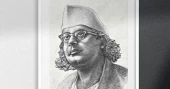
Kazi Nazrul Islam
Nazrul remains 'a shining star' in Bengali literature: Chief Adviser
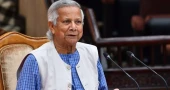
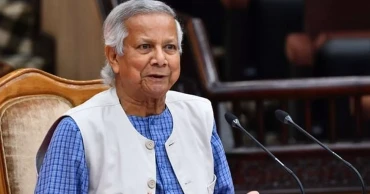
Calling Nazrul the “poet of rebellion and humanity,” Chief Adviser Prof Muhammad Yunus on Saturday said that the iconic literary figure remains a shining star in Bengali literature.
In a message marking the 126th birth anniversary of National Poet Kazi Nazrul Islam, the Chief Adviser paid his deepest respects to the memory of the legendary poet.
National Poet Kazi Nazrul Islam’s 126th birth anniversary today
“Nazrul was born at a time when the entire subcontinent was shackled by colonial oppression. His rebellious spirit rose against injustice and tyranny, and through his sharp and powerful pen, he sought to break those chains,” he said.
Prof Yunus recalled that Nazrul was imprisoned on charges of sedition for protesting against colonial rule, and earned the title of “Rebel Poet” for choosing poetry as a medium of resistance.
He noted that the current interim government officially declared Kazi Nazrul Islam as the National Poet of Bangladesh through a gazette notification earlier this year.
“Nazrul’s core message was the triumph of humanity. He raised his voice against oppression, communalism, social injustice, and exploitation. His timeless creations inspired and gave courage during the anti-British movement, the struggle for self-determination, and the Liberation War,” Prof Yunus said.
He praised Nazrul’s stand against religious bigotry and his advocacy for gender equality, as well as his contribution to enriching Bengali literature and culture through his words and melodies.
“I believe that Nazrul’s life of struggle and his literary legacy will remain a source of inspiration for the people of Bangladesh and help in building a secular and equitable society,” the chief adviser noted.
Nation to celebrate 126th birth anniversary of Kazi Nazrul Islam with three-day programme
Prof Yunus also wished success for all programmes undertaken to commemorate the 126th birth anniversary of the National Poet.
1 year ago
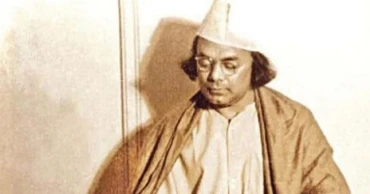
National Poet Kazi Nazrul Islam’s 126th birth anniversary today
The nation is celebrating the 126th birth anniversary of National Poet Kazi Nazrul Islam paying tribute to the revolutionary poet whose prolific work in literature, music, and philosophy continues to inspire generations.
Born on May 24, 1899 (11th Jaishtha, 1306 Bangla year) in Churulia village of Asansol in West Bengal’s Bardhaman district, Nazrul rose to prominence as a poet of rebellion and love, challenging colonial oppression, religious extremism, and social injustice through his fearless writing.
Although Nazrul was declared the National Poet of Bangladesh on May 24, 1972, the day he arrived in the country, this year marks the first state-recognised celebration of his birth anniversary following the Interim Government’s formal gazette notification on January 2, officially recognising him as the National Poet.
The Ministry of Cultural Affairs, in collaboration with Bangladesh Shilpakala Academy (BSA) and district administrations, has arranged a series of nationwide events including in Dhaka and Cumilla.
The national-level celebration will begin on May 25 with a three-day programme in Cumilla, under the theme “Legacy of Kazi Nazrul in the 2024 People's Uprising,” highlighting the poet’s enduring influence in the struggle for justice.
The inaugural ceremony at Cumilla District Shilpakala Academy will feature Cultural Adviser Mostofa Sarwar Farooki as the chief guest, with Secretary Md Mofidur Rahman presiding.
Tagore's 164th birth anniv celebrated at DU
Md Latiful Islam Shibli, Executive Director of the Kazi Nazrul Islam Institute, and the poet’s granddaughter Khilkhil Kazi, chairperson of the Trustee Board, will join as special guests.
Educationist Professor Salimullah Khan will deliver a commemorative speech while Cumilla DC Md Amirul Kaisar will give the welcome remarks.
The event will also include the presentation of the Nazrul Award 2023 and 2024 to selected recipients, followed by a cultural performance by BSA titled “Chetona O Jagorone Nazrul” (Nazrul in Spirit and Awakening).
A similar programme will be held in Dhaka at BSA's National Theatre Hall on May 26 at 6:30 pm.
Meanwhile, Bangla Academy announced on Saturday that researcher Anwarul Haque and singer Shabnam Mushtari will receive this year’s Nazrul Award for their contributions to Nazrul research and music. The awards will be presented at a special event hosted by the academy on Sunday.
Renowned cultural institution Chhayanaut will hold its annual Nazrul Utshab (Nazrul Festival) on May 25–26 at its auditorium in Dhanmondi, featuring songs, recitations, and dance by Chhayanaut performers and invited artists.
To further commemorate the occasion, the Kabi Nazrul Institute will host a grand concert on May 31 at Manik Mia Avenue, launching a new music album featuring 10 iconic Nazrul songs remastered by 10 of the country’s leading bands including Warfaze, Souls, Ark, Shironamhin, and Black. The free public event will include live band performances, poetry recitations, and cultural presentations.
Nazrul, who joined the British Indian Army in 1917 and later took up literature, journalism, and activism, left behind an extraordinary legacy. He published the influential 'Dhumketu' newspaper in 1922 and was sentenced to a year in prison for his poem 'Anandamoyeer Agomoney'.
Over a career spanning just 22 years, he composed around 3,000 songs and wrote countless poems, short stories, novels, and essays.
He also directed films, including 'Dhruva', in which he also acted, and composed music for theatre and cinema.
The National Poet passed away on August 29, 1976, at the then PG Hospital in Dhaka. Honouring his wish, he was buried beside the central mosque of Dhaka University.
1 year ago
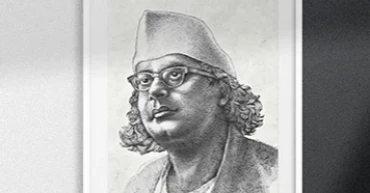
Govt officially declares Kazi Nazrul Islam as National Poet of Bangladesh
The government officially recognised Kazi Nazrul Islam as the National Poet, issuing a gazette notification on December 24.
The Ministry of Cultural Affairs made the announcement formalising a recognition long considered overdue.
This decision follows an earlier proposal approved at the Advisory Council meeting held on December 5 last year, suggesting the National Poet status be retroactively effective from May 4, 1972.
Kazi Nazrul Islam, widely revered as the “Rebel Poet,” was brought to Dhaka from Kolkata with his family on May 24, 1972. The government allocated him residence at 330-B, Road 28 (Old), Dhanmondi, to honour his contributions.
People’s power stronger than govt power: CA Dr Yunus
In a further gesture of respect, Nazrul was granted Bangladeshi citizenship on February 18, 1976 and was also awarded the prestigious Ekushey Padak that same year.
The Kazi Nazrul Islam Institute Act of 2018 officially addressed him as the National Poet, though an official gazette notification was pending until now.
The history of recognising Nazrul as a central cultural figure dates back to December 10, 1929, when he was honoured as the "National Poet" and "National Helmsman" at Albert Hall in Kolkata.
The event was attended by luminaries such as Subhas Chandra Bose, Acharya Prafulla Chandra Ray, S Wazed Ali, and Dinesh Chandra Das, representing the collective admiration of the Bengali community.
Since Bangladesh’s independence, successive presidents, prime ministers, and chief advisors have referred to Nazrul as the National Poet in official statements during celebrations of his birth anniversary. Despite widespread acceptance of his status, the absence of a formal declaration had long been noted.
Information Adviser urges secretaries to prevent lobbying in govt offices
In June 2022, Supreme Court lawyer Asad Uddin and nine others filed a writ petition seeking the publication of a gazette officially recognising Nazrul as the National Poet.
Responding to the petition, the High Court issued a rule questioning why the directive should not be enforced and instructed the Secretary of Cultural Affairs, the Director-General of Bangla Academy, and the Executive Director of the Nazrul Institute to respond within four weeks.
This gazette notification marks a historic moment, solidifying Kazi Nazrul Islam’s role as a beacon of cultural identity and resistance for the nation.
1 year ago
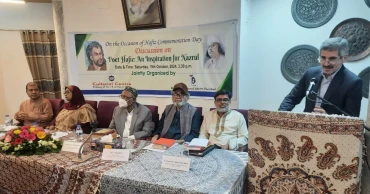
Iranian Cultural Center organises discussion on humanist poetry of Nazrul, Hafiz
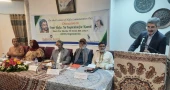
A discussion meeting and cultural programme was organized on Saturday in the capital in memory of the world famous Iranian poet Hafiz and our national poet Kazi Nazrul Islam.
Eminent nuclear scientist and founder of Bangladesh Open University Professor Dr. M Shamsher Ali, poet of the country Al Mujahidi was present as a special guest in the event while professor of Persian Language and Literature Department of Dhaka University was present as the guest of honour.
Abdus Sabur Khan, President of Bangladesh Nazrul Recitation Parishad and Shaila Ahmed, Professor of Bengali Department of Lalmatia Government Women's College and deputy secretary of Finance ministry Mohammad Jihad Uddin spoke while cultural counselor of Dhaka-based Iranian Cultural Center Syed Reza Mir Mohammadi presided over the event.
Speakers in the event said that as Bengal has a deep relationship with Persia, Bengali language and literature have many influences of Persian language and literature. Many Bengali-speaking poets have been inspired by Persian literature.
Bangladesh's national poet Kazi Nazrul Islam himself translated the poetry of Iranian poet Hafiz and Omar Khayyam, they added.
Remembering rebel poet Kazi Nazrul Islam
The speakers also said that the world-famous Iranian poet Hafiz and the national poet of Bangladesh Kazi Nazrul Islam were the poets of world humanity. Both of them sounded the same tone of human love and the union of humanity. Love is the only way to get rid of the incurable disease of conflict, and selfishness in today's human society.
1 year ago

Remove distorted version of ‘Karar Oi Louho Kopat’ from all online platforms: HC to BTRC
The High Court today (January 09, 2024) asked Bangladesh Telecommunication and Regulation Commission (BTRC) to remove the distorted re-composition of Bangladesh’s National Poet Kazi Nazrul Islam’s timeless song “Karar Oi Louho Kopat” from all online platforms, including Facebook and YouTube.
The HC bench of Justice JBM Hassan and Justice Razik-Al-Jalil passed the order after hearing a writ petition.
Barrister Mohammad Humayun Kabir, on behalf of ten lawyers of the Supreme Court and a human rights organisation Law and Live Foundation Trust, filed the writ petition on December 6.
Read: Benapole Express fire: Fire Service has no clue on the cause yet
Secretaries to the Information and Broadcasting Ministry, Information and Communication Technology Ministry, Cultural Affairs Ministry, Bangladesh Telecommunication and Regulation Commission and Kabi Nazrul Institute were made respondents.
On November 19, Barrister Mohammad Humayun Kabir sent a legal notice to the respondents seeking directives to remove the “distorted” re-composition of the national poet’s song from all online platforms.
Read: Pirojpur-2: Legal action recommended against Manju's wife
The original composer and lyricist of the song is National Poet Kazi Nazrul Islam, according to the writ petition. Renowned Indian music composer AR Rahman re-composed the song which is used in the film “Pippa.”
“Karar Oi Louho Kopat” is an immortal song and generations of listeners will be confused if both the familiar tune composed by Bangladesh’s national poet and the “distorted” version are available on online platforms, reads the writ.
2 years ago

‘Pippa’ team apologizes for AR Rahman's interpretation of Nazrul’s “Karar Oi Louho Kopat” after backlash
After massive backlash over AR Rahman’s interpretation of Bangladesh’s National Poet Kazi Nazrul Islam’s song "Karar Oi Louho Kopat" in the latest Bollywood war film “Pippa”, the makers have issued an apology on ‘X’ (formerly Twitter).
The Raja Krishna Menon-directed film, starring Ishaan Khatter, Mrunal Thakur, Priyanshu Painyuli, Soni Razdan and others, was released on November 10 on Amazon Prime Video. The film features battle between India and Pakistan in then East Pakistan during the 1971 Liberation War.
Produced by RSVP Movies and Roy Kapur Films, the film features a remake of the Nazrul song "Karar Oi Louho Kopat". The remake version has been composed by Oscar winning-music composer AR Rahman and features Indian singers Rahul Dutta, Tirtha Bhattacharjee, Pijush Das, Shrayee Paul, Shalini Mukherjee and Dilasa Chowdhury.
After the release of the song, Nazrul exponents and admirers along with general audiences in both Bangladesh and India expressed massive dissatisfaction over the remake.
Read: “Leelabati Nag: The Rebel” premiered at Liberation War Museum
In response to that, the film’s makers stated: “We understand the emotional attachment that audiences may have to the original composition, and while all art is inherently subjective, if our interpretation has hurt sentiments or caused unintended distress, we offer our sincere apologies.”
The statement notes that the producers, director and music composer of the film “Pippa” wish to clarify that their rendition of the song is a sincere artistic interpretation, embarked upon only after securing the necessary adaptation rights from the estate of the Late Kazi Nazrul Islam.
According to the statement, they approached the making of this song by faithfully following both the letter and the spirit of the license agreement for the lyrics, as duly signed by the late Kalyani Kazi and witnessed by Anirban Kazi.
“Our intent was to pay homage to the cultural significance of the song while adhering to the terms set forth in our agreement, which permitted us to use the lyrics with a new composition,” the statement claims.
Read: Something Like An Autobiography: Real Story or Just a Film?
Earlier on Saturday, several of the country’s eminent Nazrul exponents shared their official statements against the “distortion” of the song at a press conference held at the Kabi Nazrul Institute in Dhaka’s Dhanmondi.
General Secretary of Bangladesh Nazrul Sangeet Sangstha (BNSS) Khairul Anam Shakil, Kazi Nazrul Islam’s granddaughter Mistee Kazi, Nazrul exponent Sadya Afreen Mallick, veteran Nazrul singer Shaheen Samad, singer Bulbul Islam and others were present at the press conference.
According to the prominent Indian newspaper The Times of India, Kalyani Kazi’s agreement to the makers mentioned that she was "represented" to the production house as the "sole surviving legal heir" and "all rights, title and interest in the literary work are owned and vests" on her. It also stated that she was "authorized to grant the licence".
"We came to know about the agreement through the media. Legally, I am not sure if Kalyani Kazi could ignore all of us and enter into an agreement saying she is the only heir," Mistee Kazi told The Times of India.
Read: First-ever Arka Fashion Week concludes in style
2 years ago

National Poet Nazrul's 47th death anniversary being observed today
The 47th death anniversary of National Poet Kazi Nazrul Islam, widely revered for his limitless contributions to Bangla literature, is being observed in a befitting manner across the country today.
Also celebrated as the ‘Rebel Poet’, Kazi Nazrul Islam is considered a pioneer in Bangla literature.
Marking his 47th death anniversary, several organisations and institutions are holding multiple programmes throughout the day commemorating the life and works of the great poet.
Dhaka University teachers, students, officials and employees gathered at the Aparajeyo Bangla on Kala Bhaban premises alongside DU Vice-Chancellor Professor Dr Akhtaruzzaman early in the morning.
From there, they visited the poet's grave with a procession, offered wreaths and recite Fateha. Moreover, recitation of the holy Quran will be held at the university’s central mosque following Asr prayers.
Bangladesh Awami League also paid tributes at the poet’s grave with a procession and prayer.
An Awami League (AL) delegation led by its General Secretary Obaidul Quader paid homage to the poet on behalf of Prime Minister Sheikh Hasina and the party.
Read:7 best books on Bangabandhu Sheikh Mujibur Rahman
Quader urged all to be imbued with the ideologies of the National Poet to uproot communal forces from the country as they are the barriers towards development and advancement of Bangladesh.
A delegation of the BNP led by senior leader Ruhul Kabir Rizvi also paid tribute to the Rebel Poet at his grave.
Cultural institution Chhayanaut will organise a special tribute programme at its auditorium in Dhanmondi at 7 pm. The event will be simultaneously aired on its Facebook group and YouTube channel.
Several television channels, including Bangladesh Television (BTV), radio stations, including Bangladesh Betar, and online platforms are broadcasting special programmes commemorating the life and works of the National Poet.
Kazi Nazrul Islam, widely revered for his revolutionary and spectacular literary works in then-undivided India, was born in the Churulia village of Bardhaman in West Bengal, India, in 1899.
Read: Rabindranath Tagore’s 82nd death anniversary being observed
Nazrul had a brief 21-year-long literary career, during which he produced 2,600 songs, 600 poems, three books, and 43 essays, according to the Kabi Nazrul Institute.
In his early childhood, he had to work as a caretaker and as a muazzin in a mosque to support his family when his father passed away. He was forced to leave school at the age of nine in order to work for a professional "Leto" music group in Churulia, West Bengal.
While working with the group, he became familiar with Bangla and Sanskrit literature. A year later, he went back to school and enrolled at Matharun English School, but due to financial hardship, he dropped out once more in Class six.
After some time, police officer Kazi Rafizullah took him under his wing and enrolled him in Class seven at Darirampur School in Trishal, Mymensingh.
Within a few years of beginning military service in the British Army in 1917, Nazrul embarked on his literary career. He wrote the classic "Bidrohi" (The Rebel) in 1921 and founded "Dhumketu" (The Comet), a monthly journal, in 1922.
Read: National poet Kazi Nazrul Islam’s 124th birth anniversary Thursday
Due to his nationalist stance in the Indian Independence Movement, Nazrul found himself in the clutches of colonial British authorities. He wrote "Rajbandir Jabanbandi" (Deposition of a Political Prisoner) while he was incarcerated.
His works later inspired the Bangladesh Liberation War in 1971, and his poems inspired many to revolt against the oppression of Pakistan.
Freedom, humanity, love, and revolution are recurring themes throughout Nazrul's remarkable literary creations. He was against radicalism and the constraints of caste, gender, and religious prejudice.
Nazrul also published short stories, novels, and essays, although his songs and poems have received the most praise. He is renowned for his liberal use of Arabic and Farsi terms in his writings and for popularizing Bangla ghazals.
He invented his own musical genre known as "Nazrul Geeti," which consists of almost 4,000 songs he penned and composed music for, many of which were released on vinyl and HMV records.
In 1942, when Nazrul was 43 years old and suffering from an unidentified illness, he started to lose his voice and memory. His condition was later discovered to be "Pick's disease," a rare and fatal neurodegenerative disease, by a medical team in Vienna.
At the invitation of the Bangladeshi government and then President and Father of the Nation Bangabandhu Sheikh Mujibur Rahman, Nazrul's family migrated to Bangladesh and settled in Dhaka in 1972. The government of Bangladesh conferred upon him the status of "National Poet" in the same year.
Read: Why not directive to issue gazette declaring Nazrul as national poet: HC
He was awarded the honorary DLitt by Dhaka University in 1974 and he received the Ekushey Padak in 1976, for his legendary contribution to Bangla literature and culture,
On August 27, 1976, the Rebel Poet breathed his last in Dhaka and was buried next to the mosque on Dhaka University campus, fulfilling a wish he had made in one of his poems.
3 years ago

Remembering rebel poet Kazi Nazrul Islam
Saturday marks the 46th death anniversary of national poet Kazi Nazrul Islam, widely revered for his limitless contribution to Bengali literature.
To observe the day commemorating the life and works of the rebel poet, different organisations have lined up multiple programmes throughout the day.
The Ministry of Cultural Affairs paid its tributes to the poet by placing floral wreaths on his grave beside the Dhaka University Central Mosque at 7am.
Top officials of the Ministry of Cultural Affairs honoured the poet by laying floral wreaths at his grave. The programme was organised in collaboration with the Kabi Nazrul Institute and other departments and organizations under the ministry.
Dhaka University authorities also placed floral wreaths at the grave of the great poet, with a rally led by DU Vice Chancellor Dr Md Akhtaruzzaman.
Bangladesh Awami League arranged a special prayer session at the graveyard of Kazi Nazrul at 9am.
Kabi Nazrul Institute will organise a special seminar and cultural programme at Rabindra Sorobor in Dhanmondi at 5pm, which will be joined by the Ministry of Cultural Affairs Secretary Md Abul Mansur as the chief guest.
Cultural institution Chhayanaut will organise a special cultural tribute programme at its auditorium in Dhanmondi at 7pm. The event will be simultaneously broadcast on its Facebook group and YouTube channel, and the institution is dedicating this event to the late Nazrul exponent Sohrab Hossain.
Also read; Why not directive to issue gazette declaring Nazrul as national poet: HC
Marking the 46th death anniversary of the rebel poet, Bangabandhu Sheikh Mujib Medical University and Hospital (BSMMU) will lift the curtain of the Nazrul Memorial Cabin at its B Block’s 117 number cabin, the room where the poet spent his last days, in the capital’s Shahbagh.
Envisioned by BSMMU Vice-Chancellor Professor Dr Md Sharfuddin Ahmed and established in association with late Professor and Nazrul researcher Dr Rafiqul Islam and State Minister for Cultural Affairs KM Khalid, the room will be open for visitors on Saturday by State Minister for Disaster Management and Relief Md Enamur Rahman, along with cultural personality Ramendu Majumdar.
Several television channels including Bangladesh Television (BTV), radio stations, including Bangladesh Betar, and online platforms will broadcast special programmes commemorating the life and works of the national poet.
Known for his iconoclastic and majestic literary creations, Kazi Nazrul was born in Churulia village of Burdwan in the Indian state of West Bengal in 1899.
Through his fiery poems, the poet had inspired people to fight against the injustice and repression of colonial rule.
According to the Nazrul Institute, Kazi Nazrul wrote 2,600 songs, 600 poetry, three novels, and 43 articles in a career spanning 21 years before losing his speech.
After the death of his father, Kazi Nazrul obtained a job as a caregiver and also worked as a muezzin at a mosque to support his family. At the age of nine, he had to drop out of school to join a Churulia-based professional ‘leto' company.
He was introduced to Bangali and Sanskrit literature while working for the group. He returned to school a year later and enrolled at Matharun English School, but dropped out again in Class VI due to poverty.
After a while, police officer Kazi Rafizullah took him in at his home in Trishal, Mymensingh, and enrolled him in Class VII at Darirampur School.
Serving the British Army in 1917 as a soldier, Kazi Nazrul started his literary career within a few years. His cult-classic poem ‘Bidrohi’ (The Rebel) was published in 1921. A year later, he started a fortnightly magazine named ‘Dhumketu’ (The Comet).
His nationalist participation in the Indian Independence Movement landed him in the hands of colonial British authorities on several occasions.
While in prison, Kazi Nazrul authored the 'Rajbandir Jabanbandi' (Deposition of a Political Prisoner), and his creations later encouraged Bangladesh Liberation War.
Freedom, humanity, love and revolution are the constant themes in Kazi Nazrul's majestic literary creations. He was against all sorts of religious, caste-based, and gender-based discrimination and extremism.
He wrote short stories, novels and essays, but his songs and poems are his most critically acclaimed literary creations. He popularised Bengali ghazal melodies, and is noted for his liberal usage of Arabic and Persian terms in his writings.
Kazi Nazrul created a new genre in music called ‘Nazrul Geeti’, a collection of 4,000 songs that he wrote and created the music for, many of which were recorded on HMV.
In 1942, Kazi Nazrul began to lose his voice and memory due to an unexplained ailment. Later, a medical team in Vienna identified his illness as Pick's disease, a rare and incurable neurodegenerative disease.
His family travelled to Bangladesh at the invitation of then Bangladeshi government and settled down in Dhaka in 1972. For his iconic contribution to Bangla literature and culture, Dhaka University awarded him an honorary post-doctoral degree in 1974. He was awarded Ekushey Padak in 1976.
Kazi Nazrul breathed his last in Dhaka on August 29, 1976, and was buried next to a mosque on the Dhaka University campus, fulfilling a wish he had made in one of his poems.
4 years ago

Why not directive to issue gazette declaring Nazrul as national poet: HC
The High Court on Wednesday issued a rule questioning why instructions should not be given to the authorities concerned to issue a gazette declaring poet Kazi Nazrul Islam as the national poet of Bangladesh.
The HC bench of Justice Farah Mahbub and Justice Ahmed Sohel issued the ruling after hearing a writ petition in this regard.
Cultural Affairs Secretary, Bangla Academy Director General and Executive Director of Kabi Nazrul Institute were asked to respond to the rule within next four weeks.
Advocate Asad Uddin appeared for the writ petitioner while Deputy Attorney General Samarendra Nath Biswas and Abul Kalam Azad Daud for the state.
Read: HC orders providing Tk 5 lakh to legal guardian of the baby born on road in Mymensingh
On June 22, Advocate Asad on behalf of 10 Supreme Court lawyers filed a writ petition with the High Court bench.
“Though people calls Kazi Nazrul Islam as the national poet of Bangladesh, but there is no state recognition through issuing a gazette to this effect,” said Asad.
Nazrul's name has been mentioned as the national poet in two laws of Bangladesh. He was also mentioned as national poet in various government events but all are indirect recognition. Such acknowledgment may be faded in future, said the petitioner.
Besides, the poet's family has been demanding the official recognition of Nazrul as the national poet. Nazrul researchers and people related to literature and culture have also demanded it.
“But so far no visible initiative has been taken by the government in this regard. Therefore, a writ petition was filed as a conscious citizen of the country and a high court lawyer,” said Azad.
The other petitioner lawyers are — Muhammad Misbah Uddin, Md Zobaidur Rahman, Al Reza Md Amir, Md Rezaul Islam, KM Mamun-Or-Rashid, Md Asraful Islam, Shahinur Rahman, Md Rezaul Karim and Md Alauddin.
On May 31, these lawyers also served a legal notice to the government asking it to issue a gazette notification in this regard.
4 years ago

Remembering rebel poet Nazrul!
Wednesday marks the 123rd birth anniversary of national poet Kazi Nazrul Islam, widely revered for his limitless contribution to Bengali literature.
Known and regarded as the ‘rebel poet’ for his iconoclastic and majestic literary creations, Kazi Nazrul was born in Churulia village of Burdwan in the Indian state of West Bengal in 1899.
Through his fiery poems, the poet had inspired people to fight against the injustice and repression of colonial rule.
To mark the day without the fear of Covid-19 for the first time in two years, several government and non-government bodies and different cultural organisations have organised multiple cultural programmes and discussions on the life and works of the rebel poet.
This year, the birth anniversary celebration theme is the "Rebel’s Centenary".
President Abdul Hamid and Prime Minister Sheikh Hasina have issued separate messages, highlighting the colourful life of the poet and his contributions to Bangla language and literature.
In the morning, the Ministry of Cultural Affairs paid its tribute to the poet by placing floral wreaths on his grave beside the Dhaka University Central Mosque.
The main event marking the national poet's 123rd birth anniversary will take place at Cumilla Birchandra Public Library and City Auditorium (Town Hall) at 11am.
Information and Broadcasting Minister Hasan Mahmud will be present at the opening ceremony as the chief guest, which will be joined by Nazrul’s granddaughter Khilkhil Kazi as a special guest.
The country’s leading cultural institution Chhayanaut has organised a two-day 'Nazrul Uthsab' at Chhayanaut Sangskriti Bhaban, Dhanmondi, in the capital.
On Tuesday, Jatiya Kabi Kazi Nazrul Islam University (JKKNIU) in Trishal, Mymensingh, inaugurated a three-day celebration programme, featuring discussions, awards ceremony, photography exhibition and cultural programmes.
Also read: Remembering Nazrul, a poet par excellence!
4 years ago