social justice
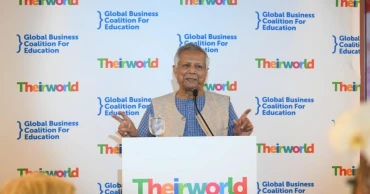
Economy must move beyond narrow wealth accumulation: Prof Yunus
Chief Adviser Prof Muhammad Yunus on Monday said they must move towards an economy that places human well-being, social justice and environmental stewardship above the narrow accumulation of wealth.
"This is not a utopian ideal. It is a necessary evolution. And at the heart of this new economy lies social business," he said, adding that social business is not a niche concept, it is a fundamental principle that business can and must exist to make a difference, not just a profit.
Prof Yunus made the remarks while delivering the keynote speech at UN high-level event on "Social Business, Youth and Technology" at UN Headquarters in New York.
It began humbly, with a one-dollar loan but today it has grown into a global movement, he mentioned.
"From healthcare and renewable energy to education and even sports social businesses are showing that it is possible to tackle the world’s most pressing challenges while remaining economically sustainable," Prof Yunus said.
UNGA: Prof Yunus, political leaders in New York
He said they are living proof that another world is within reach—a world where commerce serves humanity, where growth includes everyone and where profit is measured not only in financial returns but in lives improved, communities strengthened and our planet healed.
"Our current civilization is on a self-destructive path—one defined by endless extraction, consumption and accumulation. We are endangering the very planet that sustains us," he said.
To change course, Prof Yunus said they must build a new civilization—one motivated not by greed but by a shared commitment to solve human and planetary challenges.
In this new world, he said, wealth must be shared, not concentrated. "Power held in too few hands weakens the whole of society."
And business must be redefined, not as a vehicle for personal profit, but as an engine for social good, Prof Yunus said.
Bangladesh fully prepared for fair, peaceful election in February: Prof Yunus tells US
"This is the promise of social business. And this is how we will truly achieve the Sustainable Development Goals," he said.
But this new civilization will not be built by the same minds that created the old one, Prof Yunus said, adding that it will be designed and driven by young people—the architects of the future.
"Unlike previous generations, shaped by outdated systems, today’s youth see what could be, not just what is. Their imagination is limitless. And as I often say: 'Where imagination leads, innovation follows.' If we can imagine it, it can happen. If we don’t, it never will," he said.
Prof Yunus said, "That’s why we must encourage young people to channel their creativity into social business—where real, sustainable solutions to climate change, unemployment, poverty and inequality are born."
At this pivotal moment, Prof Yunus, called on the youth of the world to lead, not tomorrow, but today. "Dream boldly, but act deliberately. Change doesn’t have to start big."
Brink of a New Technological Era
Prof Yunus said they stand at the brink of a new technological era—one defined by artificial intelligence, big data, renewable energy and other transformative innovations.
These tools have the power to reshape industries, societies and the very fabric of human progress, he said.
"But their promise is paired with profound responsibility. Will these technologies become a blessing for humanity—or a source of harm? The answer is not yet written," Prof Yunus said.
He said it will be determined by the choices they make today and by the values they instill in tomorrow’s leaders—especially their youth.
"It is they who must step forward and guide these tools toward the common good.
When directed responsibly, technologies like AI, blockchain and the Internet of Things can dramatically accelerate our progress toward the Sustainable Development Goals," he said.
Coupled with the principles of social business—where profit is reinvested into purpose—they can revolutionize sectors from digital health and education to renewable energy and sports, he said.
Imagine AI-powered diagnostics reaching remote villages, blockchain ensuring transparency in aid distribution or IoT optimizing clean energy use in underserved communities, Prof Yunus said.
"This is not science fiction—it is the future we can build. But we must also confront the real risks: privacy breaches, algorithmic bias, cybersecurity threats, and the potential to deepen inequality," he said, adding that technology is a tool—and like any tool, its impact depends on the hands that wield it.
"That’s why we need more than technical innovation—we need ethical innovation. We need leaders who ask not only “Can we do it?” but “Should we do it?”. We need systems—like social business—that align technological advancement with social justice, equity, and environmental stewardship."
The future of technology must be shaped not by ambition alone, but by conscience, Prof Yunus said.
"Not by competition, but by collaboration. Not for the few, but for all. Let us ensure that this new technological era becomes an era of empathy, equity, and shared progress," he said.
Prof Yunus speaks of a world of "three zeros": Zero Net Carbon Emissions, Zero Wealth Concentration to End Poverty and Zero Unemployment by unleashing creativity in all.
"I also emphasise on the Zero Waste and have been a part of the UN Secretary General’s 'zero waste initiative'. This is not a dream. It is already becoming reality," he said.
That’s why, Prof Yunus said, they are encouraging young people everywhere to form 3-Zero Clubs—spaces where individuals become 3-Zero people.
A 3-Zero person commits to living sustainably, minimizing waste and embracing social entrepreneurship.
"They strive to contribute nothing to global warming, nothing to wealth inequality, and nothing to unemployment," Prof Yunus said.
As more join this movement, these clubs grow into 3-Zero families, 3-Zero villages, 3-Zero cities—and one day, a 3-Zero world.
"It starts with a single step. But together, those steps can change the world. I have always believed this forum is more than a place for speeches—it is a place for inspiration," Prof Yunus said.
"In these turbulent times, true transformation lies in our unity. If we join hands—harnessing the power of social business, the energy of youth and the potential of technology—we can untangle even the most complex global crises," he said.
Architects of New Wave
"Let us become the architects of a new wave—a world built on justice, sustainability and hope. A world where our collective dreams ignite a new dawn for all of humanity," he said.
Today, more than ever, that future stands at a crossroads, Prof Yunus said.
"Wildfires of climate change scorch the earth. The chasm of inequality grows deeper. Conflicts rage and the struggle for justice and peace tests our very humanity.
These crises are not isolated. They are intertwined—threads of a fragile tapestry, each pulling at the other, shaping the whole of our existence," he said.
What they need urgently is renewed multilateral diplomacy, deeper international cooperation, and collective commitment to sustainable development, Prof Yunus said.
Many countries, including Bangladesh, are preparing to graduate from LDC status amid severe challenges.
For Bangladesh, this includes hosting 1.3 million forcibly displaced Rohingyas, managing repeated climate shocks, and navigating global economic turbulence.
"In such a context, reducing UN budgets or shrinking official development assistance would be counterproductive. Instead, the world must redouble efforts to expand international support, provide technical assistance, and ensure a just transition for nations facing heightened vulnerability," he said.
The persistent shadow of global conflict continues to threaten peace and stability worldwide.
These are not isolated tragedies—they ripple across borders, disrupting economies, endangering food security and shattering human lives.
"In the face of such interconnected crises, we cannot resort to old solutions. What we need now—urgently—is renewed multilateral diplomacy and deeper international cooperation," Prof Yunus said.
"These conflicts do more than immediate harm; they also undermine our shared vision for a sustainable future," he said.
As an advocate for the Sustainable Development Goals, Prof Yunus has long believed that these goals cannot be fully realized within our current global system—a system still dominated by the relentless pursuit of profit over people.
"Under these conditions, the path to the SDGs can indeed appear bleak," he said.
"But I am not here to dwell on the gloom. I am here to propose a shift—a transformation of the system itself," Prof Yunus mentioned.
11 months ago

PM Hasina leaves for Geneva to attend World of Work Summit
Prime Minister Sheikh Hasina left Dhaka for Geneva, Switzerland on Tuesday (June 13, 2023) morning to attend the two-day "World of Work Summit: Social Justice for All" to be held in the Swiss city on June 14-15.
A commercial flight of Biman Bangladesh Airlines carrying the prime minister departed Hazrat Shahjalal International Airport at 10.01 am. The flight is scheduled to land at Geneva International airport at 5:30 pm local time (9:30 pm Bangladesh Time).
On June 14, UNHCR chief Flippo Grandi will call on the prime minister at the bilateral room of Hotel President Wilson.
Later the PM will call on President of the Swiss Confederation Alain Berset at Palais de Nations. After the call-on there will be a possibility of signing a Memorandum of Understanding (MoU) on Knowledge and Skills enhancement between Bangladesh and Switzerland.
Read: Work together to sustain national development: PM Hasina tells Awami League members
In the afternoon, the prime minister will address the Plenary of 'World of Work Summit 2023' at Palais de Nations.
On her arrival there, she will be greeted by ADG and Regional Director of ILO.
There will be a red carpet reception and Guard of Honour from the gate to the meeting venue.
She will also have a call on with President of Malta Dr. George Vella.
Read: PM Hasina wants greater cooperation between Bangladesh and Indian armies
In the evening, the PM will attend a dinner with high level dignitaries hosted by the DG ILO at its headquarters.
On June 15, she will attend the 'A talk at the WEF', followed by a meeting with founder of WEF Prof Klaus Schwab at WEF Office.
There, she will address at the event on "New Economy and Society in Smart Bangladesh" organised by the World Economic Forum.
In the evening, WTO DG Dr. Okonjo- Iweala will call on her at Hotel President Wilson. She will also attend a community event in the evening.
Read: Volatile global situation likely to worsen further: PM Hasina tells parliament
Hasina will leave Geneva at 11am on June 16 and she is expected to arrive in Dhaka in the early hours of June 17.
"The World of Work Summit 2023: Social Justice for All" is a high-level forum for global voices to address the need for increased, coordinated and coherent action in support of social justice, according to organisers.
It will provide an opportunity to discuss and inform the proposal to forge a Global Coalition for Social Justice, which was welcomed by the Governing Body of the International Labour Office at its 347th Session.
A number of high-level guests, including former President of France, Francois Hollande, former President of Panama, Juan Carlos Varela, and the 2014 Nobel Peace Prize Laureate Kailash Satyarthi, as well as representatives of employers and workers, will address the conference.
Read: President Erdogan and PM Hasina vow to take Dhaka-Ankara ties to new height
3 years ago

Dr. Zafrullah the warrior stops, his battles will go on
He (Dr. Zafrullah) just never stopped fighting his wars even after liberation. It never probably occurred to him to make peace with his battles and move on. In so many ways, he was the closest to what we would call a permanent warrior. He passed away but his battles will go on.
It began in his college days when he was already infected by idealism which met his "revolutionary zeal". The two made a potent broth that Zafrullah bhai drank and never stopped fighting for his causes, no matter how great his opposition was. And it's amazing when both idealism and his sense of social justice are both collectively comatose, he remained loyal to them no matter what.
Zafrullah bhai stands above most of us because he dared to stand taller than most around him. In all the years that I have known him , he has not hesitated to be himself. He followed the right wagon with as much zeal as he did the occasional wrong one’s because he was a believer in people’s rights.
What separated him from the rest was that he was selfless, totally driven by the idea that health was a right that all had a right to claim. And that it was one of the biggest democratic causes of them all. And he never stopped until death finally called his name.
Read More: People to pay tribute to Dr Zafrullah at Shaheed Minar tomorrow
The man from Sector 2
In some way, Zafrullah bhai was the perennial man from Sector 2, 1971 war. He was the helmsman of the Bisramganj hospital that he helped establish in that war zone, not just treating the warriors but training nurses and paramedics too. For many who were part of the 1971 war, it never really stops and he was one of them.
The war days belonged to the warriors but as soon as the war was over, the new state generated new needs and causes and Zafar bhai became a warrior for them. Fifty years later, it’s impossible to understand the kind of impact he had on society, emerging from the ashes of the war, who needed a voice to speak as audaciously as he did.
The health establishment
He took on the health establishment like none had done before and in this fight, many of his fellow fighters were his old comrades from Sector 2, led by Shahadat Chowdhury, Editor of the weekly Bichitra. Bichitra gave him a platform to reach out and become a vanguard as Zafrullah bhai launched media campaigns, health rights volunteers and also began to mobilize supporters to begin his greatest adventure, the Gonosasthaya complex.
The health treatment infrastructure was not a problem but when he began his pharmaceutical company, he faced massive opposition, both national and international. But with all his warrior instincts, he fought back and though he didn’t triumph, it was not a sweat for a lost cause. Today, many aspects of the general health sector cause dismay, but in some ways, health rights are more accessible for many than they were in the early days of Bangladesh particularly in machine availability.
Read More: PM mourns death of Dr. Zafrullah Chowdhury
The political Zafar bhai
I am not sure how committed he was to politics but I think he truly believed that health rights could not be assured unless political rights were won. So from the early days he supported causes and campaigns, supporting candidates, causes and political platforms right from the birth days of Bangladesh. Till the last day, he was doing what he thought was the right thing to do. Due to media exposure, many will remember him more as the political person he had become in many eyes in the last decade or so than the health rights person I saw he was most committed to as a cause.
We have walked together for long though his increasing political commitments and my lack of interest in political media and talk shows made meetings less frequent. But I remember one day, when we were both being tried in the same case –contempt of court- for a petition we had both signed, and were being searched by the High Court security. His frayed trouser end and his keychain got tangled and as he bent down to separate them he laughed in his own way and said, “Sometimes, I think it would be the best if I could go back to my village and become the local doctor”.
Farewell Zafrullah bhai, you always were our greatest village doctor.
Read More: Home Minister mourns Dr Zafrullah Chowdhury's death
3 years ago
.jpg)
Govt guarantor of social justice; governance indispensable element: Gowher Rizvi
Prime Minister's International Affairs Advisor Dr Gowher Rizvi on Wednesday said the government is the guarantor of social justice and governance is an indispensable element to ensure the equitable share of people's access and opportunity.
5 years ago