Bangladesh GDP
Climate disasters erode up to 2% of Bangladesh’s GDP
Bangladesh incurs an annual GDP loss of 1–2% due to climate change-induced disasters such as floods, droughts, cyclones, tidal surges and heatwaves.
Despite limited resources, the government has been implementing numerous initiatives to address these challenges.
However, long-term, sustainable measures and continued support from development partners remain critical.
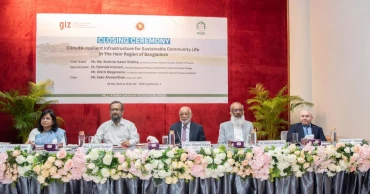
These observations were shared at the closing ceremony of the project “Climate-Resilient Infrastructure for Sustainable Community Life in the Haor Region of Bangladesh”, known as giz-Haor, held at PKSF Bhaban in the city.
The project was implemented by Palli Karma-Sahayak Foundation (PKSF) with funding from the German government.
The event was chaired by PKSF Chairman Zakir Ahmed Khan, with Md Shahriar Kader Siddiky, secretary of the Economic Relations Division, attending as the chief guest.
Fahmida Khanom, additional secretary (Environment Wing) of the Ministry of Environment, Forest and Climate Change, and Ulrich Kleppmann, deputy head of Development Cooperation at the German Embassy in Bangladesh, were present as special guests.
Joint consultation on single monitoring and compliance system held at BGMEA
PKSF Managing Director Md Fazlul Kader delivered the welcome address. Presentations were given by PKSF Deputy Managing Director Fazle Rabbi Sadeque Ahmed and General Manager AKM Nuruzzaman.
Secretary Shahriar highlighted that the government has implemented over 800 projects through the Bangladesh Climate Change Trust Fund and allocates 6–7% of the national budget annually to address climate change impacts.
He noted that Bangladesh’s two Direct Access Entities to the Green Climate Fund—PKSF and IDCOL—have secured USD 447.3 million for nine projects and eight capacity-building initiatives.
He expressed hope that PKSF would scale up its interventions to expand the positive outcomes of the giz-Haor project.
The PKSF chairman emphasised the organisation’s commitment to transparency, integrity, and rigorous monitoring, which ensures the effectiveness and quality of its interventions.
He affirmed PKSF’s continued efforts to promote sustainable and inclusive development by strengthening the adaptive capacities of climate-vulnerable communities.
Kleppmann shared that the German government is currently supporting 53 development projects in Bangladesh and reiterated Germany’s long-term commitment to climate and development cooperation.
Fahmida stated that addressing climate change cannot be the responsibility of the government alone. “This can only be achieved through collective action involving the government, private sector, and NGOs,” she stressed.
The PKSF managing director highlighted that PKSF, as a Direct Access Entity to both the Green Climate Fund and the Adaptation Fund, is undertaking various initiatives to combat floods, droughts, and salinity.
“Our efforts are improving the resilience of vulnerable communities by promoting sustainable agriculture, water resource management, and disaster risk reduction,” he added.
Under the giz-Haor project, climate-resilient infrastructure such as CC block revetments and retaining walls were constructed in three unions of Sunamganj district to protect homes from flash flood-induced erosion.
As a result, approximately 7,500 families are now safeguarded. Additionally, elevated community spaces have enhanced food storage capabilities, boosting the economic resilience of poor households.
Tree plantations along the protective structures have also contributed to biodiversity conservation. In total, 1.54 kilometers of protective walls were built in Jamalganj and Derai upazilas.
1 year ago

Bangladesh’s GDP growth slows to 3.97% in FY2024–25
Bangladesh's economy has grown by 3.97 per cent in the current fiscal year 2024–25, down from 4.22 per cent in the previous fiscal year 2023–24, according to a provisional estimate released by the Bangladesh Bureau of Statistics (BBS) on Tuesday.
In 2022–23, the growth rate stood at 5.78 per cent.
Gross Domestic Product (GDP) refers to the final value of all goods and services produced within an economy over a specific period.
According to the BBS report, the per capita income of the people of Bangladesh has now reached USD 2,820 — the highest in the country’s history.
The provisional figures were published in the BBS’s preliminary national accounts for the 2024–25 fiscal year.
Dhaka eyes $500m budgetary support, $250m for railways from Tokyo: Shafiqul Alam
The per capita income has increased by 82 dollars compared to the previous fiscal year against 2,738 dollars in the past fiscal year.
The BBS also gave the provisional account of the per capita income, gross domestic product (GDP) for the 2024-25 fiscal year.
Earlier, the highest per capita income was 2,793 dollars in the 2021-22 fiscal year. After that, the per capita income did not increase in dollar terms due to the increase in the value of the dollar.
The per capita income is not a single income of an individual. The income received in addition to the country's domestic income, including income from abroad, is the total national income of a country. This calculation is made by dividing that national income by the total population.
According to the BBS's calculations, the per capita income in the 2021-22 fiscal year was 2,793 dollars. Then, the per capita income in the 2022-23 fiscal year decreased to $2,749. In the last fiscal year, it decreased further to $2,738.
Basically, the difference in per capita income in the BBS calculation is due to the increase in the dollar exchange rate. To calculate the BBS per capita income for the current fiscal year, the average exchange rate per dollar has been taken as Tk 120.29. Last time, this exchange rate was taken as Tk 111.06.
In the current fiscal year, the per capita income in Taka terms stood at Tk 3,39,221. In the last fiscal year, it was Tk 3,04,102.
1 year ago

Bangladesh’s GDP growth plummets in Q4 of FY 2023-24: BBS
Bangladesh’s GDP growth has sharply declined in the fourth quarter (April-June) of the last financial year 2023-24, according to the Bangladesh Bureau of Statistics (BBS).
The growth was 3.91 per cent, which was 6.88 per cent in the last quarter of the fiscal year 2022-23.
The BBS released the information on Monday.
NBR focuses on boosting low tax-to-GDP ratio as major business figures come under scrutiny
As per the data, the growth in the last quarter of the last financial year has been lower compared to the last quarter of the 2022-23 fiscal year.
According to the calculation of the 4th quarter of the financial year 2023-24, the GDP size at current prices is Tk 13,783,612 million (Tk 13,784 billion) while in the 4th quarter of the financial year 2022-23 it was Tk 12,160,736 million (Tk 12,161 billion).
On the point-to-point basis at constant prices, the growth in the 4th quarter of FY2023-24 was 3.91 percent as against 6.88 percent in the 4th quarter of FY2022-23.
The growth in the first three quarters of FY 2022-23 was 6.25 percent, 7.05 percent and 3.02 percent respectively which in FY 2023-24 stood at 6.04 percent, 4.78 percent and 5.42 percent respectively.
Employment generation takes priority over GDP growth: Planning Adviser Wahiduddin
Agriculture Sector: On a point-to-point basis at constant prices, the agriculture sector grew by 5.27 percent in the 4th quarter of FY2023-24, as against 6.55 per cent in the 4th quarter of FY2022-23.
In the first three quarters of FY 2022-23, the growth of this sector was 0.22 percent, 3.83 percent and 1.92 percent respectively which stood at 0.35 percent, 4.08 percent and 5.16 percent in FY 2023-24 respectively.
Industrial Sector: On a point-to-point basis at constant prices, the industry sector grew at 3.98 percent in the 4th quarter of FY2023-24, as against 10.16 percent in the 4th quarter of FY2022-23.
In the first three quarters of the financial year 2022-23 the growth of this sector was 5.80 percent, 10.55 percent and 6.91 percent respectively which in FY 2023-24 stood at 8.22 percent, 2.91 percent and 6.25 percent respectively.
Services Sector: On a point-to-point basis at constant prices, the service sector grew by 3.67 percent in the 4th quarter of FY2023-24, compared to 4.82 percent in the 4th quarter of FY2022-23.
In the first three quarters of the financial year 2022-23 the growth of this sector was 9.43 percent, 6.37 percent and 1.45 Percent respectively which in FY 2023-24 stood at 5.07 percent, 5.78 percent and 3.81 percent respectively.
1 year ago

SMEs are lifeline to country's economy: Tipu Munshi
Commerce Minister Tipu Munshi on Wednesday said SMEs are the lifeline to the economy as its contribution to the country's GDP is about 26 percent.
5 years ago