Buet
Power Division to investigate grid failure that hit southern districts
The Power Division has formed a 7-member inquiry committee to investigate the grid failure that led to a blackout across 21 out of the country's 64 districts, all in the southern region under Barisal and Khulna divisions.
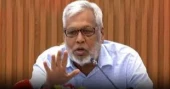
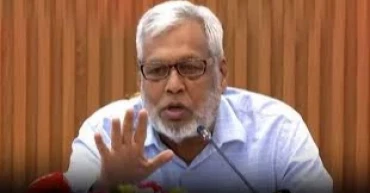
Energy Advisor Dr M Fouzul Kabir Khan announced the formation of the probe body, to be led by Pro-Vice Chancellor of Bangladesh University of Engineering and Technology (BUET) Prof Abdul Hasib Chowdhury.
The inquiry committee was asked to submit its report and recommendations within the next 7 working days.
The other members of the committee include Prof of Mechanical Engineering Department of BUET Dr Md Ehsan, Divisional Commissioner of Md Firoz Shah of Khulna, Member (P& D) of Bangladesh Rural Electrification Board and Chief Engineer of West Zone Power Distribution Company.
Addressing a press briefing at the Power Division said the committee will also look into the matter as to why the recommendations of a committee formed last in 2014 following a nationwide grid failure were not implemented.
He said the technical fault in the grid did not affect the entire country because of some measures taken up by different organisations including BPDB and PGCB.
Responding to the question he said that this year there might be some load shedding. But that power cut will always remain within a tolerable level.
“We hope the power generation will be approximately 16,500 MW against a demand of 18,000 MW,” he added.
Load-shedding to be spread equally across rural and urban areas: Energy Adviser
He admitted that in some areas there are reports of power outages. “But those occurred due to technical fault or for other reasons, not for the generation shortfall.”
He also informed that another inquiry committee was formed by the Road Transport Ministry to investigate the incident of power failure in operation of the Metro Rail in Dhaka.
“That power utilities which supply electricity to Metro Rail were not responsible. The fault caused by the Metro Rail system,” he added.
1 year ago
Bangladesh hosts first-ever renewable energy festival at Buet
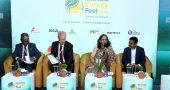
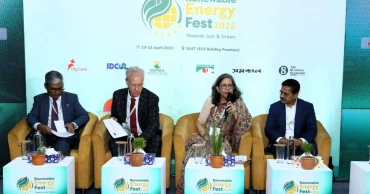
Bangladesh took a historic leap towards a sustainable future as the country’s inaugural renewable energy festival, the Renewable Energy Fest 2025, began on Wednesday at the Bangladesh University of Engineering and Technology (Buet).
Jointly organised by ActionAid Bangladesh, Buet, and the Just Energy Transition Network Bangladesh (JETnet-BD), the two-day event is envisioned as a catalyst for a just and inclusive energy transition rooted in policy reform, technological innovation and robust youth participation.
The festival opened with a spirited inauguration ceremony, where dignitaries unveiled a symbolic sculpture reflecting Bangladesh’s renewable energy ambitions.
Attendees then explored the Innovation and Technology Fair, showcasing state-of-the-art green technologies and products developed by local entrepreneurs and corporations.
A central feature of the festival is the launch of the ‘Youth Hub’—a dynamic space for youth-led discussions, workshops, cultural performances, quizzes, and networking opportunities.
The inaugural session, “The Energy Awakening: Justice, Innovation, and Power to the People,” was presided over by Farah Kabir, Country Director of ActionAid Bangladesh.
Professor Dr Abu Borhan Mohammad Badruzzaman, Vice-Chancellor of Buet, delivered the closing remarks, emphasising the role of academia in driving innovation.
Prominent guests in attendance included Dr Michal Krejza, Head of Development Cooperation at the EU Delegation to Bangladesh; Md Mahbubur Rahman, Additional Managing Director and CFO of City Bank PLC; and Alamgir Morshed, CEO of the Infrastructure Development Company Limited (IDCOL).
In a reaffirmation of national sustainability targets, stakeholders reiterated Bangladesh’s commitment to achieving 15% renewable energy by 2030 and a 100% transition by 2050.
Dhaka's renewed push puts Rohingya crisis back in global spotlight: Shafiqul Alam
Speakers called for finance-friendly, inclusive, and people-centred solutions to meet these bold goals.
Dr Krejza reaffirmed the European Union’s support:
“The EU has pledged €1.3 billion. We expect Bangladesh to increase its renewable energy usage, restructure its energy systems, and ensure political stability through democratic processes.”
Echoing the urgency, Farah Kabir stated:
“To meet the projected electricity demand of 58,410 MW by 2041, Bangladesh must invest heavily in renewable sources. This festival is a platform to align policymakers, investors, and youth around that vision.”
Md Mahbubur Rahman pointed to the critical need for streamlined financing, reduced bureaucracy, and smoother land acquisition.
Meanwhile, Alamgir Morshed advocated for tax reforms and low-interest green financing to accelerate renewable investments.
The opening day also featured three high-level policy dialogues on social and environmental implications, governance, infrastructure, women's participation, and youth engagement. The sessions—‘Power Talk: Leaders in Energy Transition’, ‘Energy Policy and Governance in Bangladesh’, and ‘Women in Renewable Energy’—set the stage for a roadmap towards future policy recommendations.
The second and final day of the festival will host three more policy dialogues and the much-anticipated ‘Power Pitch’ session, where emerging innovators will present their ideas to potential investors. The event will culminate in an awards ceremony recognising significant contributions to Bangladesh’s renewable energy landscape.
Among other notable attendees were Md. Ziaul Haque, Director at the Department of Environment; Nayoka Martinez-Backstrom, First Secretary (Environment and Climate Change) at the Swedish Embassy; Faizul Karim from the World Bank; Rayyan Hassan, CEO of Green Transition Solution; and Ibrahim Khalil Al Zayad, Chairperson of AAIBS.
The event also welcomed over 100 civil society organisations, development partners, environmental specialists, and members of the media.
1 year ago
BUET to host country's first Renewable Energy Festival from Wednesday
Bangladesh’s first-ever festival dedicated to renewable energy, the ‘Renewable Energy Fest 2025’, will kick-off at the Bangladesh University of Engineering and Technology (BUET) campus on Wednesday. The two-day festival will run from April 23-24, said the organisers.
To mark the festival, a special rally and flash mob were organised on Tuesday in Dhaka as part of the global “Fund Our Future” campaign.
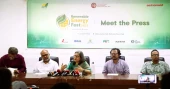
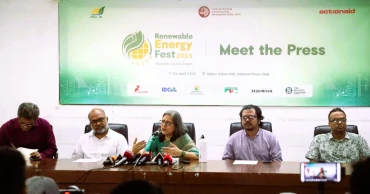
During the event, participants called for an end to fossil fuel financing and advocated for increased investment in renewable energy. The objectives and activities of the Renewable Energy Fest were also outlined at a press conference on the same day.
The festival is a joint initiative of ActionAid Bangladesh, BUET, and the Just Energy Transition Network Bangladesh (JETnet-BD).
Land-based LNG terminal near Matarbari to be implemented under PPP
A spirited rally set off from Doel Chattar, passed by Shikkha Bhaban, and concluded in front of the National Press Club. Over 150 young climate activists from 10 youth organisations took part in the lively and peaceful rally, brandishing placards, artworks, songs, and posters demanding climate justice.
Farah Kabir, Country Director of ActionAid Bangladesh, Abul Kalam Azad, Manager of the Just Energy Transition team, Mostafa Al Mahmud, President of the Bangladesh Sustainable and Renewable Energy Association (BSREA); Mukaddim Sarwar, Senior Assistant Vice President of Infrastructure Development Company Limited (IDCOL); Rashed Ibn Obaid Ripon, member of the coordinating committee of Jetnet-BD and representatives from The City Bank were present at the press conference.
The conference highlighted the aims and activities of the Renewable Energy Fest, the urgent need for a just energy transition in Bangladesh, and the critical role of youth in this process.
1 year ago
Is an alternative capital to Dhaka feasible?
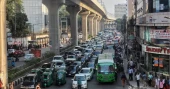
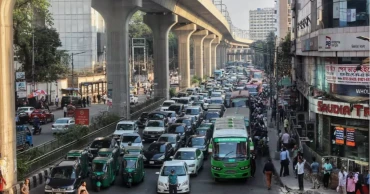
Zahidur Rahman, a businessman, was walking through Paltan in the capital when a sudden gust of wind blew dust into his nose and mouth, while vehicles around him blared their horns so loudly that even pressing his ears with both hands offered no relief.
"This city is no longer liveable. The only reason I stay here is for work. Otherwise, I would have left long ago. Everything is centralised in Dhaka, forcing citizens to crowd into the city. Even if one wishes to leave in search of a safer life, it is not a viable option," he said.
The city’s public transport is often so overcrowded that passengers barely find standing room. Many are seen clinging to bus doors at great risk.
Maruful Haque, an official at a private bank, shared his daily struggle saying, "Finding space on a bus during office hours is nearly impossible. But skipping work is not an option. So, we push our way inside or hang onto the door—whatever it takes to reach the office."
The congestion is not limited to buses. Roads remain gridlocked, while footpaths are barely walkable. "But there is no alternative. We must live in this city. We cram onto buses, struggle through traffic and reach work exhausted. This is our daily reality," Maruful lamented.
The Case for an Alternative Capital
Professor Dr M Shamsul Hoque from the Department of Civil Engineering at Bangladesh University of Engineering and Technology (Buet) believes the discussion on relocating the capital is beyond debate.
"Around 40 countries have moved their capitals, and some are in the process. Most recently, Indonesia relocated its capital to Nusantara, and Egypt is following suit," he said.
He added, "Just as a doctor can tell when a patient’s heartbeat is slowing irreversibly, Dhaka is beyond repair. Despite massive investments, there has been no improvement. The city has become non-responsive."
Is it possible to remove rickshaws from Dhaka? Experts say ‘yes’
Countries such as India, Pakistan, Brazil, Nigeria, Myanmar, Malaysia, Indonesia, Egypt, and South Korea have either moved or are moving their capitals, mainly due to overpopulation and traffic congestion.
Other concerns include groundwater depletion, environmental degradation, pollution and natural disasters. Many nations aim to create modern, smart, environmentally sustainable, and investment-friendly capitals.
Purbachal: A Missed Opportunity?
According to Dr Hoque, Dhaka urgently needs an alternative, and Purbachal could have been a viable option. "Some may find this idea shocking, others emotional. But the country cannot run on emotions. Had we planned earlier, Purbachal could have been an affordable alternative capital."
He explained, "Purbachal is elevated and flood-free—an essential feature for a capital. Unlike other parts of Dhaka, which required landfilling, Purbachal has naturally solid ground, reducing construction costs."
But, the area has now been turned into a township. "We have distributed plots, making individuals millionaires. This is an injustice no modern nation would commit. In a densely populated country like ours, plots should not be allocated in this manner—flats would have been more appropriate."
Dr Hoque also pointed out Dhaka’s deteriorating condition. "In 2005, the average vehicle speed was 25 km/h; now, it has dropped to 5 km/h. Dhaka’s heartbeat is nearing zero. Despite all efforts, the city continues to decline."
A City Beyond Its Capacity
Dr Akter Mahmud, a professor of Urban and Regional Planning at Jahangirnagar University, highlighted Dhaka’s alarming population density. "The city covers only 300 square kilometres but houses around 15 to 20 million people, although official statistics claim 10.6 million. That is inaccurate."
"With 48,000 people per square kilometre, Dhaka is the world’s most densely populated capital. Ideally, a city should have no more than 200 people per acre, but in some areas, like Lalbagh, it reaches 600."
Such overpopulation leads to severe consequences: "Pollution of air and water, traffic congestion and a lack of open spaces and parks. Schools lack playgrounds, and children grow up in cramped conditions, affecting their mental development."
Dr Mahmud said, "Essential services cannot meet demand. Securing a doctor’s appointment is a challenge. Public transport, hospitals, and other facilities are overcrowded. This results in poor living standards."
Addressing the problem is not simple, he warned. "People flock to Dhaka for jobs, education, and healthcare. Additionally, river erosion and other factors force migration. While shifting the capital may be costly for a country like Bangladesh, decentralising services can be an effective solution."
A Multi-Capital Approach?
Dr Mahmud suggested a different strategy: "Malaysia established Putrajaya as an administrative capital, while Frankfurt serves as Germany’s financial hub. Bangladesh could designate Chattogram as the economic capital while keeping administrative functions in Dhaka or another city like Cumilla."
Opt for renewable energy to make city livable: Experts
Investing in other cities could gradually reduce Dhaka’s burden, he argued. "More government and private sector investment in divisional and district towns would generate jobs and encourage people to stay in their hometowns."
Opposition to an Alternative Capital
However, Dhaka North City Corporation Administrator Mohammad Ejaz dismissed the idea of an alternative capital.
"This is impractical. Look at Malaysia or other countries that moved their capitals—many were ineffective. Dhaka is not inherently dysfunctional; it is our mismanagement that has caused the issues," he said.
He insisted, "If Dhaka were unliveable, people wouldn’t keep coming. Try stopping them—they will still find a way in. The city is alive, which proves it is functioning."
"Labelling Dhaka ineffective is baseless. Instead of seeking alternatives, we should focus on making it more liveable—something that has never been properly attempted," he added.
1 year ago
HC upholds death sentences for 20 Buet students in Abrar Fahad murder case
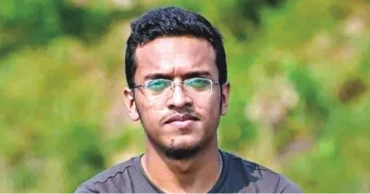
The High Court (HC) on Sunday upheld the trial court’s verdict, confirming the death penalty for 20 students of Bangladesh University of Engineering and Technology (Buet) and life imprisonment for five others in the sensational Abrar Fahad murder case.
A High Court bench comprising Justice AKM Asaduzzaman and Justice Syed Enayet Hossain delivered the verdict in a jam-packed courtroom.
Earlier, on Saturday, the HC had scheduled Sunday for pronouncing its verdict on the death references and appeals filed by the convicts. The hearing on these matters concluded on February 24, after which the case was kept under review.
What Abrar Fahad's parents said regarding Chhatra League ban
Abrar Fahad, a second-year student of Buet’s Electrical and Electronic Engineering (EEE) department, was beaten to death on October 6, 2019, by activists of the Bangladesh Chhatra League (BCL) at Sher-e-Bangla Hall.
The attack was reportedly triggered by a Facebook post Abrar had made about water-sharing issues between Bangladesh and India. His body was later found on the dormitory’s staircase.
The following day, Abrar’s father filed a murder case at Chawkbazar Police Station. The incident sparked nationwide outrage, leading to widespread protests.
On December 8, 2021, a Dhaka court sentenced 20 Buet students to death and handed life imprisonment to five others for their involvement in the murder.
HC resumes hearing on death references in Abrar murder case
Convicts and sentences
The 20 students sentenced to death are: Mehedi Hassan Rasel, Anik Sarker, Mehedi Hassan Robin, Ifty Mosharaf Sakal, Moniruzzaman Monir, Meftahul Islam Jiyon, Majedur Rahman, Muzahidur Rahman, Tabakhairul Islam Tanvir, Hossen Mohammad Toha, Shamim Billah, Nazmus Shadat, Muntasir Al Jemi, Mizanur Rahman, Mahmud Setu, Shamsul Arifin Rafat, Morshed Omorto Islam, Ehtesamul Rabbi, Morshed Uzzaman Jishan, Mujtaba Rafeed,
The five students who received life imprisonment are: Muhtasim Fuyad, Akash Hossain, Mowaz Abu Horaira, Omit Shaha and Ishtiaq Hassan Munna.
Of the total 25 accused in the case, five are on the run.
The HC began hearing the death reference and appeals on November 28 last year before reaching its final decision today.
1 year ago

No problem with student politics, concern is control of one student body: Gayeshwar
BNP senior leader Gayeshwar Chandra Roy on Monday (April 01, 2024) said student politics on the university campuses is not the problem, the concern is over the control of a single student organision on the campuses.
“Buet authorities will take decision whether they will allow student politics on the campus or not. Because of that (Abrar Fahad killing) the Buet authorities had banned student politics on the campus, they will see whether such situation is still continuing or not and take decision accordingly,” he said.
He said these while talking to reports after visiting injured BNP Natore district unit’s join convener Dewan Shahin at Bangabandhu Sheikh Mujib Medical University (BSMMU). Dewan Shahin recently got seriously injured in an attack allegedly by some Awami League men.
Gayeshwar, a BNP standing committee member, said the situation at Jahangirnagar University is worse where Bangladesh Chhatra League secretary Manik had celebrated ‘rape century’. “It was stigma for the nation. But AL considers this shame as ornaments.”
Read more: Student politics could be returning to Buet, VC indicates
They are behaving recklessly with the support of the administration, he alleged.
He said ruling Awami Legue (AL) is staying in power unleashing atrocities and by using muscle power against oppositions.
In the last 15 years Natore BNP leaders have been facing inhuman torture by AL men. “Despite oppression the leaders and activists did not leave BNP. The scenario of torture on BNP men across the Bangladesh is same to Natore,” he said.
Terming AL as an isolated political party, Gayeshwar said without terrorist activities they (AL) could not survive in politics.
Read more: BCL no longer hiding its intention to rule BUET campus
“In this situation we have to raise our voice and get ready to give reply to their brutality,”he said.
Responding to a question from reporters, the BNP leader said the government is waiting to hear the death news of BNP Chairperson Khaleda Zia.
“I guess sweetmeat will be distributed at Gano Bhaban once they hear her death news.”
“We have nothing to expect from this government. But what they are doing with the BNP Chairperson will be considered as a planned murder,” he said.
Read more: Following legal reversal of ban, general students and BCL respond with differing visions for Buet’s future
2 years ago

Student politics could be returning to Buet, VC indicates
In view of the High Court's statement that “There is no obstacle to student politics in Bangladesh University of Engineering (Buet), Vice-Chancellor Dr. Satya Prasad Majumdar today (April 01, 2024) gave a clear indication that student politics might be returning to Buet campus.
Speaking to the media at his office today, the Buet VC said, “We have to accept what the High Court says. Court order must be obeyed. To implement this, we have to go through some process.”
HC wants to know why ban on politics in Buet shouldn't be declared illegal; stays decision
The Vice-Chancellor said that in order to maintain discipline on the campus, students, teachers and the administration have to reach a mutual decision, and for this to happen, discussion is necessary.
“We will look into the matter based on discussion among teachers, students and the administration,” the Buet VC added.
Read more: Following legal reversal of ban, general students and BCL respond with differing visions for Buet’s future
2 years ago
HC wants to know why ban on politics in Buet shouldn't be declared illegal; stays decision
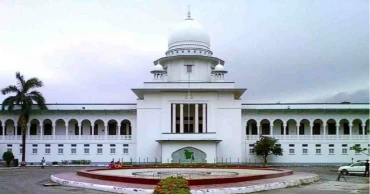
The High Court on Monday stayed the decision of Bangladesh University of Engineering and Technology (Buet) authorities restricting politics on the campus.The HC bench of Justice Md Khasruzzaman and Justice KM Zahid Sarwar passed the order after hearing a petition filed by Imtiaz Rahim Rabbi, also a Buet student and a leader of Chhatra League, whose hall allotment was cancelled recently amid students’ protest against the gathering of some BCL leaders on the campus defying ban.
BCL no longer hiding its intention to rule BUET campusThe HC also issued a rule asking the government to explain as to why the decision of Buet authorities banning politics on the campus, taken in 2019, should not be declared illegal.Secretary to the Home Ministry, Buet Vice-Chancellor and its registrar were made respondents to the rule.Senior Advocate Shaha Manjurul Haque stood for the petitioner while Deputy Attorney General Samrendra Nath Biswas and assistant attorney general Abul Kalam Khan Daud represented the state.Advocate Manjurul said with this order there is no bar to continue student politics on the campus.On October 7, 2019, Abrar Fahad, a second-year student of Electrical and Electronic Engineering, was beaten to death by a group of Chhatra League (BCL) activists at the university's Sher-e-Bangla Hall in the early hours.On October 11, same year, Buet authorities banned student politics on the campus. It also issued a notification in this regard.
Don’t want BUET to become a breeding ground for negative political activities and militancy: QuaderOn July 19 2023, the Buet authorities again issued a notice prohibiting students and teachers from participation in politics on the campus. They issued the notice following media reports about the names of the members of BCL Central Committee where some students of Buet also got some posts in the committee.On Thursday night , some BCL leaders including the president Saddam Hossain entered the campus, sparking anger among general students.The staged demonstrations the following day protesting bid to revive political activities of BCL. They also held a press conference in front of Buet Shaheed Mianr on that day and continued their demonstration till Friday evening after taking position in front of the office of Directorate of Student Welfare on the campus.Later, the authorities concerned cancelled the hall allocation of Imtiaz who allegedly played a vital role in facilitating the entry of the BCL men.
A probe body was formed in this connection and it was asked to submit its report within April 8.
2 years ago

3 Bangladeshi universities to get $100 million from ADB to improve CSE, IT programs
The Asian Development Bank (ADB) and the Government of Bangladesh on Tuesday (November 28, 2023) signed a $100 million loan agreement to improve computer science, software engineering, and information technology (IT) programs in three universities in Bangladesh.
Md. Shahriar Kader Siddiky, Secretary, Economic Relations Division (ERD), and Edimon Ginting, Country Director, ADB, signed the loan agreement on behalf of Bangladesh and ADB, respectively, at a ceremony at ERD in Dhaka.
“This project will help accelerate fourth industrial revolution technology adoption, realize the vision of Digital Bangladesh, and enable the country to reap the demographic dividend by creating digitally qualified young human resources and entrepreneurs,” said ADB Country Director Edimon Ginting.
“This new initiative builds on ADB’s ongoing skills development support through industry partnerships to increase competitiveness and foster innovation,” he said.
Read: ADB to provide $200 million to promote energy efficiency, transition in Bangladesh
The Improving Computer and Software Engineering Tertiary Education Project will upgrade the computer science and engineering, software engineering, and information technology degree programs of the leading public universities in Bangladesh. The universities receiving the funding are: Bangladesh University of Engineering and Technology (BUET), University of Dhaka (DU), and Jashore University of Science and Technology.
These programs will adopt blended learning techniques and integrate the latest technologies such as artificial intelligence, robotics, and internet of things.
These programs will seek international accreditation to ensure that students get updated curricula that adhere to international standards.
Read: ADB to lend $336.5 million to Bangladesh to help develop vaccine production
ADB will support the establishment of modern classrooms and laboratories, collaboration and start-up spaces, and auxiliary facilities in the three universities.
These facilities will incorporate climate- and disaster-resilient designs, energy- and water-saving features, and will include women-friendly amenities and services.
The universities will develop capacities of teachers to be proficient in new instructional approaches and emerging digital technologies.
The students and teachers from the three and other universities will also work with industry partners to come up with innovative solutions through joint research and development.
Mandatory internship opportunities, career counseling, and industry placement will be provided to undergraduate students, particularly for women.
Read: ADB provides $90 million for clean water, sanitation services in the Hill Tracts
2 years ago

BUET students take oath against student politics on campus
Following the recent incident of arrests of a group of BUET students from Sunamganj Tanguar Haor and their being freed on bail, general BUET students have taken an oath to ensure a safe campus.
In this regard, BUET students collectively staged a program in front of the BUET cafeteria on Tuesday and took oath.
The oath said: "I promise that from this moment on, as a member of the Bangladesh Engineering University family, I will fulfill all the personal and collective moral and human responsibilities assigned to me for the welfare and safety of all of this university with utmost honesty and devotion."
BUET students protest as Abrar Fahad's murder accused attends class
"I will always be vocal against every injustice and discrimination that I am aware of on the campus of this university."
"I also pledge that we will collectively prevent all forms of terrorism and communal violence from arising in this university. We will root out all forms of discriminatory subculture and abuse of power inconsistent with morality. So that no more innocent lives will be lost in this yard. We will ensure that no innocent student be is subjected to torture from now on."
24 Buet students, 8 others granted bail 2 days after arrest during Tanguar Haor tour
After taking the oath, the students arranged a press conference at the same place.
Demanding a proper investigation to look about the running BUET students- who were arrested from Sunamganj after being doubted as 'Shibir activists' , students said, "We have requested authority to make a probe and we also requested the authority to take immediate steps if they are found guilty. "
34 Buet students among 36 detained while touring Tanguar Haor
"Again, we BUET students expressed our strong position against the return of Ashikul Islam Bitu who was found guilty by BUET authority for ragging and uncooperative manner during Abrar Fahad's murder investigation. We will not share classes with such a notorious person and if BUET authorities do not take any steps quickly, we will not think twice to boycott classes," they said.
3 years ago