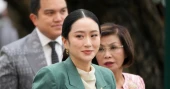
Thailand’s prime minister
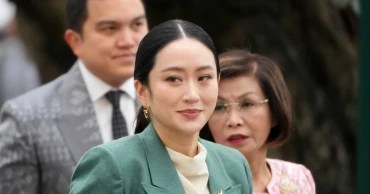
Thai court suspends PM Paetongtarn Shinawatra over leaked phone call
Thailand's Constitutional Court suspended Prime Minister Paetongtarn Shinawatra from office pending an investigation over a leaked phone call with a former Cambodian leader.
The judges voted unanimously Tuesday to take the petition accusing her of a breach of ethics, and voted 7 to 2 to suspend her from duty.
Paetongtarn has faced growing dissatisfaction over her handling of the latest border dispute with Cambodia, involving an armed confrontation on May 28 in which one Cambodian soldier was killed. The leaked phone call while she engaged in diplomacy over the border dispute set off a string of complaints and public protests.
Paetongtarn said Monday she would accept and follow the court process although she didn’t want to see her work interrupted. “If you ask me whether I’m worried, I am,” she told reporters.
Earlier Tuesday, King Maha Vajiralongkorn had endorsed a Cabinet reshuffle forced when a major party left Paetongtarn's coalition government over the leaked phone call.
The reshuffle replaced former Deputy Prime Minister Anutin Charvirakul, leader of the Bhumjaithai Party, which had held several Cabinet positions in her government.
Protesters in Bangkok demand Thai prime minister's resignation
Paetongtarn also faces investigations over an alleged breach of ethics by the Office of the National Anti-Corruption Commission, whose decision could also lead to her removal.
Outrage over the call mostly revolved around Paetongtarn’s comments toward an outspoken regional army commander and her perceived attempts to appease Cambodian Senate President Hun Sen to ease tensions at the border.
Thousands of conservative, nationalist-leaning protesters rallied in central Bangkok on Saturday to demand Paetongtarn’s resignation.
1 year ago
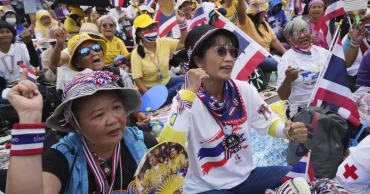
Protesters in Bangkok demand Thai prime minister's resignation
Thousands of demonstrators took to the streets of Bangkok on Saturday, demanding the resignation of Prime Minister Paetongtarn Shinawatra amid escalating political tensions triggered by a leaked phone conversation with former Cambodian leader Hun Sen.
Public anger has been mounting over Paetongtarn’s handling of a recent border clash with Cambodia, which erupted on May 28 in a disputed area and resulted in the death of a Cambodian soldier.
The leaked phone call with Hun Sen, who now serves as Cambodia’s Senate president, has become a focal point of the protests and has sparked multiple investigations in Thailand that could potentially unseat Paetongtarn.
Criticism of the prime minister centers on her remarks regarding a prominent regional military commander and her apparent attempts to placate Hun Sen in an effort to de-escalate tensions along the border.
Thai PM’s leaked conversation with Hun Sen ignites political crisis and public fluster
Protesters, waving national flags and holding banners, gathered around Bangkok's Victory Monument, where a large stage was set up. Speakers urged unity and expressed their love for the country, while demonstrators chanted slogans, sang, and danced to patriotic songs.
Tatchakorn Srisuwan, a 47-year-old tour guide from Surat Thani province, said he traveled overnight to join the demonstration, condemning Paetongtarn’s leadership.
“As a Thai citizen, I’ve never seen a prime minister so weak,” he said. “We don’t want to invade others, but we must stand up for our sovereignty.”
The protest saw participation from prominent members of the so-called Yellow Shirts movement, known for their royalist stance and opposition to the Shinawatra family. The group has long been critical of Paetongtarn’s father, former Prime Minister Thaksin Shinawatra, who is believed to have close ties with Hun Sen.
Yellow Shirt protests in the past have been linked to political unrest, including the military coups that ousted Thaksin in 2006 and Paetongtarn’s aunt, Yingluck Shinawatra, in 2014.
1 year ago
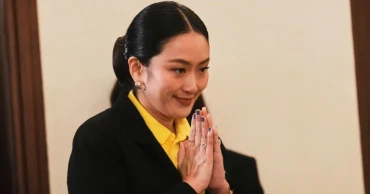
Thai PM’s leaked conversation with Hun Sen ignites political crisis and public fluster
Thailand’s Prime Minister Paetongtarn Shinawatra is under mounting pressure to resign amid a deepening political crisis sparked by a leaked phone call with Cambodia’s former leader, which has intensified tensions over a recent border dispute between the two countries.
On Thursday, Paetongtarn publicly apologized after a key coalition ally withdrew support for her Pheu Thai Party-led government, citing the controversial recording. The prime minister has already been under fire from nationalist critics for what they see as a lenient approach toward Cambodia — a sensitive issue given the longstanding enmity between her father, former PM Thaksin Shinawatra, and Thai right-wing factions.
The latest row follows a deadly border clash on May 28 in a disputed area, which resulted in the death of a Cambodian soldier.
Controversial Leak and Fallout
Cambodia’s Senate President Hun Sen, who served as prime minister for decades, released the entire 17-minute phone conversation on Facebook after a shorter version had been leaked a day earlier. He said the call was recorded to prevent “misunderstanding or misrepresentation” and noted that he had shared it with over 80 individuals.
In the recording, Paetongtarn is heard addressing Hun Sen as “uncle” while the two, speaking through interpreters, discussed easing border restrictions following the deadly skirmish. Controversy erupted after she referred to the Thai military commander stationed at the disputed zone as “an opponent,” which critics say signaled weakness and deference to Cambodia.
Aung San Suu Kyi’s supporters strive to set world record to honor her 80th birthday
Paetongtarn defended her comments, stating they were part of a negotiation strategy aimed at de-escalating tensions and fostering peace. However, she announced she would no longer hold private talks with Hun Sen, accusing him of prioritizing domestic popularity over regional diplomacy.
“It is now evident that his concern lies solely with boosting his image at home, with little regard for the consequences on bilateral relations,” she said.
Thailand’s Foreign Ministry lodged a formal protest with the Cambodian ambassador, denouncing the leak as “a breach of diplomatic etiquette, a serious violation of trust, and harmful to neighborly conduct.”
Paetongtarn has previously emphasized the personal ties between the Shinawatra and Hun families. Her father Thaksin and Hun Sen have long referred to each other as “godbrothers.” In 2009, Hun Sen controversially appointed Thaksin as an adviser to the Cambodian government, though Thaksin resigned shortly thereafter.
Mounting pressure
Hours after the leak, the Bhumjaithai party, the biggest partner in Paetongtarn’s ruling coalition, said it would quit because of the leaked phone call. The party's statement said the recording “posed an impact on Thailand’s sovereignty, territory, interests and the army.” The party called for Paetongtarn to take responsibility for the damage, although they did not say how.
There has already been a rift between Bhumjaithai and Pheu Thai over reports that the former would be shuffled out of the powerful Interior Ministry. Several Bhumjaithai leaders are also under investigation over the alleged rigging of the Senate election in which many figures who are reportedly close to the party claimed a majority of seats.
India and Canada to resume diplomatic ties nearly two years after Sikh Separatist killing
The departure of Bhumjaithai left the 10-party coalition with 255 seats, just above the majority of the 500-seat house.
Opposition leader Natthaphong Ruengpanyawut of the People’s Party on Thursday called for Paetongtarn to dissolve Parliament and hold a new election. He said the leaked phone call was “the last straw” that destroyed people's faith in her administration.
Dozens of nationalists protesters gathered near the Government House on Thursday, holding Thai national flags and signs calling for Paetongtarn to resign. Some senators said they will file a motion to impeach her, and several other individuals also filed complaints over the matter to law enforcement agencies.
People have also expressed concern that Paetongtarn’s comment towards the local army commander could potentially lead to a military coup. Her father, Thaksin, was ousted in a coup in 2006, and Thaksin’s sister, Yingluck Shinawatra, became prime minister in 2011 and was also toppled by the military in 2014.
The military said in a statement Thursday that it would like the people to “maintain confidence in the Royal Thai Army’s steadfast commitment to constitutional monarchy and its readiness to execute its constitutional mandate of protecting national sovereignty through established legal frameworks and institutional mechanisms."
1 year ago

Thailand denies forcing fleeing villagers back to Myanmar
Thailand’s prime minister denied Tuesday that his country’s security forces forced villagers back to Myanmar who had fled from military airstrikes, saying they returned home on their own accord.
Prime Minister Prayuth Chan-ocha, nevertheless, said his country is ready to shelter anyone who is escaping fighting, as it has done many times for decades. His comments came a day after humanitarian groups said Thailand has been sending back some of the thousands of people who have fled a series of air attacks by Myanmar's military.
“There is no influx of refugees yet. We asked those who crossed to Thailand if they have any problem in their area. When they say no problem, we just asked them to return to their land first. We asked, we did not use any force,” Prayuth told reporters.
“We won’t push them back,” he said. ’If they are having fighting, how can we do so? But if they don’t have any fighting at the moment, can they go back first?”
The governor of Thailand's Mae Hong Son province, where as many as 3,000 refugees had sought shelter, said later that those still on Thai soil were expected to return to their own country in a day or two.
The weekend attacks, which sent ethnic Karen people to seek safety in Thailand, were another escalation in the violent crackdown by Myanmar’s junta on protests against its Feb. 1 takeover.
At least 510 protesters have been killed since the coup, according to Myanmar’s Assistance Association for Political Prisoners, which says the actual toll is likely much higher. It says 2,574 people have been detained.
Protests continued Tuesday despite the deaths of more than 100 people on Saturday alone.
Engineers, teachers and students from the technology university in the southern city of Dawei marched without incident.
The number of protesters killed in the city rose to eight with the announcement of the death of a teenager who was shot by soldiers on Saturday as he rode a motorbike with two friends. According to local media, a hospital certificate attributed his death to “serious injuries as he fell from a motorbike.”
Medical workers in Mandalay, the country’s second biggest city, honored three of their colleagues who have been killed by security forces. The two doctors and a nurse were remembered in a simple ceremony in front of a banner with their photographs and the words “Rest In Power.”
At a cemetery in the biggest city, Yangon, three families gave their last farewells to relatives killed Monday in a night of chaos in the South Dagon neighborhood. Residents said police and soldiers moved through the streets firing randomly with live ammunition.
The coup that ousted the government of Aung San Suu Kyi reversed the country's progress toward democracy since her National League for Democracy party won elections in 2015 after five decades of military rule.
At Thailand’s Mae Sam Laep village along the Salween River, which forms the border with Myanmar, paramilitary Thai Rangers on Tuesday twice waved off a boat that had come from the other side carrying seven people, including one lying flat and another with a bandage on his head. But ambulances soon arrived on the Thai side and it landed anyway.
Thai villagers helped medical staff carry the injured people on stretchers to a small clinic at a nearby checkpoint. One man had large bruises on his back with open wounds, an injury one medical staffer said could have been caused by an explosion.
An elderly woman in the group had small cuts and scabs all over her face. Thai nurses in protective gear to guard against COVID-19 attended to her, giving her and others tests for the coronavirus.
Another villager from the boat, 48-year-old Aye Ja Bi, said he had been wounded by a bomb dropped by a plane. His legs were hit by shrapnel and his ears were ringing, he said, but he was unable to travel to get help until Tuesday.
The airstrikes appeared to be retaliation for an attack by guerrillas of the Karen National Liberation Army on a government military outpost, in which they claimed to have killed 10 soldiers and captured eight. The group is fighting for greater autonomy for the Karen people.
About 2,500-3,000 refugees crossed into Thailand on Sunday, according to several humanitarian aid agencies who have long worked with the Karen.
They said on Monday, however, that Thai soldiers had begun to force people to return to Myanmar.
“They told them it was safe to go back even though it is not safe. They were afraid to go back but they had no choice,” said a spokesperson for the Karen Peace Support Network, a group of Karen civil society organizations in Myanmar.
The army has restricted journalists’ access to the area where the villagers crossed the border.
Myanmar’s government has battled Karen guerrillas on and off for years — along with other ethnic minorities seeking more autonomy — but the airstrikes marked a major escalation of violence.
Political organizations representing the Karen and Kachin in northern Myanmar have issued statements in recent weeks warning the government against shooting protesters in their regions and threatening a response.
They were joined Tuesday by the Three Brothers Alliance, which represent the guerrilla armies of the Rakhine, Kokang and Ta-ang -- also known as Palaung -- minorities.
The alliance condemned the killing of protesters and said if it did not stop immediately, they would abandon a self-declared cease-fire and join with other groups to protect the people.
Their statement, like those of the Karen and Kachin, seemed to suggest that any military response by them would be in their home areas, not in the cities of central Myanmar where the protests and repression have been the strongest.
Supporters of the protest movement are hoping that the ethnic armed groups could help pressure the junta. Protest leaders in hiding say they have held talks, but there have been no commitments.
The United States on Monday suspended a trade deal with Myanmar, also known as Burma, until a democratic government is restored in the Southeast Asian country.
The office of the U.S. Trade Representative said the country was immediately suspending “all U.S. engagement with Burma under the 2013 Trade and Investment Framework Agreement.″ Under the agreement, the two countries cooperated on trade and investment issues in an effort to integrate Myanmar into the global economy, a reward for the military’s decision to allow a return to democracy — a transition that ended abruptly with last month’s coup.
The announcement Monday doesn’t stop trade between the two countries. Last week, the United States restricted American dealings with two giant Myanmar military holding companies that dominate much of that country’s economy.
5 years ago