ISO
BFSA flags alarming trans fat levels despite regulations
Despite regulations to control harmful trans fatty acids in food the overall market situation remains alarming, said the Bangladesh Food Safety Authority (BFSA).
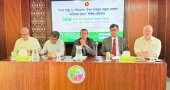
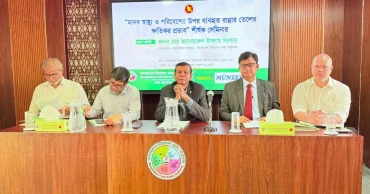
It raised the concern at a seminar titled “Harmful Effects of Used Cooking Oil on Human Health and the Environment” held on Monday at the BFSA seminar room.
The awareness seminar was jointly organised by BFSA and Munzer Bangla Private Limited. BFSA Chairman Anwarul Islam Sarkar and Martin Shestag, Project Manager (South Asia) of Munzer Bioindustrie GmbH, were present at the event.
According to BFSA, analysis of edible oil samples collected across the country in FY 2024–25 revealed widespread non-compliance with safety standards.
Test results showed that 7 out of 11 soybean oil samples (63%), 93 out of 95 dalda samples (97%), 26 out of 30 butter samples (86%), and 6 out of 14 margarine samples (42%) contained trans fatty acids above the permissible limit.
The authority said that under the Trans Fatty Acid Control Regulations 2021, the maximum allowable limit of trans fat is 2 percent (excluding naturally occurring trans fat), effective from December 31, 2022.
The regulation applies to all processed, packaged and prepared foods, and products cannot be labelled as ‘trans fat-free” or “zero trans fat’.
BFSA officials said inspections in hotels and restaurants frequently detect irregularities, particularly the repeated use of burnt cooking oil, which poses serious health risks.
As part of its ongoing efforts, BFSA collects used cooking oil from restaurants and conducts awareness campaigns through bulk SMS, posters and TV scroll messages, urging traders and consumers to avoid repeated use of cooking oil.
The authority follows internationally recognised testing methods for detecting trans fatty acids, including those approved by the World Health Organization (WHO), International Organization for Standardization (ISO), Association of Official Analytical Chemists (AOAC), American Oil Chemists’ Society (AOCS) and International Dairy Federation (IDF).
However, BFSA acknowledged several challenges, including limited laboratory capacity, shortage of skilled manpower, lack of chemical reagents and low public awareness.
In its presentation, Munzer Bioindustrie GmbH said cooking oil becomes hazardous when repeatedly heated at 180–200°C, leading to chemical changes that produce toxic compounds linked to heart disease, cancer and other chronic illnesses.
In Bangladesh, trans fat is mainly produced through two common practices: the use of partially hydrogenated oils (PHO), locally known as dalda or vanaspati, and the repeated reuse of cooking oil.
Another study revealed that PHO used in bakeries and restaurants can contain more than 10 percent trans fat, far above the WHO-recommended limit of 2 percent.
The presentation also noted that economic incentives drive many street food vendors and small traders to reuse cooking oil multiple times, degrading its quality and increasing toxic compound formation.
More than 100,000 tonnes of used cooking oil are generated annually, much of which re-enters the food chain illegally, posing a major public health risk.
Experts also highlighted household-level concerns, noting that used oil is often reused excessively, mixed with fresh oil, or disposed of through sinks and drains, contributing to environmental pollution and drainage blockages.
“Health does not begin in hospitals but in everyday life—especially in the kitchen,” said Ewald-Markus Munzer, Managing Director of Munzer.
Highlighting ongoing efforts, BFSA Deputy Director Ruhul Amin said the agency is expanding monitoring and awareness activities to control misuse of used cooking oil and improve food safety standards.
“During the last Ramadan, BFSA conducted 720 monitoring drives, inspecting different shops, hotels and restaurants. In many cases, business owners cooperated with us,” he said.
“We informed them how used oil can be properly disposed of, its optimal use, and that they can also receive financial benefits in return,” he added.
According to data presented at the event, Munzer Bioindustrie GmbH collects around 16 metric tonnes of used cooking oil annually.
However, between April and June 2023 alone, the company collected about 85 metric tonnes of burnt oil.
Officials said hotels and restaurants across the country have the potential to supply at least 100 metric tonnes of used oil, indicating significant opportunities for proper collection and recycling.
“To utilise this opportunity, we have brought together business owners, students and relevant stakeholders. Our goal is to raise awareness and build an effective supply chain so that used oil can be collected and reused properly,” a speaker said.
BFSA Member (Food Industry and Production) Professor Mohammad Shoeb also spoke at the event.
6 months ago
iBAS++ scheme earns ISO certificate
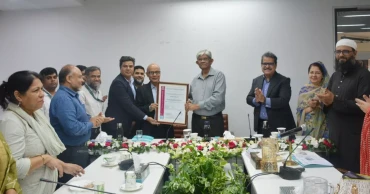
The Integrated Budget and Accounting System (iBAS++) scheme of the Strengthening Public Financial Management Program to Enable Service Delivery (SPFMS) under the Finance Division of the Ministry of Finance has earned the prestigious ISO/IEC 27001:2013 certification in the category of information security management systems.
This certificate, awarded by the global organization Bureau Veritas, recognizes the systematic and comprehensive approach implemented by iBAS++ to secure sensitive information.
Bureau Veritas granted the certification after a thorough examination, inspection, and verification process.
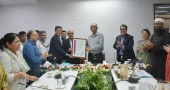
In a ceremony held at the SPFMS office in Dhaka, the certificate was formally handed over to Finance Advisor Dr. Salehuddin Ahmed by Bureau Veritas' CIF Operation Manager (Bangladesh), Mukut K. Barua.
Dr. Salehuddin Ahmed attended the event as the chief guest, while Dr. Md. Khairuzzaman Majumder, Secretary of the Finance Division, chaired the session.
High ranking officials from the Finance Division and representatives of development partner organizations were also present. National Program Director of SPFMS, Mohammad Saiful Islam, provided an overview of various activities under the SPFMS program.
Addressing the ceremony Dr. Salehuddin Ahmed said useful, efficient and pragmatic approach of iBAS++ in managing automated financial services would help ensuring transparency and accountability of the use of financial resources.
Prior to the certificate handover, Dr. Salehuddin Ahmed inaugurated the extended section of the SPFMS office and an e-library.
According to the recent evaluation by the certification authority, iBAS++ met all the requirements for obtaining the ISO/IEC 27001:2013 certification for its application, related IT operations, and data processing activities.
ISO is a global alliance of national standards bodies, and ISO/IEC 27001 is an international standard that helps organizations protect their information assets.
The ISO certification of iBAS++ is considered a significant milestone in securing government budget and expenditure management information, marking a major achievement in the government’s information management practices.
Through the iBAS++ system, over 400 financial management reports can be generated to support policy-making, monitoring, auditing, and other activities.
iBAS++ interfaces with all major government systems, including the Central Bank’s core banking system, the Tax Identification Number (TIN) database, the National ID (NID) database, the electronic Government Procurement (e-GP) system, systems from the Ministry of Public Administration, the Planning Commission, the Bangladesh Employee Welfare Board, birth and death registration, land development tax, the Election Commission, and the National Board of Revenue database. This integration has ensured faster service delivery by the government.
2 years ago
.jpg)
8 more local companies receive ISO certificates
Eight more local companies have received ISO 22000 certificates from the International Organisation for Standardization (ISO), paving the way for the firms to export their products to foreign markets.
With the eight companies, a total of 21 local firms have so far obtained the ISO 22000 certificates with the help of the Small and Medium Enterprise (SME) Foundation.
The eight companies are Safe Trading Corporation, Pratibha Trading, Abhijit Food and Beverage Industries, Masud Agro Processing Food Products, Bani's Creation, Ayurvedic Pharmacy (Dhaka), Chhip Food BD and All-wells Marketing.
Also read: Chinese Company to set up hair fashion accessories industry at BEPZA economic zone
The certificates were handed over to the companies through a function on Monday, said a press release of SME Foundation.
Addressing the function, Chairman of the SME Foundation Prof Masudur Rahman said now the food and agricultural processing companies can export their products of 500 million US dollars. The Foundation will help SMEs to raise the export earnings to one billion US dollars in this sector by 2030, he said.
Director General of the SME Foundation Dr Mofizur Rahman said the Foundation will help eight more small and medium enterprises to obtain the ISO 22000 certificates in the current financial year.
Also read: Govt urged to reject offer for Covid-19 vaccine from any tobacco company
Additional Secretary of Commerce Ministry Hafizur Rahman and member of Food Safety Authority Rezaul Karim were present in the event.
The SME Foundation has been creating awareness about Food Safety Management System (FSMS), Good Manufacturing Practice (GMP) and Good Agricultural Practice (GAP), providing training to entrepreneurs, and extending assistance to enterprises to attain international standard certificates.
In 2013, three local companies attained the ISO 22000 certificates for the first time with the help of the SME Foundation. Later, four other companies got the international standard certificates in 2015 and six ones in 2017.
Read Plastic businessmen want harassment-free environment
4 years ago

Marcel feature phones hit local market
Local brand Marcel has started its journey in the country's mobile phone market with "Made in Bangladesh" tagged feature phones.
Marcel is known to the domestic customers for its electrical and home appliance products including refrigerator, TV and AC.
On Thursday, Marcel announced the launch of its mobile phone marketing activities at a ceremony held in the capital.
Also read: Marcel Digital Campaign Season-10 begins
The brand released three models of feature phones in the market. The phones were manufactured at Marcel's factory in Gazipur's Chandra.
Models of the newly launched phones are Axino A01, A25 and B50.
The phones, which come with different prices and configurations, have 16GB microSD card support, digital camera, FM radio with recording facility, full multimedia, internet browsing, Facebook, Bangla keypad, and many other features.
Also read: Marcel tv’s guaranteed discount campaign kicks off
Marcel Mobile Project Operation Manager Habibur Rahman Tuhin said, "We are producing mobile phones following the International Organization for Standardization (ISO) standard. Also, Marcel has its research and development (R&D) wing for producing the latest mobile phones."
Golam Morshed, managing director of the brand, said: "Marcel has already established its strong position in the market. I expect Marcel mobile phones will be at the top of the customers' choice with its latest features and smartphones."
There will be a 30-day replacement guarantee and 1-year after-sales service on Marcel phones. The brand is set to bring smartphones soon, too, read a press release.
Read Marcel offers Tk 1 lakh cash vouchers on fridge, washing machine, oven
5 years ago