Solar
CPD urges review of solar project cancellations amid Chinese investors’ concerns
The Centre for Policy Dialogue (CPD) on Monday urged the interim government to reconsider its recent decision to cancel 37 solar power plant projects, warning that the move could severely undermine investors’ confidence, particularly among Chinese stakeholders.
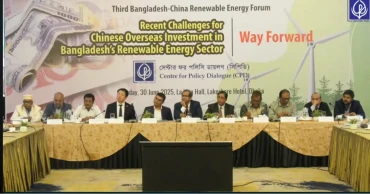
The recommendation came during a seminar titled ‘Recent Challenges for Chinese Overseas Investment in Bangladesh’s Renewable Energy Sector: Way Forward’, held at a Dhaka hotel on Monday.
The cancelled projects, worth over US $6 billion and totalling more than 3,287 megawatts in capacity, were approved under the previous Awami League government.
The interim administration has cited political considerations and allegations of irregularities as reasons for the cancellation.
Chinese investors, who had committed significant funding to several of the projects, expressed alarm during the event.
Representatives from Jinko Solar, Chint Solar, and the Chinese Renewable Energy Industries Association (CREIA) joined Bangladeshi officials and sector leaders in voicing concern.
Presenting the keynote paper, CPD Research Director Dr Khondaker Golam Moazzem and Programme Associate Abrar Ahammed Bhuiyan noted that 15 of the affected companies had already acquired land, meaning the cancellations could lead to financial and legal complications.
CPD raises alarm over Bangladesh’s energy budget
CPD warned that the government’s decision sends a negative message to the international investment community, particularly at a time when Bangladesh is seeking to expand its renewable energy capacity.
The think tank emphasised that such policy reversals could deter future investment, not just from China but from other key partners as well.
Among the special guests at the seminar were Jalal Ahmed, Chairman of the Bangladesh Energy Regulatory Commission; Mohammad Alauddin, Rector of the Bangladesh Power Management Institute; and Nahian Rahman Rochi, Head of Business Development at the Bangladesh Investment Development Authority (BIDA).
Officials from both the public and private sectors stressed that policy inconsistency, land acquisition difficulties, and bureaucratic hurdles are key barriers to realising Bangladesh’s renewable energy goals.
Bangladesh aims to generate 20 percent of its electricity from renewable sources by 2030, rising to 30 percent by 2040. This will require annual investments of nearly US $1 billion through the end of the decade, and even more in subsequent years.
China, which invested approximately US $676 billion in clean energy globally in 2023, accounts for 15.1 percent of Bangladesh’s total FDI stock. More than half of Chinese FDI in Bangladesh is directed toward the renewable energy sector.
Speakers at the event, including Masudur Rahim, CEO of Omera Renewable Energy Ltd; Mostafa Al Mahmud, President of the Bangladesh Sustainable and Renewable Energy Association (BSREA); and Han Kun, President of the Chinese Enterprises Association in Bangladesh, called for greater transparency and stability in energy sector policymaking.
Proposed budget fails to holistically address economic challenges: CPD
They urged the government to engage in constructive dialogue with affected investors and ensure that decisions do not jeopardise the country’s long-term energy security and investment climate.
1 year ago
.jpg)
Hasan Mahmud calls for foreign funding to boost use of solar energy in agriculture
Information and Broadcasting Minister Hasan Mahmud has urged Bangladesh’s development partners, including the World Bank, to finance the country’s drive to increase the use of solar power in agriculture.
Hasan said this at a dialogue on the prospect of solar-powered irrigation to enhance climate resilient agriculture in Bangladesh held at Bangladesh Pavilion in the Scottish city of Glasgow on Monday.
READ: Communal violence: Facebook cannot deny responsibility, says Hasan Mahmud
The use of solar energy has increased in the country because it is climate tolerant, cost-effective, eco-friendly, he said.
“Every year, 1.24 lakh mts diesel is used to run irrigation pumps in the country. This can be saved if solar panels are installed to operate the pumps. Solar energy also helps reduce carbon emissions,” he said.
Besides, a solar panel can operate for up to 20 years uninterruptedly, he said.
The use of solar panels instead of diesel-run irrigation pumps was as important as the process of reducing the damage caused by future climate change.
Therefore, Bangladesh has taken initiative to increase the use of solar panels instead of diesel in irrigation pumps.
Idcol has been working to install solar panels in irrigation and the government has undertaken 789 projects at a cost of 443 million US dollar from the Climate Change Trust Fund with its own funding.
READ: BNP’s 20-party alliance has only 8-10 parties: Hasan Mahmud
He said Bangladesh has been working to mitigate the risks posed by climate change by formulating its own climate change strategic and action plan.
Idcol has installed 1,515 solar irrigation pumps with aid of different organisation, easy loan and technological support, which is so admirable.
He said the achievements of IDCOL in developing renewable energy and energy efficiency have given Bangladesh a global recognition.
4 years ago

Solar Home System: IDCOL partners seek govt intervention in loan write-off issue
Five largest partner organisations (POs) of state-owned IDCOL, who played a vital role in expanding the solar home system (SHS), are now seeking the government’s intervention to resolve the loan write-off issue.
Otherwise, they say, they will be deprived of the benefit and face huge losses.
Official sources said IDCOL recently forwarded a proposal to the Bangladesh Bank seeking a write-off approval of Tk 306.41 crore default loans for its 39 POs. Its 44 POs have about Tk 1,400 crore in default loans.
Also read: Is solar power the solution to Bangladesh's growing energy ...
They said these loans, provided by IDCOL, became default because of the government’s fast grid power expansion programme.
“Grid electricity expanded to the off-grid areas that discouraged SHS consumers to pay back the loans they received from POs. Such unpaid loans finally made the POs defaulters in paying back the IDCOL,” said a top official of a firm involved in the renewable energy programme.
IDCOL had distributed the loan after receiving funds from different donor agencies, including the World Bank.
Read Govt rooftops can generate 2,000 MW of solar power, say experts
According to World Bank’s latest data, an estimated $1,094.93 million was invested in the HSH project to provide electricity to about 20 million people — which means about $266 per household.
Of the investment, 63 percent came from the World Bank, 14 percent from the Asian Development Bank and 12 percent from the Japan International Cooperation Agency.
The entire fund was distributed by IDCOL as a soft loan which resulted in saving Bangladesh $1,852 million while providing clean energy since 2003, says a recent World Bank survey.
Also read: Rooftop solar power: 'Net metering can ensure cheaper ...
It said the project helped households gain $745 million, partner organisations $310 million and the IDCOL $379 million while the government's net benefit was $474 million, said the donor agency.
Solar industry insiders said the SHS programme was launched by IDCOL in 2003. In the last 18 years, over 5.5 million solar home systems were installed.
They said that there was a tripartite partnership to the financial model under which IDCOL provided about 70 percent of the total cost of installing the SHS as soft loans to the POs, while the remaining 30 percent was invested by the POs and the customers themselves.
Read Green energy's share of power generation lagging far behind conventional sources
5 years ago