free media
New report seeks reforms to ensure free, pluralistic media in Bangladesh
A new report on Bangladesh’s media landscape has highlighted that restrictive laws and political pressures continue to limit media freedom and trust in Bangladesh.
To address this, it recommended urgent legal and policy reforms to align with international standards, fair licensing and transparent state advertising, stronger protections and fair pay for journalists, credible self-regulation, gender equality in newsrooms, and greater support for community and indigenous media.
The report also called for investment in professional standards and nationwide media literacy to rebuild public trust.
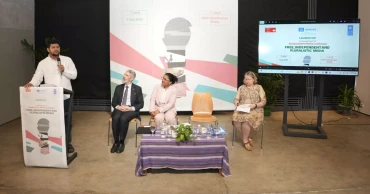
The United Nations Development Programme (UNDP) and the United Nations Educational, Scientific and Cultural Organization (UNESCO), with support from the Embassy of Switzerland, on Thursday launched the report.
An Assessment of Bangladesh’s Media Landscape: Free, Independent and Pluralistic Media, a comprehensive study examined both the challenges and opportunities facing Bangladesh’s media sector during this critical period of transition.
UNDP, UNESCO assess Bangladesh's media landscape with Swiss support
In response to Bangladesh’s recent political and social shifts, this joint assessment, undertaken between July and December 2024, offers a timely roadmap for meaningful reform to build a freer, more independent and truly pluralistic media environment.
Developed through extensive nationwide consultations with journalists, policymakers, civil society, academics and development partners, the report highlights entrenched barriers while pointing to practical pathways for positive, lasting changes.
Speaking as the chief guest, Information and Broadcasting Adviser Mahfuj Alam said media must uphold ethics and accountability, so that people’s trust is not broken again and generations are not wronged.
Attending the dialogue, Sonali Dayaratne, Resident Representative UNDP Bangladesh, said a free, independent and pluralistic media is the foundation of any vibrant democracy.
"This joint assessment by UNESCO and UNDP, with the government of Switzerland’s support, reinforces what must be done to safeguard media freedom and strengthen public trust.
We are committed to working with partners like UNESCO to advance structural reforms, support media professionals, and raise public awareness about the media’s vital role as a pillar of democracy,” she further said.
Hurdles that impede women’s meaningful participation in media highlighted
Alberto Giovanetti, Counsellor and Head of Political, Economic and Cultural Affairs, Embassy of Switzerland in Bangladesh, said this assessment is a timely reminder that a free, independent and pluralistic media is the bedrock of a vibrant democracy.
"We thank UNDP and UNESCO for supporting this important initiative and urge all partners to advance the critical reforms needed to protect media freedom and strengthen public trust."
UNESCO Representative to Bangladesh, Susan Vize, moderating the event said, “Freedom of expression is a fundamental pillar of democratic institutions. If we want to build a society in which we work together towards the principles which realise basic human rights, and to guarantee quality of life, we must ensure that freedom of expression and the media is an essential part of this process”
Earlier Prof. Dr. Joan Barata, Senior Legal Fellow, Future of Speech, Vanderbilt University, USA and Dr. Shameem Reza, Professor, Department of Mass Communication and Journalism, University of Dhaka, presented the keynote paper on the Assessment.
The presentation was followed by reflections from media experts and development partners.
As Bangladesh moves forward, implementing these recommendations will be crucial to ensuring a free, trusted, and inclusive media that strengthens democracy and supports sustainable development, said UNDP.
1 year ago
Govts urged to ensure free, independent, diverse media
UN Secretary-General Antonio Guterres has urged all governments to do everything in their power to support a free, independent and diverse media.
"Free and independent journalism is our greatest ally in combatting misinformation and disinformation," he said in a message marking the World Press Freedom Day that falls on May 3.
Guterres said the United Nations Plan of Action on the Safety of Journalists aims to create a safe environment for media workers across the globe – because information is a public good.
He said the global challenges they have faced during the COVID-19 pandemic underline the critical role of reliable, verified and universally accessible information in saving lives and building strong, resilient societies.
Also read: World Press Freedom Index: Bangladesh slips one place to 151st
During the pandemic, and in other crises including the climate emergency, journalists and media workers help all navigate a fast-changing and often overwhelming landscape of information, while addressing dangerous inaccuracies and falsehoods, said the UN chief.
In too many countries, they run great personal risks, including new restrictions, censorship, abuse, harassment, detention and even death, simply for doing their jobs, said adding that the situation continues to worsen.
The economic impact of the pandemic has hit many media outlets hard, threatening their very survival, Guterres said.
Also read: Digital Security Act not for curbing press freedom: Anisul
As budgets tighten, so too does access to reliable information. Rumours, falsehoods and extreme or divisive opinions surge in to fill the gap, he said.
5 years ago