waste
Hajiganj Municipality: A town suffocated by its own refuse
Once known for its vibrant markets, bustling roads and deep-rooted heritage, Hajiganj municipality in Chandpur now groans under the weight of a crisis it can no longer ignore, a mounting sea of waste threatening the health and dignity of its people.
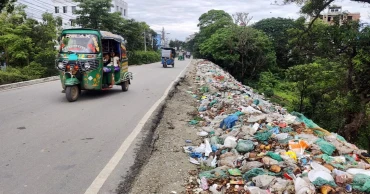
Every day, some 60 tonnes of waste are left scattered across this busy town, not in hidden corners or behind closed gates, but right in the heart of its daily life.
Streets, water bodies, bridges and even revered landmarks have become unwilling hosts to piles of filth that emit a stench strong enough to make passersby wince and residents fall ill.
The municipality, home to over 100,000 people and a floating population of up to 60,000 more, is among the more developed urban centres in the district.
Delays stall Chandpur River Port, locals left waiting
Established in 1985 and upgraded to a first-class municipality in 2004, Hajiganj is crisscrossed by the bustling Chandpur–Cumilla regional highway and thrives on trade, education and local governance.
Yet, beneath the surface of its economic bustle lies a truth too foul to ignore as there is no designated dumping ground for its waste.
A Town Choked by Its Own Growth
From early morning to late evening, cleaners under the municipality’s care collect around 30 tonnes of garbage.
But that is only half the story.
Another 30 tonnes, equally offensive and potentially more dangerous, is dumped haphazardly by residents and businesses alike. Together, this wave of waste surges through Hajiganj daily with no sustainable outlet.
The result? Waste now lines key arteries of the town: from the Mithania Bridge on the Cumilla highway, to the Dakatiya Bridge on the Hajiganj-Ramganj road, past the rail crossing on Hajiganj-Kachua road and heartbreakingly close to the historic Hajiganj Boro Mosque.
The air is thick with the stench of rot and the acrid smoke from burning refuse, forcing the townspeople to breathe in danger with every breath.
Locals voice their agony with weary resignation.
“The smell and smoke have made our lives miserable,” said Abdur Rahim and Nasir Gazi from Paschim Bazar, adding, “Mosquitoes are everywhere, and dengue has returned with a vengeance.”
Children and the elderly suffer the most. Their fragile bodies react quickly to the polluted air — many coughing, wheezing, or bedridden with fever.
CNG driver Nurul Islam paints a grim picture of his daily route, “When we drive along the Hajiganj-Kachua road, the smell of rotting garbage is unbearable. And when it’s set on fire, the entire area disappears in smoke for hours.”
Launch operations suspended in Chandpur for inclement weather
A System Without a Solution
Despite repeated calls for action, the municipality appears cornered. Mahbubur Rashid, the assistant engineer (water and sanitation) of Hajiganj, admitted the bitter truth, “The municipality owns no land to set up a dumping station. We’re still using sites chosen by past administrations.”
Current administrator and Upazila Nirbahi Officer Md Ibne Al Zayed Hossain assured that efforts are being made to address the crisis. “We’re trying to remove the waste heaps. But for a lasting solution, we need mass awareness and public cooperation,” he said.
The situation is worsened by the near-complete absence of clean and accessible public toilets, a silent hardship that especially affects women, the elderly, and people with disabilities.
A National Crisis in a Local Shell
Hajiganj is not alone in this crisis. A study by the Asia-Europe Foundation shows that more than half of all waste in Bangladesh is dumped in the open. Uncollected and often burned in the open air, this waste poses massive threats — from polluting water sources to clogging drainage systems and exacerbating waterlogging even after light showers.
As towns grow and cities sprawl, so too does the tide of waste — unchecked, unmanaged and in many places, simply ignored.
Dhaka, the nation's capital, is already counted among the world’s most polluted cities. The United Nations Population Fund (UNFPA) warns that without urgent, coordinated measures, the waste problem will only worsen — not just in megacities but in smaller municipalities like Hajiganj.
A Cry for Cleanliness
Hajiganj’s predicament is a poignant reminder that development without planning leads not to progress, but to peril. Its streets echo with a silent plea — for dustbins over ditches, for solutions over stench, for a future where its children can play in parks, not pick through piles of refuse.
If ever there was a time for action, it is now. Before Hajiganj — and towns like it — are buried under the very waste they produce.
1 year ago

Innovative, smart solutions must for plastic waste management: Tazul Islam
Stakeholders will have to develop innovative and smart solutions for managing plastic waste in Bangladesh, LGRD Minister Md Tazul Islam said Saturday.
"Waste collection is now not considered to be sustainable as it is still not viewed as a business proposition," he added while speaking at the seminar "Enabling policy for sustainable plastic waste management" in Dhaka.
An effective solution would be the circular system, which ensures the consumption of plastic does not increase and moves towards a sustainable waste management model, Tazul said.
"We must also empower the value chain actors and provide holistic support to the informal sector, comprising the micro-entrepreneurs, scrap dealers and waste pickers. This informal yet important sector must be facilitated and a proper structure should be developed for our own sake," he added.
Read: Deal signed to set up waste-based power plant in Narayanganj
"The government's Vision 2041 has incorporated plastic waste management in its sustainable urbanisation goals," Senior Secretary of the Prime Minister's Office Md Tofazzal Hossain Miah said at the programme jointly organised by the Federation of Bangladesh Chambers of Commerce and Industry (FBCCI) and Unilever Bangladesh.
Unilever Bangladesh CEO and Managing Director Zaved Akhtar and FBCCI President Md Jasim Uddin also spoke.
3 years ago

Govt to bring rural waste under proper management: LGRD Minister
Local Government and Rural Development (LGRD) Minister Md Tajul Islam on Sunday said the government is working to bring the waste generated in the city as well as rural areas under proper management.
Work is underway to bring the waste under proper management as waste is a challenge for all countries, he said at a meeting on 'Solid Waste Management Information Sharing' organized at Centre on Integrated Rural Development for Asia and the Pacific (CIRDAP) in the capital.
The amount of waste generated in the country has multiplied in the past as the purchase capacity of people increased, he said.
Also read:Bangladesh, India share best practices in waste management
Tajul Islam said that a lot of garbage, medical waste, is generated in the village now which contains many harmful substances harmful to human health.
In this regard, he said, “We are also working following the formula that the developed world is generating electricity through incineration by collecting waste.”
In the meantime, with the approval of the Prime Minister, arrangements have been made to start power generation from waste in Two City Corporation of Dhaka, Gazipur, Chattogram and Narayanganj City Corporation, he added.
The minister also said all city corporations and districts, upazilas and municipalities will also get electricity generated from waste in phases.
He urged everyone to refrain from dumping garbage in rivers, canals, lakes and other water bodies.
He further said about three thousand tonnes of garbage is being generated daily in Dhaka North and South City Corporation, two thousand five hundred tonnes in Chattogram, two thousand tonnes in Gazipur and a lot of waste is being generated in Narayanganj.
Also read: Italy to invest in waste management in Bangladesh: Ambassador Enrico
There is a lot of stench in the secondary transfer station-STS causing a lot of problems for pedestrians and people living in the area. He directed the authorities concerned to review the technical alternatives so that the stench does not spread.
LGRD Secretary Helal Uddin Ahmed, Japanese Ambassador to Dhaka Naoki, Country Representatives from Japan International Cooperation Agency (JICA) and senior officials were present at the meeting.
4 years ago
.png)
Purchase committee clears 42.5MW waste-to-energy project
The Cabinet Committee on Public Purchase has approved 16 proposals, including the setting up of a 42.5 MW waste-to-energy plant and four solar power plants with the total capacity of 181 MW.
The approval came from a virtual meeting of the committee held on Wednesday with Finance Minister AHM Mustafa Kamal in the chair.
As per the approvals, Canves Environmental Investment Company Ltd, China, will set up the 42.5 MW waste-to-energy project at Kaultia, Gazipur from where state-owned Bangladesh Power Development Board (BPDB) will purchase electricity under a contract for over a period of 25 years at US21.50 Cents, equivalent to Tk 17.20, per kilowatt hour (peach unit).
READ: Cabinet body approves proposal for 30 oxygen plants
The BPDB will have to spend Tk 14,408 crore to buy the power during the contract period.
Another three private companies will set up three separate solar parks at three places.
The BPDB will buy electricity from each of the projects at a tariff of US 10.60 cents, equivalent to Tk 8.48, considering US dollar rate at Tk 80, over a contract period of 20 years.
Of the projects, Bangladesh-China Renewable Energy Company (Pvt) Limited will set up a 60 MW grid-tied solar park at Suzanagar Upazila, Pabna, and a 68MW solar park at Sirajganj Sadar upazila while Cyclect Energy Pte. Ltd, Singapore will set up a 50MW solar park at Jibonnagar, Chuadanga.
The BPDB will have to spend Tk 1649.12 crore to buy electricity from the Suzanagar project, 1,798.48 crore from Sirajganj project and 13,22.40 crore from Jibonnagar project for buying electricity during the contract period.
The Western Renewable Energy Pvt. Ltd., will set up a 3MW solar-battery-diesel run hybrid power plant at Monpura upazila, Bhola from where the BPDB will buy electricity at Tk 21.25 per kilowatt hour over a period of 20 years.
It will have to spend Tk 459 crore to purchase electricity from the plant over the contract period.
The CCPP approved three separate proposals for the import of 90,000 metric tons (MT) of urea fertilizer and 30,000 MT of phosphoric acid by Bangladesh Chemical Industries Corporation (BCIC), and another three separate proposals for the import of 90,000 MT of MOP fertilizer by Bangladesh Agriculture Development Corporation (BADC).
READ: Cabinet committee approves 4 proposals, including LNG import
Meanwhile, the Cabinet Committee on Economic Affairs approved in principle a proposal to implement the 'Dhaka East-West Elevated Expressway' project under the public private partnership.
The project cost was estimated at Tk 16,000 crore. It will connect the Dhaka-Aricha highway to Dhaka-Chittagong highway via Savar and Sonargaon, Narayanganj.
4 years ago

10 DSCC teams to monitor removal of sacrificial animal waste
Dhaka South City Corporation (DSCC) has formed 10 teams and set up a central control room to monitor the removal of sacrificial animal waste from July 21-24.
Regional executive officers will lead the teams comprised of officials and employees of the city corporation.
A central control room has been set up at the Shitalakkha Hall of Nagar Bhaban to supervise the waste removal activities.
People of Dhaka South can contact the control room through the number 01709900888 up to July 24.
READ: DSCC completes removing sacrificial animal waste
Also, around 385 heavy and light vehicles have been prepared, and the places of sacrifice will be decontaminated through 12 water carts by sprinkling water mixed with antiseptic liquid and bleaching.
Five thousand five hundred cleaners – including DSCC's own, outsourced and primary waste collection service provider staff – will be ready to keep the environment clean.
Also, special bags will be distributed among the DSCC dwellers for storing and disposing of waste.
To protect the environment, about 30 tonnes of bleaching powder and 1,800 litres of liquid disinfectant will be sprayed in the designated places.
READ: Govt seeks people’s assistance for disposing animal wastes
5 years ago

Bidyanondo: collecting waste, saving nature
Dhaka, known as one of the unhealthy cities in the world because of several types of environmental pollution, has to suffer in almost every election- thanks to the advertisements usage in the election campaigns of the candidates. A good load of posters and banners cover the whole cityscape and after the ending of these elections, both the city corporations suffer to clean up these huge messes.
6 years ago
Mir Jumla Road turns into garbage dumping zone, again
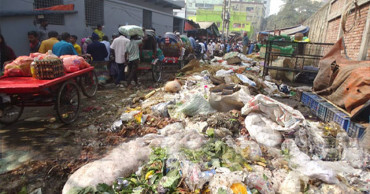
It took only three months for Mir Jumla Sarak, adjacent to Digubabu Bazar area, to return to its ‘original’ state – filthy, congested, and hard to navigate.
About three months ago, police freed the road after several rounds of drives. People going to Narayanganj College, Narayanganj High School, T&T office, launch and bus terminals prefer this route.
“But makeshift markets usually keep the road occupied throughout the year,” a local man said, declining to be named.
Continuous eviction drives helped keep the road free and clean to some extent for several months. But now, a large number of makeshift shops have occupied the road and are dumping wastes there.
During a recent visit, the UNB Correspondent found that the road has turned into waste dumping zone, making it very hard for people to move in the area.
Vehicles cannot enter as the road became narrow thanks to illegal occupation.
Some of the shops’ owners were extremely rude to this correspondent and said that running reports on the road’s condition will be in vain.
People said a former district police chief removed all makeshift shops from the road but after he was transferred, the shop owners occupied the place again. They have since been dumping wastes on the road.
Locals blamed the lack of supervision by authorities concerned for the sorry state of the key road and demanded freeing it as soon as possible.
Shyamal, the cleaning inspector of Narayanganj City Corporation, said a number of chicken traders set up shops on the road, preventing waste collection vehicles of the city corporation from entering the area.
“That’s why there are wastes on the road. Necessary measures will be taken to remove the garbage as soon as possible,” he said.
6 years ago