Molasses
Chuadanga’s centuries-old molasses haat comes alive in winter
In the middle of winter, trading activity has surged at the historic Sarojganj date molasses market in Chuadanga, one of Bangladesh’s most renowned traditional haats for palm jaggery, with the aroma of freshly boiled sap filling the air.
Nearly 300 years old, Sarojganj Haat sits twice a week, on Mondays and Fridays, and during the peak season now records transactions worth more than Tk one crore weekly.
On each market day, sales range between Tk 1.5 crore and Tk 2 crore. If the current momentum continues, total transactions this season are expected to reach Tk 50–55 crore, according to local traders.
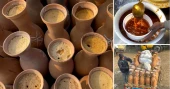
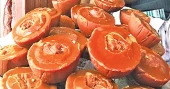
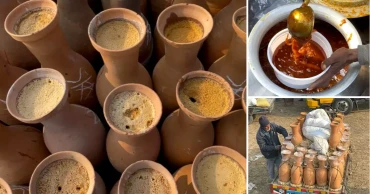
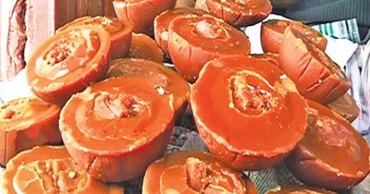
A visit to the haat presents a vibrant tableau of rural commerce. Earthen pots brimming with liquid jaggery line the stalls, while freshly made nolen patali are neatly stacked alongside newly produced molasses displayed in bamboo baskets and wooden frames. Buyers and sellers engage in animated bargaining, their calls echoing through the market.
Read more: A Sweet Legacy: Traditional molasses-making flourishes in Jhenaidah village
Renowned for its distinctive taste, rich colour and natural aroma, Sarojganj’s date molasses enjoys strong demand across the country.
Retail prices currently range from Tk 230 to Tk 350 per kilogram, depending on quality. Earthen pots weighing between 12 and 16 kilograms sell for Tk 1,800 to Tk 2,600, while different varieties of nolen patali fetch between Tk 300 and Tk 430.
Molasses collected from the haat is supplied to a wide network of districts, including Dhaka, Kushtia, Meherpur, Jhenaidah, Pabna, Rajshahi, Rangpur, Barishal, Sylhet, Khulna, Mymensingh, Magura, Rajbari and Panchagarh.
Sazzad Hossain, a molasses producer from Sarabaria village in Chuadanga Sadar upazila, said the jaggery is prepared using traditional methods passed down through generations.
“Sap collected from date palm trees is boiled in traditional ovens using tin strainers. When the sap thickens, it is stirred continuously to make molasses. We have been producing pure jaggery using this age-old method for generations,” he said.
On market days, sellers arrive with their produce by bicycle, van or even carrying heavy earthen pots on their heads. Buyers carefully examine the colour, thickness and overall quality before finalising their purchases.
Read more: Cold and fog bite into Narail’s honey season
Shahidul Islam, a trader from Pabna, said he returns to Sarojganj every year because of the product’s purity. “The price is a bit higher, but the quality is superior,” he said.
Date palm farmer Jamal Uddin from Baliakandi village in Chuadanga Sadar said he is collecting sap from 35 palm trees this season and expects to produce around 400 to 500 kilograms of molasses.
Local trader Ujjal Kumar Adhikari described Sarojganj Haat as one of the largest molasses markets in the country, operating continuously for nearly three centuries through generations of traders and producers.
Haat operator Md Alauddin Ala said traders from across Bangladesh, including Dhaka and Chattogram, regularly attend the market. “Each haat sees transactions worth Tk 1.5 crore to 2 crore, and we ensure the safety of both buyers and sellers,” he said.
According to the Department of Agricultural Extension (DAE) in Chuadanga, sap is being collected from around 2,72,000 date palm trees in the district this season, with a production target of 2,700 metric tonnes of molasses.
Read more: Severe cold throws normal life in Chuadanga out of gear
Deputy Director Md Masudur Rahman Sarkar said farmers are producing pure, sugar-free molasses and that regular monitoring is being conducted to prevent adulteration.
Locals said trading at the Sarojganj date molasses market will continue in full swing until Chaitra, promising yet another successful winter season for this historic marketplace that remains a symbol of Chuadanga’s rich agrarian heritage.
9 months ago
A Sweet Legacy: Traditional molasses-making flourishes in Jhenaidah village
In the tranquil village of Khandakbaria under Shailkupa upazila, a plume of sweet-scented steam curls into the air as a rustic factory hums with life, a symbol of heritage and resilience that has defied time for nearly six decades.
Here, amidst lush sugarcane fields and the gentle murmur of rural life, the art of traditional molasses-making continues to thrive, unfazed by the passage of generations or the march of modernity.
Tucked along the roadside like a well-kept secret, this humble facility has been producing pure, unadulterated sugarcane molasses—known locally as ‘gur’—through a time-honoured process that blends old-world charm with contemporary adaptations.
Operated by brothers Rezaul Islam and Mizanur Rahman, the factory stands as a testament to their late father's vision and devotion, his legacy preserved in every drop of the golden syrup they lovingly craft.
“We’re simply carrying on what our father began,” said Mizanur, his hands stained with cane juice, eyes glowing with pride.
“Long before the Mobarakganj Sugar Mill rose in Kaliganj in 1965, he was boiling molasses in clay pots right here, using cattle-driven crushers to extract the juice,” he said.
Today, though the bulls are gone, replaced by belt-powered shallow engines, much of the process remains deliciously traditional.
Target set to collect 3,000 mts molasses from date palm trees in Chuadanga
The sugarcane—harvested fresh from nearby fields—is fed into machines that crush the stalks, releasing a stream of green-gold nectar.
The juice is then filtered through coarse cloth and poured into enormous pots set over open, wood-fired stoves. Flames dance beneath six clay ovens, coaxing the liquid to a boil until it thickens and darkens into a deep reddish hue, redolent with caramelised sweetness.
The bubbling syrup is stirred with care, shifted between stoves to perfect its consistency, then ladled into tin vessels and cooled in clay pots—a ritual as rhythmic as the seasons.
The result: molasses of remarkable flavour, colour and purity, beloved in kitchens far and wide for sweet treats such as pitha, payesh, semai and suji.
Once a staple of rural households across Jhenaidah, such molasses-making units have become increasingly scarce, giving the brothers' factory a near-mythic status in the area.
With its tin-roofed shelter, soot-darkened walls, and the ever-present scent of burning wood and cane, it is more than a workplace—it is a living museum of rural craftsmanship.
Production typically spans the cool months from December to March, with around one kilogram of molasses extracted from every ten kilograms of sugarcane.
Togur: The Molasses Made from Watermelon Juice in Bangladesh
“In our heyday, we could make 400 kilograms a month. These days, the yield is lower, but we remain committed to quality over quantity,” he said.
Rezaul added, “This year, we hope to produce about 30 maunds—roughly 1,200 kilograms. We’re selling each kilo for Tk 200. Some farmers bring their own cane and use our facility to make molasses for home use. It gives them better value than selling raw cane at low prices.”
The molasses, once cooled and packed, travels beyond Jhenaidah, sweetening meals in distant districts while kindling a sense of nostalgia among those who know its roots.
Additional Agriculture Officer Abul Hasnat praised the factory's efforts, noting that local authorities are fully supporting such initiatives to ensure safe and high-quality production.
“This is a shining example of how traditional industries can survive and prosper with the right guidance,” he said.
Sarojganj Bazar in Chuadanga goes upscale with ‘quality’ molasses
Indeed, as long as the fires burn beneath the clay stoves of Khandakbaria and the cane fields yield their bounty, the brothers' syrupy legacy is set to endure—thick, golden and unforgettable.
1 year ago

Togur: The Molasses Made from Watermelon Juice in Bangladesh
Molasses is one of the sweetest foods in Bangladesh. And, Water Melon is one of the most popular fruits grown in Bangladesh. The juice of this succulent fruit refreshes the mind and body on summer days. But the idea of molasses made with watermelon juice is absolutely unprecedented. Mrityunjay, a watermelon farmer from Chhotobond village in Dumuria Upazila of Khulna startled the country with this wonderful innovation. He named the newly invented molasses (locally termed as ‘Gur’) 'Togur,' as it is made from watermelon (locally termed as ‘Tormuj’) juice. Let's find out some information about this new type of molasses.
How the idea of Togur came about
Mrityunjay has been cultivating watermelons since 2019. Besides good yield, he has also been able to make some profits in this period. During the cultivation season, he got some watermelons which are quite small in size. These watermelons, called 'Kats', are almost unsaleable and are left in the field. Most of the time, when they get wet in the rain, they rot and spread a bad smell. Some Kats, however, can be used as food for domestic animals and fish.
Read Yummy sweets for Durga Puja: Traditional Bengali desserts to try in the great religious festival
Suddenly one day it came to Mrityunjaya’s mind that if molasses can be made out of date and palm juice, it is possible for watermelon juice as well! Immediately, he went to the Upazila Agriculture Office to consult. Then along with his wife Mitali, he tried to make molasses with a few Kat watermelons. After making it, he was surprised at the sweet taste of Togur which looks like date molasses.
5 years ago