aquaculture
Student-led shrimp farming sparks rural aquaculture boom in Naogaon
What started as an experiment in a single pond in Naogaon is emerging as a model for rural innovation, showing how careful management and mixed farming methods can redefine livelihoods in Bangladesh’s remote districts.
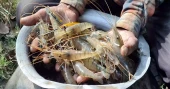
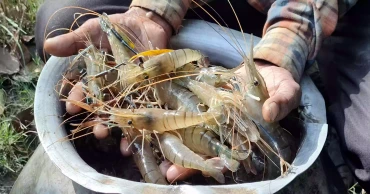
Traditionally known for carp and other freshwater fish, Naogaon is witnessing the first successful cultivation of giant freshwater shrimp, or galda chingri, a species mostly farmed in Khulna, in the district’s ponds.
Raju Sardar, a student and fish farmer in Dighirpar village of Sadar upazila, has drawn attention by integrating galda with carp species in his pond.
His approach, combining careful water monitoring, balanced feeding and regular pond maintenance, has encouraged other farmers to explore the high-value species.
Since Raju began the initiative, at least 30 to 40 farmers in and around the area have started cultivating galda shrimp using the mixed farming method.
Raju, who has long practised carp polyculture, said conventional methods yielded limited profits, prompting him to explore alternatives.
In June last year, he joined a demonstration programme titled ‘Giant freshwater shrimps farming under improved management’ conducted by a local development organisation’s agriculture unit.
He initially received 500 galda fry through the program and, undeterred by scepticism from others, invested in an additional 1,000 fry.
The integrated farming approach proved successful: within months, shrimps grew rapidly, with each kilogram now containing only seven to eight shrimps, a benchmark for freshwater cultivation.
Raju projects a harvest of 120 to 130 kilograms of galda shrimps, which could fetch between Tk 1.20 lakh and Tk 1.40 lakh at market rates of Tk 800–1,000 per kilogram. When combined with carp production, the mixed system nearly doubles income from the same pond.
Workshop renews push for dedicated aquaculture policy
Local fish farmer Saiful Islam said the initiative has shifted perceptions. “We never imagined that a species mostly farmed in Khulna could thrive in Naogaon. Raju’s pond has become a live training centre for farmers,” he said.
Farmers, encouraged by the market demand and prices, are now planning to expand shrimp cultivation.
Md Shahriar Hossain, Fisheries Officer at the development organisation’s agriculture unit, said the initiative is part of efforts to modernise the fisheries sector by introducing profitable species with low investment.
“Galda farming has been introduced in Naogaon for the first time. Its success has sparked interest in mixed farming, which has proven highly profitable,” he said.
Dr Md Bayezid Alam, Senior Fisheries Officer of Naogaon Sadar Upazila, described freshwater galda farming as a new chapter for the district’s fisheries sector.
“With proper management, galda can be cultivated even in small ponds. Wider adoption could boost employment, increase fish production, and strengthen the local economy,” he said, adding that training and technical support will be provided to interested farmers.
Raju Sardar’s success underscores the potential of innovative aquaculture in reshaping rural economies beyond Bangladesh’s traditional coastal hubs, he said.
7 months ago
Project launched to boost climate resilience, food security in Cox’s Bazar
The government of Bangladesh has taken a project aimed at strengthening the resilience and livelihoods of poor and marginal communities in Cox’s Bazar, one of Bangladesh’s most disaster-prone districts, through sustainable, nature-based solutions.
The project, titled “PRO-ACT Bangladesh – Resilience Strengthening through Agri-Food Systems Transformation in Cox’s Bazar,” will be implemented by the Department of Agricultural Extension (DAE) under the Ministry of Agriculture and is set to run until June, 2028.
With an estimated cost of Tk 53.01 crore, fully funded by foreign grants, the project seeks to improve food and income security, promote sustainable agriculture, and reduce disaster risks in four upazilas — Cox’s Bazar Sadar, Ramu, Ukhiya, and Teknaf.
Under the initiative, 10,000 farmers will receive training and input support to cultivate nutrient-rich crops, while 600 families involved in aquaculture will be trained in modern fish-farming techniques.
Besides, 1,050 farmers will be supported in toxin-free dry fish processing including branding and market access development.
Read more: Access to credit for agri sector can enhance food security: Bangladesh Bank Governor
The project also envisions creating five agricultural aggregation centres to boost market connectivity and promote ICT-based agricultural extension services.
Local service providers and farmers’ groups will be trained on financial literacy, digital tools, and business planning to improve access to agricultural credit and strengthen value chains.
To enhance disaster preparedness, communities will receive training on the Landslide Early Warning System (LEWS) and crop-based land use maps will be developed to integrate disaster risk reduction into agricultural planning.
According to the Planning Commission, the project will play a pivotal role in mitigating the adverse effects of climate change and addressing the environmental degradation worsened by the Rohingya refugee influx — including deforestation, land erosion, and waterlogging.
Funded by the European Union and implemented in collaboration with the Food and Agriculture Organization (FAO), Forest Department, and Department of Fisheries, PRO-ACT Bangladesh focuses on restoring ecosystems and strengthening the adaptive capacities of vulnerable populations.
With a target to reach more than 54,000 beneficiaries, including smallholder farmers, women, and marginalised groups, the initiative aims to transform Cox’s Bazar’s agri-food systems through climate-smart agriculture, sustainable resource management, and inclusive economic opportunities.
Officials said the project aligns with Bangladesh’s long-term climate adaptation goals and underscores the government’s commitment to building a resilient future in the face of worsening climate challenges.
Read more: Bangladesh's food security at risk as farmland shrinks by 3.75 percent in 8 Years: BBS Survey
Cox’s Bazar is facing frequent exposure to a wide range of natural hazards and extreme weather conditions such as cyclones, heavy rainfall, landslides, flash floods and storm surges.
In recent years, the district has been particularly vulnerable to recurring landslides and cyclones.
The severity of these disasters is worsened by widespread poverty and the limited coping capacity of local communities — with about 33 percent of the district’s population living below the poverty line, according to UNDP.
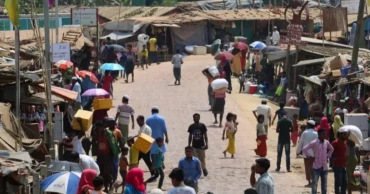
Since 2017, Cox’s Bazar has also hosted around one million Rohingya refugees, which has significantly increased the population at risk.
The influx has contributed to new environmental and safety challenges, including deforestation, hill-cutting, and mounting pressure on infrastructure. Because of overcrowded settlements, hilly terrain, and temporary housing conditions, Rohingya families are particularly susceptible to severe weather events.
Read more: Dream project derails; Khulna-Mongla railway struggles without freight flow
10 months ago

Natore’s bio fish feed offers cheaper, safer future for aquaculture
An experimental initiative in Natore has led to the development of a bio fish feed that could significantly reduce fish farming costs while ensuring safety for human health, say researchers involved in the project.
Developed by biologist Dr GNM Elias, the innovative feed is made from protein-rich Black Soldier Fly (BSF) larvae, combined with mustard oil cake, molasses and a fungus called Trichoderma.
The ingredients are locally sourced, making the feed not only cost-effective but also environmentally friendly.
Dr Elias told UNB that after years of research, he devised this organic formula by rearing BSF larvae on discarded vegetables like eggplants.
The larvae consume the waste, reproduce and die, leaving behind eggs rich in protein and vitamins that fish find highly nutritious.
“The feed is completely safe and healthy for human consumption,” said Dr Elias, adding that it also improves water quality and enhances ecological balance in fish ponds.
In trial applications, the feed has shown promising results by boosting plankton growth—the natural food source for fish—while also supporting the organic matter needed for duck farming in the same ecosystem.
To enhance the feed's nutritional value and sustainability, Dr Elias used sugar mill byproducts and refined the Trichoderma fungus through research support in Malaysia.
According to him, the formula releases nutrients in phases, contributing to the steady growth of fish and maintaining the natural equilibrium of the water body.
Local farmers who participated in the trial are encouraged by the outcome.
Shafiul Haque, a fish farmer in the region, described the innovation as “timely and promising” and said commercial production could make aquaculture more cost-effective and sustainable.
Another farmer, Mehedi Hasan, said their ponds have shown encouraging results using the feed and urged authorities to take steps towards its large-scale production.
Dr Elias previously focused on applying Trichoderma in organic fertilisers, which proved effective in potato and other root crop farming.
12 people injured in attack by auto-rickshaw drivers in N’ganj
By blending poultry litter and sugar mill press mud with Trichoderma, he created a bio-fertiliser that increased yields by nearly 30% in northern Bangladesh.
This year, farmers in the region have reported strong harvests of potatoes and onions using the organic mix.
1 year ago

Bangladesh, Botswana agree to share knowledge, expertise in agriculture, fisheries, aquaculture
Bangladesh and Botswana have agreed to identify potential areas of cooperation in agriculture, livestock and fisheries and exchange technical knowledge and expertise in the agriculture sector.
Both sides agreed to continue discussions in agriculture and fisheries at the government, farmers and expert levels.
Bangladesh's State Minister Md Shahriar Alam, who is on a two-day official bilateral visit to Botswana, met with Botswana's Minister of Agriculture Fidelis M Malao in Gaborone Friday (February 10, 2023).
Shahriar was accompanied by the Bangladesh High Commissioner in Pretoria, foreign ministry officials and embassy officials.
Read More: US sees huge potential to grow its relations with Bangladesh: Counselor Chollet
The Botswana delegation was represented by high officials of the Ministry of Agriculture, including representatives of the fisheries and aquaculture sector.
Fidelis said Botswana is connected to many countries of the region by land routes.
The Botswana government is putting special focus on developing the country's fisheries and aquaculture sectors, he added.
Shahriar said his visit to Botswana marked the first foreign ministry delegation visit to Botswana and expressed satisfaction over the conclusion of the visa waiver agreement for holders of diplomatic and official passports and memorandum of understanding (MoU) on bilateral political consultations between the countries.
Read More: Business Eswatini for signing MoU with FBCCI
He briefed the Botswana side about Bangladesh's achievements in the agriculture sector during the last decade, including the production of food staples, vegetables, fisheries, poultry and livestock, despite having a comparatively low amount of land.
He called on the Botswana side for considering providing contract farming opportunities to Bangladeshi entrepreneurs in the unused agricultural land.
Bangladesh already initiated contract farming in other countries in Africa on a low scale, Shahriar added. "Cooperation may be forged among B2B and B2G levels on contract farming."
3 years ago
.jpg)
Indian government is revamping aquaculture for a ‘blue revolution’
All governments, at different points in time, have opted for a revamp in policies geared at increasing agricultural productivity. Mostly, these have included crop yield, animal husbandry and milk production. However, rarely ever has a government formulated a specific policy keeping in mind the vast potential that the fisheries sector holds, reports Saudi Gazette.
Though the developmental journey for multiple governments has undertaken massive improvements in areas related to productivity and availability of food sources, the fisheries sector has remained untouched and neglected for long. This apathy to blue revolution has changed considerably with India’s first and biggest fisheries scheme called the Pradhan Mantri Matsya Sampada Yojana (PMMSY), with an outlay of Rs.20,050 crores over a period of five years on Sept. 10, 2021.
Read: India's first grass conservatory established in Uttarakhand's Ranikhet
PMMSY is designed to address critical gaps in fish production and productivity, quality control, adoption of advance technology, post-harvest infrastructure and management, modernization, innovation and strengthening of value chain, traceability, establishing a powerful fisheries management framework and fishers’ welfare. While aspiring to consolidate the achievements of Blue Revolution Scheme, PMMSY envisages many new, unique and innovative scheme and vision for the sector.
Obviously, the scheme is part of the larger Blue Revolution that was undertaken by the government of India towards ensuring the growth of the aquaculture industry. Through design, India aimed at tapping the massive reserves of fish around the mainland of India as well as around islands. Additionally, the idea was to modernize the industry through new technologies and processes, which would transform the sector and double the income of the fishermen and fisherwomen involved.
With increased productivity, the assumption was that the post-harvest infrastructure would also get a solid boost with private market players also grabbing a foothold into the sector seeing its immense potential. Therefore, it is clearly not difficult to put the foot on the throttle in these areas resulting in an easy three times exports price-to-earnings ratio by the year 2022 which would lead to profits as well as food security for those families that are dependent on the livestock from these catches.
Though the fish production sector accounted for a meager 1.25% of the national economy in the year 2018-19, its share of the total agriculture production was about 8%. Over the years, especially since the Blue Revolution was embraced by the government of India, the growth rate of the sector has doubled from 5.2% to 10.8% in only four years.
Quite simply speaking, the PMMSY has been geared towards achieving five goals: (a.) doubling the income of fishermen and fisherwomen, (b.) increasing the fish production to 2.2 crore tons per annum within a period of 5 years, (c.) reducing the loss in fish production from 20 to 10%, (d.) creating 55 lakh new employment opportunities, and (e.) doubling the exports of fish to Rs.1 lakh crores in next 5 years.
At the same time, the focus was on ensuring the development of the sector through sustainable means without infringing upon the environmental processes of the day. Therefore, the scheme has focused on developing the sector by engaging in sustainable, responsible, inclusive and equitable practices alone. One of the biggest factors towards achieving that has been the up-gradation of fishing vessels and breeding centers, putting in place bio-toilets and aqua-parks, developing aquaculture start-ups and coastal fishing villages.
Special thrust will be given for employment generation activities such as seaweed and ornamental fish cultivation. It emphasizes on interventions for quality brood, seed & feed and species diversification.
Singular attention will be given on aquaculture in saline/alkaline areas, Sagar Mitras, FFPOs/Cs, Nucleus Breeding Centers, fisheries and aquaculture start-ups, incubators, integrated aqua parks, integrated coastal fishing villages development, aquatic laboratories network and extension services, traceability, certification and accreditation, RAS, Biofloc & Cage Culture, e-trading/marketing networks, fisheries management plans, etc.
Read: India opens to vaccinated foreign tourists after 18 months
With the sudden interest amongst the private players and government, the Research & Development in Aquaculture and Marine Biotechnology has begun attempting to explore the limitless possibilities of the fisheries sector. More than 122 deep-sea fishing vessels have been upgraded with 2755 bio-toilets being installed. On top of the same, about 53,000 rafts and monolines have already been disbursed to increase seaweed cultivation, which in turn is the most sustainable way of ensuring the survival of fish.
But the growth in volume of production need not mean the upliftment of those involved in the sector, and to ensure the same, the government of India has focused on the welfare of people associated with the sector along with increasing production. With the constant expansion in the Kisan Credit facilities over the last few years, the line of credit available to these fisher folk has quadrupled. Already, about 8 lakh individuals have benefited from the scheme with proposals worth Rs.3,000 crores from 34 states/UTs already approved until last month.
With increased production, the scheme has laid down a solid groundwork for development of the sector to ensure that the income of farmers increases along with the share of Indian aquaculture in the global market. It is only a matter of time that the hard work and vision translates to a massive production growth.
4 years ago