RAJUK

A decade on, Uttara lake development still stuck in limbo
More than a decade after it was first approved with the promise of giving residents a cleaner, greener and more accessible lake environment, the Uttara Lake Development (1st Revised) Project remains mired in delays, extensions and rising costs.
What was once envisioned as a model urban regeneration initiative—protecting the Uttara lake system from encroachment, improving water retention, preventing pollution and creating vibrant walkways and recreation spaces—has instead become a striking example of chronic stagnation in public infrastructure development.
Recently the government extended the project deadline for the sixth time, pushing completion to June 2026.
A Decade of Deadlines Missed
The project, undertaken by the Ministry of Housing and Public Works was originally approved in 2014. At the time, it carried a modest two-year timeline from July 2014 to June 2016 and a cost estimate of Tk 37.32 crore.
Read more: Banani Society's 55k Adda Park: Community-led initiative transforms decaying lakeside into urban oasis
But as years passed with repeated extensions and little visible improvement, the financial footprint expanded dramatically.
After revisions, the cost now stands at Tk 90.73 crore, nearly two and a half times the original estimate.
RAJUK alone is bearing Tk 78.85 crore of that amount.
“We need to protect the lake from pollution and encroachment, but all we see are deadlines being moved,” said Aminul Haque, a long-time resident of Sector 4.
Why the Delay? RAJUK Lists a Long Chain of Reasons
Officials attributed the most recent delay to multiple complications in the field.
Unusually heavy rainfall during the current fiscal year has held back progress, while the land acquisition process has taken longer than expected.
Read more: Kaptai Lake must be protected as a national asset: Farida Akhter
The project area includes two mosques, forcing RAJUK to proceed cautiously.
Daytime restrictions on truck movement have meant that sludge removal could only be carried out at night.
Moreover, the project site is situated in a densely populated and congested neighbourhood, requiring slow and careful pallasiding work to avoid disturbing surrounding houses.
RAJUK officials also reported resistance while attempting to evict illegal structures in an adjacent slum, further slowing the pace of work.
The Implementation Monitoring and Evaluation Division (IMED) approved the government’s proposal for a one-year extension, but only under strict conditions.
IMED emphasised that all remaining activities must be completed within the newly approved timeframe and no further extensions would be allowed.
Read more: Teesta Dam ‘renovation’ in Rangpur turns into a 'sand bonanza'
It observed that no audit objections were raised between the 2017–18 and 2022–23 financial years, but that audit work for 2023–24 is still pending.
Current Progress: Some Movement, Much Left to Do
According to RAJUK’s latest report, cumulative financial progress reached Tk 56.84 crore, or 62.65 per cent, as of May 2025, while physical progress stood at 65 per cent.
The Planning Commission acknowledged the challenges of working in such a densely populated area but agreed that the extension was necessary to complete the remaining 35 per cent of work, including the removal of illegal structures around the lake.
The project has been allocated Tk 16 crore in the Annual Development Programme for the 2025–26 financial year.
Residents Wait—and Hope
On paper, Uttara Lake should by now be lined with walkways, lush greenery, open spaces and cleaner water flowing through a restored ecosystem.
But for many residents, the lake remains a reminder of promises delayed and opportunities lost.
Read more: Tk 2105 cr housing projects for July martyrs’ families, injured get govt nod
“It’s not that nothing has changed,” said Mumu Chowdhury, who lives near the lake area. “But the pace is too slow. We deserve better—this is our environment, our community.”
With yet another deadline now set for mid-2026, residents are hoping this will finally be the last extension.
9 months ago
Plot Allocation Case: Hasina, niece UK MP Tulip sentenced to jail
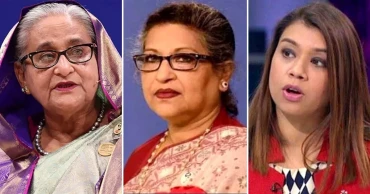
A Dhaka court on Sunday sentenced ex-PM Sheikh Hasina, her sister Sheikh Rehana and Rehana’s daughter and British MP Tulip Siddiq to different jail terms in a case filed over the misuse of power in securing a 10-katha government plot in Purbachal area of the capital.
Judge Rabiul Alam of Dhaka Special Judge Court-4 pronounced the verdict.
Sheikh Hasina, earlier sentenced to death for crimes against humanity, was handed five years’ imprisonment, while Rehana seven years and Tulip Siddiq two years of jail.
The court also fined each of them Tk 1 lakh with six months’ imprisonment in default of payment.
Besides, 14 other accused were sentenced to five years’ imprisonment each along with fine.
Read more: RAJUK plot scam: Verdict in case against Hasina, Rehana, 15 others on December 1
According to the case statement, ACC Deputy Director Salahuddin filed the case on January 13 accusing Sheikh Rehana of unlawfully obtaining a 10-katha plot at Purbachal New Town through abuse of power and procedural irregularities.
Seventeen people, including Sheikh Hasina, Sheikh Rehana and Tulip Siddiq, were named as accused in the case.
On November 18, the court completed the witness examination and recording statements of 32 people.
On July 31, the court framed charges against the accused.
This case is part of six related cases with three others scheduled for verdict on November 27.
Read more: Hasina gets 21 years in jail over Rajuk plot allocation irregularities
9 months ago
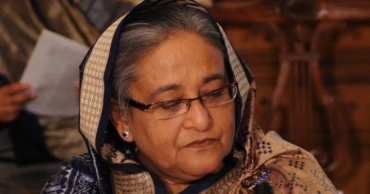
Hasina gets 21 years in jail over Rajuk plot allocation irregularities
A Dhaka court on Thursday (November 27) sentenced former Prime Minister Sheikh Hasina to 21 years in jail in three cases over irregularities in plot allocation by Rajdhani Unnayan Kartripakkha (Rajuk).
Judge Md Abdullah Al Mamun of Dhaka Special Judge Court-5 delivered the judgment in the packed-jam court in her absence.
Hasina, who took shelter in India amid the mass protest on August 5 last year, got seven years in jail in each case, totaling 21 years of jail.
Read more: ICT releases full verdict on Hasina, Kamal’s death penalty
Her son Sajeeb Wazed Joy and daughter Saima Wazed Putul were also awarded five years in jail each, with Joy facing a fine of Tk 1 lakh.
Former RAJUK official Khurshid Alam, who was present at the dock during the verdict delivery, was sentenced to one year of jail.
Besides, Housing and Public Works official Saiful Islam Sarkar was acquitted from the charges in the cases.
The court in its observation said Sheikh Hasina betrayed the country by grabbing public property under her name without following legal procedures.
On November 23, the court set November 27 to deliver judgment in the cases filed by the Anti-Corruption Commission (ACC) over graft.
On July 31, the court framed charges against 47 people including Hasina, her son Sajeeb Wazed Joy, daughter Saima Wazed Putul in the cases.
Read more: ACC’s year of mixed outcomes: 249 cases closed, yet acquittals dominate
The other accused in the cases are Hasina’s sister Sheikh Rehana, her daughters Tulip Rizwana Siddiq, Azmina Siddiq Ruponti, son Radwan Mujib Siddiq Bobby, Secretary of the Ministry of Housing and Public Works Shahid Ullah Khandaker, Additional Secretary Kazi Wasi Uddin, Administrative Officer Saiful Islam Sarker, Senior Assistant Secretary Purabi Goldar, former Rajuk Chairman Anisur Rahman Mia, former members Mohammad Khurshid Alam, Kabir Al Asad, Tanmoy Das, Nurul Islam, Mohammad Nasir Uddin, Shamsuddin Ahmed Chowdhury, Director Sheikh Shahinul Islam, Deputy Directors Hafizur Rahman and Habibur Rahman, former State Minister Sharif Ahmed, and former Prime Minister’s Private Secretary Salauddin.
Ninety-one witnesses testified in the cases.
The ACC filed the six cases in January this year accusing them of illegally securing Rajuk plots misusing their positions.
Chargesheets in all six cases were submitted to court.
According to the case statement, Sheikh Hasina and her family members in collaboration with high-ranking officials of Rajuk allocated plots on political considerations through abuse of power and irregularities,
On July 20, the six cases over Rajuk plot allocation were transferred to the two special courts—Dhaka Special Court-4 and Special Court-5.
Read more: Recovered gold not only Hasina’s, includes family members too, says ACC
9 months ago
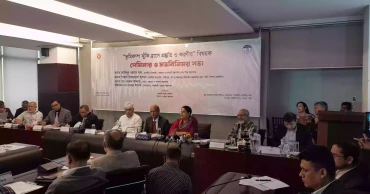
Only 3,252 out of 21 lakh buildings in Dhaka, Gazipur assessed for earthquake safety: RAJUK
Rajdhani Unnayn Kartipakkha (RAJUK) has assessed the earthquake resilience and risk of only 3,252 structures among 21 lakh buildings in Dhaka and Gazipur so far.
RAJUK Executive Engineer Khandaker Md Wahid Sadiq shared the information on Monday (November 24) at a views-exchange meeting titled "Preparedness and Actions to Reduce Earthquake Risk” held at the Institution of Engineers, Bangladesh (IEB) in the capital.
He said RAJUK has conducted earthquake resilience and risk assessments of 3,252 buildings in Dhaka and Gazipur using the FEMA-310 guideline for seismic evaluation.
Frequent Earthquakes: Can Dhaka prepare itself for the big one?
Among these, 2,705 educational institutions, 207 hospitals, 36 police stations, and 307 other buildings have undergone the Rapid Visual Assessment (RVA), he said.
Of them, 579 buildings including 568 educational institutions, 5 hospitals, 3 fire stations, and 3 other buildings have completed the Preliminary Engineering Assessment (PEA).
A total of 187 buildings including 94 schools, 78 colleges,11 universities and 4 hospitals, have undergone the Detailed Engineering Assessment (DEA) for which RAJUK has recommended retrofitting.
Dhaka can’t withstand major quake; 95% of its buildings unplanned: Experts
RAJUK has also recommended the demolition of 42 buildings in Dhaka and Gazipur due to high seismic risk, said the RAJUK official.
Environment Adviser Syeda Rizwana Hasan, Housing and Public Works Adviser Adilur Rahman Khan attended the event presided over by RAJUK Chairman Md Riazul Islam.
9 months ago
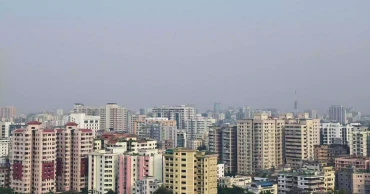
Dhaka can’t withstand major quake; 95% of its buildings unplanned: Experts
Dhaka, one of the world’s most densely populated megacities, may face a catastrophic humanitarian disaster if struck by a major earthquake, leading geologists and engineers have warned.
Multiple assessments indicate that more than eight lakh of the capital’s 21.45 lakh buildings could collapse if a quake of magnitude 7 or higher hits the region.
Poor enforcement of the national building code, unauthorised construction, flawed designs and decades of lax oversight have placed the city among the most earthquake-vulnerable capitals in the world, according to the experts.
A Warning Jolt
On November 21, Dhaka and surrounding districts experienced severe shaking from a magnitude-5.7 earthquake. At least 10 people were confirmed dead and more than 100 injured.
A magnitude-3.3 aftershock struck Narsingdi area the following morning and evening, heightening concerns that a larger and more destructive quake may be imminent.
Bangladesh’s leading geologists say the quake was not an isolated event, but a precursor to something more dangerous.
‘Plate Lock Has Opened’
Dr Syed Humayun Akhter, former professor of geology at the University of Dhaka and former vice-chancellor of Bangladesh Open University, told UNB that the earthquake originated along the boundary of the Burma Plate in the east and the Indian Plate in the west. “This plate boundary had been locked for many years. The magnitude-5.7 event has unlocked it,” he said.
Read more: Ceiling And Wall Cracks After An Earthquake: When To Worry
According to him, Bangladesh narrowly avoided a far worse disaster. “We are fortunate the quake was not magnitude 7 or 7.5. But such a major earthquake may happen in the near future.”
Research shows that the region has accumulated enough tectonic stress to trigger a quake as powerful as magnitude 8.2 to 9, Dr Akhter added. “Only a tiny amount of that energy was released this time.”
He said Friday’s shaking was among the strongest felt in recent memory, with a shallow depth of just 10 kilometres—making it far more damaging.
Bangladesh Sits on Three Active Plates
Dr Anwar Hossain Bhuiyan, professor at the University of Dhaka’s Department of Geology, explained that Bangladesh lies near the junction of three major tectonic plates—the Indian, Burmese and Eurasian plates—making earthquakes inevitable.
The country’s subsurface is composed largely of soft sedimentary rocks that amplify shaking. When the natural frequency of the ground matches the vibration frequency of buildings, the effects are devastating, he warned.
Dhaka’s Buildings Are Not Ready
A 2022 Urban Resilience Project by Rajuk painted an alarming picture:
Total buildings in Dhaka: 21,45,000At risk of collapse: Over 8,00,000 (40%)High-rise buildings: Over 75,000—most built without meeting minimum standardsBetween 2006 and 2016, around 95,000 buildings were constructed in the capital. Shockingly, only 4,147 had Rajuk approval, meaning 95.36% were unauthorised or built without approved designs.
Construction by untrained masons, design alterations mid-construction and widespread unauthorised development have pushed the city to the brink of a structural disaster, experts say.
Govt closely monitoring earthquake aftermath in Bangladesh: Chief Adviser
Rajuk Responds: ‘Accountability Being Strengthened’
Rajuk Chairman Engineer Md Riazul Islam told UNB that the agency is trying to bring long-neglected accountability back into the system. So far, 3,382 illegal or non-compliant buildings have been identified.
Following Friday’s quake, all Rajuk officials’ leave was cancelled and teams were sent to inspect cracked or damaged structures.
New Plan: Colour-Code At-Risk Buildings
Rajuk officials said international-grade technology will soon be introduced for mandatory building fitness assessments. Under the new plan, buildings will be marked in different colours based on structural safety—illegal, vulnerable or earthquake-resistant—to allow residents to immediately understand which structures are habitable.
Oversight Failures Compound the Risk
Md Abdul Latif Helali, former chief engineer of Rajuk, said building standards are routinely ignored. “A magnitude-5.7 earthquake already caused cracks in many buildings. A magnitude-7 quake would create unimaginable devastation.”
He revealed that sophisticated equipment purchased under the World Bank-funded Urban Resilience Project—worth hundreds of crores—remained unused due to bureaucratic apathy. A proposed trust to assess disaster-resilient buildings in Mohakhali is also stalled in administrative hurdles.
‘Dhaka Will Be Unmanageable After a Major Quake’
BUET’s former professor M Shamimuzzaman Bosunia warned that despite some improvement in preparedness, the government simply does not have the capacity to manage the aftermath of a major earthquake.
“Gas and electricity lines will ignite fires. Water and sewage systems will collapse. Survivors won’t even find a safe route to evacuate. Dhaka will become unliveable,” he said.
What You Should Do During Earthquake
Strongest Shaking in Recent Times
Rubaiyat Kabir, acting head of the Bangladesh Meteorological Department (BMD) Earthquake Monitoring Centre, said the 5.7-magnitude quake was the strongest in decades. While smaller quakes of magnitude 4 to 5 have been recorded elsewhere in the country in recent months, those originated outside Bangladesh.
“This region has a history of large earthquakes. A major quake can occur at any time, but predicting the exact moment is impossible,” he added.
BMD Director (in-charge) Md Mominul Islam said Dhaka’s weak soil prolongs shaking.
He said the first 72 hours after any earthquake are the most critical. Two aftershocks following Friday’s quake were normal, he said, but the sequence serves as a stark reminder of the country’s high seismic risk.
Incapable Fire Service
Former Director General of Fire Service and Civil Defence Brigadier General (retd) Ali Ahmed Khan told UNB that while the force has some preparedness, its capacity is far from adequate for a major disaster.
“More trained volunteers are urgently needed. Hospitals must have adequate emergency facilities and blood bank reserves,” he said.
Bangladesh earthquake death toll rises to 10; scores injured
9 months ago
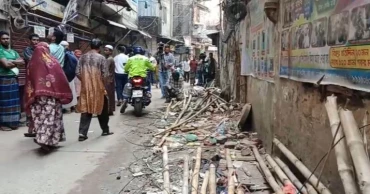
Armanitola building to be sealed if owner misses 7-day deadline: Rajuk
Rajdhani Unnayan Kartripakkha (Rajuk) has warned that the earthquake-damaged building at Kasaituli in capital’s Armanitola will be sealed if the owner fails to submit its design and approval papers within seven days.
It will disconnect of gas, electricity and WASA lines on the eighth day, followed by evacuation of the residents, Rajuk officials said when a team led by its chairman Engineer Md Riazul Islam inspected the damaged ‘Rahmatulla building’ on 20 KP Ghosh Street around 10am on Saturday (November 22).
The seven-member team visited the site after a section of the building’s railing collapsed during Friday’s earthquake, leaving four people dead.
Read more: Bangladesh earthquake death toll rises to 10; scores injured
Four others are still receiving treatment at Mitford Hospital.
At least ten people were killed in the 5.7-magnitude quake that jolted Dhaka and several other districts on Friday.
Of them, four died in Dhaka, five in Narsingdi—the epicentre of the quake—and one in Narayanganj.
At least 5 injured after jumping from DU halls during earthquake
9 months ago
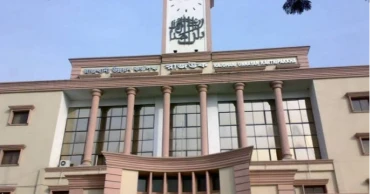
Rajuk Draft Ordinance: Master plan violation to carry Tk 10cr fine, 2 years’ jail
The government has planned to enforce major changes to Dhaka's urban governance framework, introducing strict penalties and a long-awaited legal overhaul as the Rajdhani Unnayan Kartripakkha (Rajuk) has begun the process of legitimising hundreds of thousands of unauthorised buildings across Dhaka.
Breaking a decades-long stalemate, Rajuk has drafted its first-ever policy to assess and regularise structures built without approved designs.
The government is also set to replace the 38-year-old Rajuk Act with a new legal instrument, the Rajdhani Unnayan Kartripakkha (Rajuk) Ordinance–2025, featuring tough enforcement provisions.
Urban planners say the new law and draft regularisation policy mark a significant step towards tackling Dhaka’s illegal construction, unplanned urbanisation and recurring building safety risks. But they emphasise that effective implementation, not new legislation, will prove the real challenge.
Legitimising Buildings
Rajuk acknowledges that a vast number of buildings within its jurisdiction have been constructed without official design approval.
The new draft policy proposes bringing such buildings under regulation if they do not violate the National Building Code or Rajuk’s master plan.
Read more: Rajuk to demolish 3,382 buildings in Dhaka for design violations, says chairman
Owners seeking legal status will be required to pay penalties equivalent to three to five times the design approval fee.
According to Rajuk sources, the draft policy has already been presented to the Urban Development Committee, which has made several recommendations.
Major Reform
With the long-outdated Town Improvement Act of 1953 deemed irrelevant in today’s context, the government is moving to replace it with the ordinance 2025.
The new ordinance introduces provisions on Rajuk’s accountability, urban redevelopment, land readjustment and government appropriation of land value gains, among other reforms.
Harsh Penalties
The draft ordinance includes stringent penalties for a wide range of offences:
Violating the master plan will carry up to two years’ imprisonment or a Tk 10 crore fine, or both; continued offences will incur Tk 10,000 per day.
Building structures exceeding 10 feet in an open space will draw a Tk 50 lakh fine.
Read more: Rajuk's law, board structure need to change to make it people-centric: Environment Adviser
Filling low-lying land or obstructing natural water flow without approval will attract two years’ jail or a Tk 10 crore fine.
Encroaching on roads for construction will lead to a Tk 75 lakh fine or six months’ imprisonment.
Obstructing Rajuk’s work will result in four months’ jail or a Tk 10 lakh fine.
Constructing a makeshift hut (kacha or kutcha structure) without permission may bring a Tk 5 lakh fine or three months’ imprisonment; continued offences will incur Tk 2,000 per day.
Expert Opinions
Under the new ordinance, Rajuk’s board will be expanded from five to ten members.
Rajuk Chairman Riazul Islam told UNB that the final decision on the board’s composition and qualifications will be taken after consultations with professional bodies. “This will be done very soon,” he said.
Professor Dr Adil Muhammad Khan, President of the Bangladesh Institute of Planners, said Rajuk has become overly focused on development projects instead of its core regulatory responsibilities.
“Unless the bureaucratic structure is reformed, these changes will not deliver results,” he told UNB. While acknowledging the new law and policy as a ‘major step’ towards resolving Dhaka’s illegal construction and safety crisis, he reiterated that enforcement would be the real test.
DAP Revision
The government has also approved, in principle, the revision of the 2022 Detailed Area Plan (DAP). The updated plan reduces Dhaka’s administrative blocks from 275 to 68 and limits the city’s area to 1,094 square kilometres.
Key Changes:
· Increased building height and density limits (from 250 to 300).
· Doubling of Floor Area Ratio (FAR) in many zones, enabling 10–11-storey construction where five storeys were previously allowed.
· Lifetime validity for occupancy certificates.
· Mandatory sewage treatment plants for buildings on five kathas or more.
· Extension of application processing time from 45 days to 180 days.
Read more: Landowners besiege Rajuk demanding cancellation of DAP
10 months ago
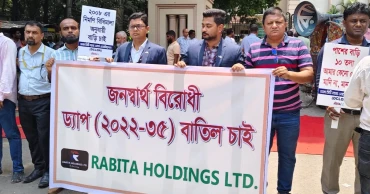
Landowners besiege Rajuk demanding cancellation of DAP
A group of landowners on Tuesday besieged Rajdhani Unnayan Kartripakkha (Rajuk) Bhaban demanding cancellation of Detailed Area Plan (DAP) and protesting ‘irregularities and corruption’ in Rajuk.
The protesters, under the banner of ‘Dhaka City Landowners’ Association’ staged demonstrations in front of the Rajuk in Motijheel of Dhaka in the morning.
Anti-tobacco coalition demands effective tax structure to reduce demand
Md Majed, a landowner, alleged “I own a little over three kathas of land. But after we gave up our land, they only allowed the construction of a five-storey building, whereas I had asked for permission to build eight storeys — which they denied. We want permission for high-rise buildings in exchange for the land.”
Real-estate employee Farhan said they can’t construct structures over the five-storey in all areas due to the DAP restriction of the Rajuk, causing losses of their firm.
Several landowners alleged that due to irregularities and corruption by the Rajuk officials there has been a complication in implementing plans for a long time.
General people can no longer build houses without bribe, they alleged.
The Rajuk chairman could not be reached over mobile phone despite repeated attempts.
Notably, on August 24, 2022, the DAP published by Rajuk was released in gazette form with the aim of reducing the issues in capital Dhaka and building a planned city.
First round of national consensus talks concludes after two months
This law was enacted for area-based population density distribution, urban development lines, transit-based development, setting standards for citizen amenities, block-based development, and development rights exchange.
1 year ago
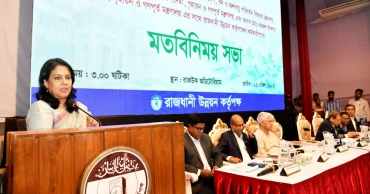
Rajuk's law, board structure need to change to make it people-centric: Environment Adviser
Environment Adviser Syeda Rizwana Hasan on Wednesday called for a change of the laws governing the Rajdhani Unnayan Kartripakkha (Rajuk) and its board structure to make the capital development authority more people-friendly and relevant to the times.
“To make Rajuk citizen-centric and modern, the Town Improvement Act and the Building Construction Act must be redrafted. Minor amendments won’t suffice. These laws must be re-enacted, preserving what is necessary while accommodating current realities,” she said during an exchange of views with Rajuk officials.
Rizwana emphasised that the Rajuk board must not consist solely of bureaucrats. “The board should include skilled urban planning experts and work through designated working groups,” she added.
She also questioned the authority of the Rajuk chairman to convert residential buildings into commercial ones. “This power should be revoked. The board can decide on such matters without violating the masterplan,” she said.
Highlighting the need for a fresh vision for Dhaka, she said it should reflect the voices of civil society, Rajuk, and the general public.
Social movement crucial to tackle noise pollution: Adviser Rizwana
She added that services must be decentralised to reduce the pressure on Dhaka.
The adviser further said that Rajuk must clearly define its role—whether it is a developer or a regulator. “Rajuk should no longer be allowed to engage in housing development.”
The adviser noted that housing can be provided for the homeless, not for the rich.
She called for comprehensive area-based masterplans and stronger regulation of private housing projects, noting that there was no such initiative in the past.
She also mentioned that Rajuk must be kept free from political influence.
Criticising the destruction of land in Purbachal, Rizwana said, “There is no justification for providing housing for ministers and lawmakers.”
Rajuk must also work to preserve the nation's built and cultural heritage, she mentioned.
Improving the quality of urban life should be Rajuk’s top responsibility, she noted, adding that Rajuk's own office building should be modern and environmentally sustainable.
“Every project must have an exit plan. Rajuk and the Estate Department need to become citizen-focused. Services should be digitalised, complaint resolution mechanisms must be effective, supervision should be outsourced, and external experts must be employed for audits,” she added.
1 year ago
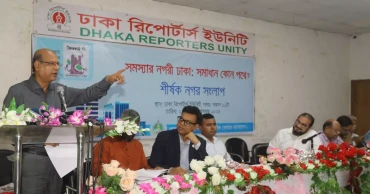
Rajuk to demolish 3,382 buildings in Dhaka for design violations, says chairman
The illegal portions of 3,382 under-construction buildings in Dhaka, which have deviated from the designs approved by Rajdhani Unnayan Kartripakkha (Rajuk), will be demolished after proper identification, said its chairman Engr Md Riazul Islam on Monday.
“Orders have been issued to halt construction of these illegal buildings and their non-compliant portions will be demolished in phases. In the first phase, Rajuk will take different actions, including disconnecting utility connections, filing of criminal cases, cancellation of designs and sealing of those buildings, if necessary,” he said.
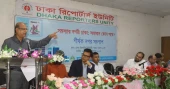
The Rajuk chairman revealed the information while speaking at a dialogue titled ‘Problematic City Dhaka: Which Way to Solutions?’ organised by the Urban Development Journalists Forum of Bangladesh (UDJFB) at the Dhaka Reporters’ Unity.
Rajuk plot graft: Warrants issued for arrest of Hasina, Rehana, 51 others
“We have identified 3,382 buildings under construction in Rajuk areas that have violated regulations. We will demolish the portions that deviate from the approved designs. As long as I am in office, this work will continue. Whether through demolition or other means, we will bring these buildings into compliance. We are also conducting regular mobile court operations,” he said.
Mentioning the importance of establishing a unified urban governance system, the Rajuk Chairman said, “If Dhaka is not brought under one umbrella, no matter how much planning is done, it will not work. All decisions must come from one place. There is no problem whether there is a city government or a mayor who has power. Decisions have to be taken from one place regarding all the services including water, electricity, gas, services in the city.”
Arrest warrant issued for Hasina, Putul in Rajuk plot graft case
Noting that, it is not possible to do all the work together, Riazul said, “We are ensuring that there will be no violation occurred in the under-construction building. We have no plan to allocate new plots. We will recover the encroached plots and arrange housing for the lower and middle class people.”
During the event, a magazine named ‘Dhakaai’ was unveiled.
Besides, a book edited by UDJFB adviser Helimul Alam Biplob with a title of ‘Dhaka’s Canals on Their Dying Breath: An In-Depth Look at How the Capital’s Waterways Are Being Choked’ was unveiled during the event.
Mohammad Fazle Reza Sumon, former president of the Bangladesh Institute of Planners (BIP),who was present as special guest, said, “We have been plagued by problems to make Dhaka more important.
Bureaucratic complexities are responsible for Dhaka’s current state. According to the Detailed Area Plan (DAP), Dhaka will be made livable for 2.35 crore people. In this case, zone-based planning has been mentioned. It is possible to restore Dhaka's livability if good governance and accountability can be ensured. ”
Prof Ahmad Kamruzzaman, Chairman of the Center for Atmospheric Pollution Studies (CAPS), said, “Dhaka was meant to be a city of nature, compassion and good management, but it is now plagued by air pollution, noise pollution, traffic congestion and lead pollution. How long must we face our children’s questions about this unplanned city’s problems?”
Half of Dhaka’s population cannot sleep due to toxic smoke from burning waste at Aminbazar and Matuail areas while 80 percent noise pollution is caused by vehicles, he said.
“Dhaka has become a city of heat. It is impossible to make a plan for 2.5 crore people. If we cannot solve these problems, Dhaka will remain at the bottom of livability indices,” he added.
END/UNB/M-MAS/SAM
1 year ago