Sunamganj

Three members of ‘Lady Kanta’ gang held in Sunamganj
Police have arrested three women including the suspected leader of notorious criminal gang ‘LadyKanta’ during a special overnight operation in Sunamganj district town.
The arrestees are Kanta Begum, widely known as ‘Lady Kanta, Subarna Akter Akhi, wife of Abdul Aziz of Hasannagar; and Jannat Akter, daughter of Alhad Mia of Laxmipur village in Jamalganj upazila.
Police also recovered a locally made sharp weapon resembling a sword from their possessions during the operation conducted in different parts of the town late Sunday night.
Police said the gang had been involved in organised criminal activities in the district town and its surrounding areas for a long period.
Investigators said the group used a unique strategy to carry out crimes.
Members of the gang used to disguise themselves and enter homes as assistance seekers or posing as domestic workers. Once inside, they would take advantage of opportunities to steal cash, gold ornaments and valuable mobile phones before fleeing the scene, they said .
Officer-in-Charge (OC) of Sunamganj Sadar Model Police Station, Ratan Sheikh, said Kanta, also known as Lady Kanta, and her associates had allegedly been carrying out thefts and robberies for years by entering homes in disguise.
He said they were arrested in an operation conducted on the basis of intelligence information and that legal action against them was underway.
3 months ago
Shimul bloom draws thousands to Sunamganj; exposes infrastructure strain
Every spring, a remote riverbank in northeast Bangladesh, Sunamganj, turns bright red, sparking a short-lived but major economic boost.
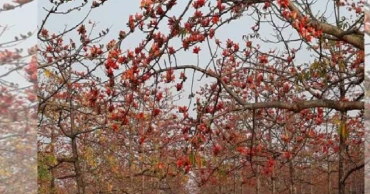
Along the banks of the Jadukata River in Tahirpur upazila, some 300 kilometres from Dhaka, thousands of shimul (silk cotton) trees have erupted into bloom, transforming the famed Shimul Garden into a vivid red canopy against the rolling blue hills of Meghalaya across the border.
This year’s display coincided with Pahela Falgun and Valentine’s Day falling on the same date, amplifying the draw. Visitors poured in from early morning, many dressed in yellow, orange and red to mark the first day of spring, turning the riverside into what locals described as a carnival of colour.
The garden’s origins trace back to 2000, when then chairman of Badaghat Union, Joynal Abedin, planted around 3,000 shimul trees across 100 bighas of land at Manigaon. Over time, the site gained national recognition and has been described by local sources as one of the largest shimul gardens in Asia.
Two decades later, the seasonal bloom has become central to the economy of Tahirpur’s remote communities.
Small eateries, roadside tea stalls, hotels and boat operators reported brisk business as thousands arrived to photograph the fiery blossoms, ride horses through the grounds and sit along the riverbank. For many residents, the few weeks of peak bloom now represent a vital source of annual income.
“It felt like walking into a dream,” said a female visitor from Dhaka who travelled with her husband to see the blossoms. “We had seen photos before, but the real experience is beyond imagination. The only drawback was the crowd, making it difficult to find a quiet corner.”
The surge has also exposed infrastructure constraints. Long queues formed at boat terminals, while narrow approach roads struggled to handle the influx of vehicles. Traffic congestion and overcrowding were common complaints.
Ali Haider, another tourist, described the location as extraordinary but said improved road connectivity and the swift completion of a bridge over the Jadukata River would ease travel hassles and likely attract even more visitors.
Authorities deployed tourist police and members of law enforcement agencies, including plainclothes personnel, to maintain order and ensure safety during the peak period.
Funding delays stall haor embankments, putting Sunamganj’s Boro harvest at risk
Rakib Uddin, owner of the garden, said thousands of tourists began arriving from the first day of spring. Communication facilities have improved compared with previous years, he added, though visitors and locals alike believe further upgrades -- better roads, transport management and facilities -- could elevate the site into a premier tourist destination.
For now, however, the attraction’s power lies in its transience. Within weeks, the crimson petals will fall, the crowds will thin and the garden will return to quietude — waiting for another spring to set the riverbank ablaze once more, Rakib added.
7 months ago

Election: 451 centers marked high-risk, 18,300 security personnel deployed in Sunamganj
Tension and political excitement are running high in haor-dominated Sunamganj district ahead of the national election.
To ensure smooth voting in the district’s five constituencies, the administration and the Returning Officer’s office have taken extensive security measures.
According to the district election office, Sunamganj has a total of 664 polling centers and 4,250 polling booths, of which 451 centers have been classified as high-risk.
For the first time, all polling centers in the district will be monitored through CCTV cameras while police personnel will be equipped with body cameras.
A combined force of around 18,300 members from the army, Border Guard Bangladesh (BGB), police, Rapid Action Battalion (RAB), and Ansar has been deployed in the district.
This includes 3,500 police, 12,000 Ansar, and 1,100 army personnel, with 24 BGB platoons assigned to the district’s 12 upazilas to ensure border and internal security.
Read More: 21 BGB platoons to secure Bandarban during national election
The election in Sunamganj is witnessing a multi-party contest alongside strong independent candidates.
Particular attention is on Sunamganj-4 where expelled BNP leader Dewan Zainul Zakerin is running independently and Sunamganj-3, where some religious leaders have significant influence.
Voters are also showing keen interest in casting ballots for both the parliamentary election and the referendum, scheduled on the same day.
Deputy Commissioner and Returning Officer Dr Mohammad Ilias Mia said, “We are committed to conducting a free and fair election. Maximum security measures have been ensured so that voters can exercise their right to vote without fear.”
Superintendent of Police ABM Zakir Hossain added that intelligence monitoring has been intensified and mobile patrol teams will remain active to prevent any disturbances in the election areas.
7 months ago
Idle machines, rising waters: A losing battle to protect Noluar Haor
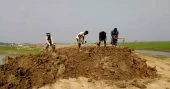
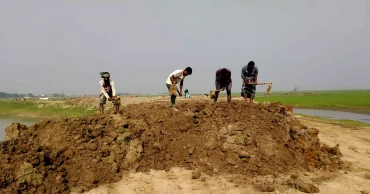
In the sprawling wetlands of Noluar Haor, the sound of idle excavators echoes across the fields, as machinery stands ready, dump trucks lined up, yet embankment work on several critical projects has stalled - all for want of soil.
For the local Project Implementation Committees (PICs), the shortage has become a source of growing frustration.
Committees overseeing projects 6, 7, 8, and 9 are among the hardest hit. Some have only recently begun construction, while others brought equipment weeks ago, hoping to start work immediately.
“We cannot proceed properly because of the soil shortage,” said Rubel Mia, UP member and president of PIC 9, adding, “We are even buying soil from elsewhere just to get started.”
These embankments are not merely infrastructure projects; they are lifelines for the farmers of Jagannathpur.
Historically, breaches in the Shalika embankment have submerged boro paddy in the haor, destroying livelihoods.
The western edge of Noluar Haor, where these projects are concentrated, was meant to see soil-cutting work completed long ago. Instead, local farmers now witness machinery waiting, suspended in time, while the clock ticks on the flood season.
On a field visit on 31 January, the situation was clear: projects 4, 5, 6, and 10 were in full swing, with competitive soil-cutting underway. Projects 7 and 9 had just begun, and at project 8, machines stood idle at the embankment, poised to start work in the days ahead.
Farmers expressed a mix of concern and impatience.
“The loose soil was cut long ago by the PICs,” said Ataur Rahman, who tends boro crops in the haor, adding, “We cannot afford any more delays. Embankments must be finished on time.”
Local campaigners are equally adamant. Mohammad Shahidul Islam Bakul, chairman of Chilaura-Holdipur Union Parishad and president of the Haor Protection Movement in Jagannathpur, said, “The government has allocated millions of taka to protect farmers’ hard-earned crops. We expect swift action. Farmers’ livelihoods cannot be gambled with.”
Horse killed for damaging potato field in Sunamganj; farmer detained
In Noluar Haor, the coming weeks will be crucial, locals said.
They said the success of these embankments could determine whether thousands of hectares of boro paddy survive the next flood season — or sink beneath the waters once more.
7 months ago
Kushiyara River’s slow bite threatens key road in Sunamganj
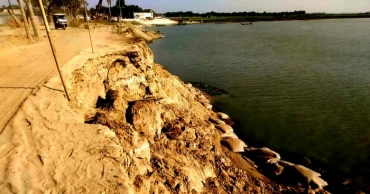
Along the restless banks of the Kushiyara River in Sunamganj’s Jagannathpur upazila, a vital road is fighting a losing battle against erosion, leaving thousands of residents anxious as commuters risking their lives every day.
The Jagannathpur-Barafechi road, once wide enough to accommodate steady traffic, has been reduced to a narrow strip hanging precariously over the riverbank.
With sections of the earth beneath it already eaten away, the road now teeters on the edge of collapse, creating constant tension among people living in nearby villages.
During a recent visit to the area, riverbank protection work was seen underway near Barafechi Bazar, where concrete blocks are being placed in an effort to halt erosion.
But the situation remains grim just west of the project area, where the river has already bitten deeply into the land, leaving the roadway dangerously narrow.
Illegal topsoil extraction threatens ‘Gaillar Haor’, croplands in Sunamganj
The affected stretch serves as the only communication link between several localities and the Jagannathpur upazila headquarters.
Any disruption, residents fear, would completely sever transport and isolate communities from essential services, locals said.
They said the threat feels immediate and unavoidable.
Rahmat Ali, a resident of the upazila, warned that if the hanging portion of the road collapses into the river, people in the area will face severe hardship.
They urged the authorities to take urgent measures to protect the road before it is washed away entirely.
For drivers, the danger is a daily reality.
Expressing concern, Amin Uddin, a local driver, said they are compelled to use the road despite knowing the risks.
“We know the road could fall into the river at any moment. But we have no choice. To earn a living and reach our destinations, we are risking our lives,” he said.
Officials say efforts are underway, even if they are not immediately visible to passers-by.
Contacted, Sheikh Farid, Jagannathpur upazila officer of the Water Development Board, said erosion protection work is also being carried out along the affected section.
After flood, Boro season unfolds in Sunamganj
He added that geo-textile bags filled with soil are being dumped into the riverbed as part of deep dumping operations aimed at stabilising the bank.
According to him, progress has slowed due to a shortage of sand and soil. However, an erosion control project is expected to be completed within the current year.
“Once the work is finished, the road will no longer be at risk,” he said.
7 months ago
Horse killed for damaging potato field in Sunamganj; farmer detained
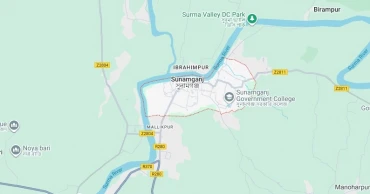
A horse was hanged to death in Sunamganj’s Sadar upazila allegedly for damaging a potato field. Police have detained an elderly farmer for questioning.
The incident took place at Lalpur Gucchhagram village in Sunamganj Sadar upazila. The horse belonged to local farmer Ayub Ali.
Officer-in-Charge of Sunamganj Sadar Police Station Ratan Sheikh said the horse’s body was recovered with a rope tied around its neck beside a potato field owned by another farmer, Joydor (60).
According to the horse’s owner, Joydor had threatened a day earlier to kill the animal for damaging his potato field.
The OC said they detained Joydor after visiting the spot and are questioning him, and the incident is under investigation and legal action will be taken following due process.
7 months ago
Illegal topsoil extraction threatens ‘Gaillar Haor’, croplands in Sunamganj
Fertile farmlands of ‘Gaillar Haor’ in Shantiganj upazila of Sunamganj district has been facing severe degradation as an influential syndicate continues large-scale illegal extraction of topsoil, posing a serious threat to local agriculture and rural infrastructure.
The upper fertile layer of cropland, commonly known as topsoil, in Alampur village under Purba Pagla Union, is being indiscriminately removed using excavators, according to local people.
The soil is reportedly being used to fill private homesteads and roads, while the ongoing operation has disrupted both agricultural productivity and daily life.
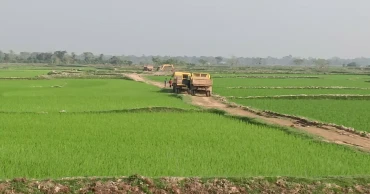
During a recent visit to the area, this UNB correspondent observed multiple excavators digging deep pits across vast stretches of cropland.
Read more: Unchecked soil lifting threatens Gomti River, infrastructures in Cumilla
The extraction continued day and night, with rows of heavy dump trucks transporting the soil to different locations.
The constant movement of trucks has damaged newly built rural roads, intensifying public suffering.
Local people alleged that the illegal activity is being carried out under the direct leadership of influential former local representatives Saidul Islam and Kalam Mia.
Farmers affected by the soil removal expressed deep concern and said they feared retaliation if they protested openly.
Several farmers, speaking on condition of anonymity, said the removal of topsoil, the most fertile portion of farmland, has permanently destroyed soil productivity. They warned that deep excavation has also increased the risk of adjacent farmlands collapsing.
If the haor is carved up like this, there will be no land left for cultivation in the future, said Jamaluddin, a farmer.
They demanded immediate and strict intervention from the administration.
Under the Soil and Sand Management Act, 2010, extracting soil from agricultural land for commercial or personal use is a punishable offence.
Locals, however, alleged that the syndicate continues its activities by evading administrative oversight or using political influence.
Beyond agricultural damage, the operation has also caused severe deterioration of rural roads.
Read more: Overuse of chemical fertilisers threatens soil health in northern Bangladesh
Heavy trucks carrying soil have led to road collapses, making daily movement increasingly difficult for villagers.
When contacted, Fatema Tuz-Zohra, Assistant Commissioner (Land) of Shantiganj upazila, said the administration is aware of the issue.
“Cutting topsoil from cropland is completely illegal. We have received information about soil extraction in Alampur village. A mobile court will be conducted there soon,” she assured.
Those who were involved in the act would not be spared and legal action will be taken, including the seizure of machinery used in the illegal activity, she said.
Meanwhile, experts from civil society urged for exemplary punishment, including imprisonment and confiscation of excavators, to protect the haor’s fragile ecosystem.
Read more: BIWTA dredging restores navigability of Sunamganj rivers; boosts trade, employment
They also feared that if the government did not take immediate action, Shantiganj’s agricultural economy and ecological balance could suffer irreversible damage.
7 months ago
BIWTA dredging restores navigability of Sunamganj rivers; boosts trade, employment
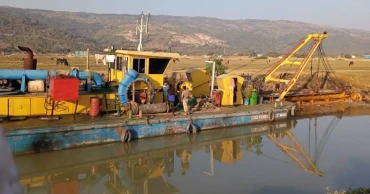
Conservation dredging by the Bangladesh Inland Water Transport Authority (BIWTA) has significantly improved navigability of key waterways in Tahirpur upazila, reviving trade, easing transportation and creating fresh employment opportunities in the region.
As dredging has restored water flow in the Patlai, Baulai and Rakti rivers, cargo vessels carrying coal and stones are once again operating smoothly, particularly along the Takerghat–Mokshedpur route.
The development has brought long-awaited relief to traders, workers and local residents dependent on river-based trade.
For years, the three rivers would almost dry up during the dry season, crippling operations at the Barachhara, Charagaon and Bagli customs stations.
Read more: Shipping Ministry forms committee over alleged BIWTA bribery
Importers of coal and stone suffered heavy losses as goods transport stalled and thousands of workers were left without regular employment.
To address the crisis, BIWTA has been carrying out conservation dredging over the past two to three years using cutter suction dredgers. As a result, navigability has improved markedly in the current fiscal year, allowing vessels to transport larger volumes of goods without disruption.
In Takerghat area, the Patlai River, which once dried up completely during the dry season—forcing people and livestock to cross on foot—now supports the movement of both small and large vessels.
Md Khasrul Alam, president of the Barachhara Coal Importers Group and former chairman of Sreepur Uttar Union Parishad, said the dredging had doubled business activities over the last two years.
“If capital dredging is undertaken in the future, trade will increase manifold,” he said.
Read more: Dawn upon Rangamati: Govt steps in to protect rivers and people
BIWTA officials said dredged soil is being distributed free of cost for public welfare projects with due approval. The soil has been used to fill low-lying areas of government schools, colleges, mosques, madrasas, graveyards and rural roads across several unions, contributing to local development.
8 months ago
After flood, Boro season unfolds in Sunamganj
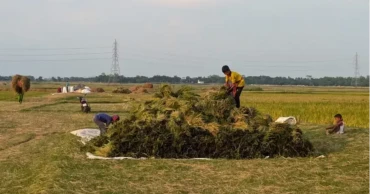
As the vast haor waters slowly recede, life in Sunamganj’s low-lying wetlands is once again defined by urgency, mud and relentless labour by farmers.
Across the district, farmers have plunged into the Boro cultivation season, racing against a narrow planting window that will determine their livelihoods for the year ahead.
From one upazila to another, the haor landscape has turned vibrant with activity. Knee-deep in muddy water, farmers and agricultural labourers work from dawn to dusk, transplanting paddy seedlings on freshly exposed land. Shantiganj, Tahirpur, Madhyanagar, Dharmapasha, Shalla and Jamalganj are among the upazilas where the seasonal rush is most visible.
According to the District Agriculture Department, seedlings have already been planted on 1.53 lakh hectares of land in Sunamganj.
Read more: Jujube cultivation brings new prosperity to Cumilla’s Shikarpur village
With haor waters withdrawing gradually, farmers are making full use of every available day to ensure timely transplantation and a successful harvest.
Boro cultivation in the haor region typically begins after floodwaters recede, following the preparation of seedbeds in November and December.
This year, soil testing has been completed in advance, and required fertilisers, including urea, TSP, DAP, MOP and gypsum, have been applied as per recommendations.
Farmers are cultivating a mix of high-yielding and hybrid rice varieties, including BRRI dhan-28, BRRI dhan-29, BRRI dhan-89 and BRRI dhan-92. If weather conditions remain favourable, rice ears are expected to emerge in April-May, marking the crucial phase when grains mature ahead of harvest.
Yet the physical toll of the season is unmistakable. Despite the biting winter cold, labourers stand for hours in icy water, trampling mud to plant seedlings by hand. For many, agriculture is the only means of survival, leaving little room for rest.
“I work from 8am till evening for a daily wage of Tk 600 and one meal,” said Ibrahim Mia, a farmer from Khushdar Haor in Lalpur village. “Even in severe winters, we have to trample mud in water. We are poor people and survive through hard labour.”
Like many others, Ibrahim hopes that good yields and fair market prices will reward their effort. “If we get proper prices, farmers will be more motivated,” he said.
Read more: Haor regions to see controlled pesticide use in upcoming Boro season
Officials say the Boro season is not only vital for food production but also creates seasonal employment in the haor belt.
Deputy Director of the Sunamganj District Agricultural Extension Department Mohammad Omar Faruk said Boro remains the district’s main cropping season.
“Workers from different districts have come to Sunamganj to take part in the planting activities,” he said, adding, “They are earning between Tk 600 and Tk 800 per day, which has created temporary employment opportunities in the haor areas.”
He said the Boro cultivation target for the current season has been set at 2,23,505 hectares, with planting already completed on about 1,53,000 hectares.
As farmers push forward against time, cold and uncertainty, the receding haor waters signal both hope and hardship, a familiar rhythm in Sunamganj, where the success of the Boro season shapes food security and livelihoods for thousands.
Read more: Kushtia farmers upset over canal blockage, fear permanent waterlogging
8 months ago
Slow dam construction leaves Sunamganj’s Haor farmers on edge
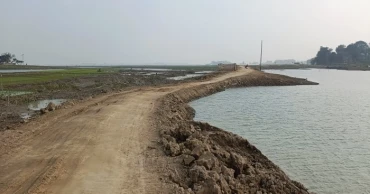
Anxious days are returning for farmers in the haor areas of Sunamganj as work on crop protection dams remains sluggish, even three weeks after the official deadline for starting construction passed.
Although construction has begun in some haors, the overall pace has been slow, fuelling frustration among farmers who depend on the timely completion of embankments to protect their Boro crops from early floods.
Many fear that continued delays could leave vast tracts of farmland vulnerable during the coming monsoon.
According to the Water Development Board, several factors have hindered timely implementation.
Delays in the recession of water from the haors and complications in forming Project Implementation Committee (PIC) have stalled work in multiple upazilas, including Tahirpur, Derai and Shalla.
Fertiliser crunch threatens Kushtia’s onion boom despite high prices
Officials also pointed out that administrative activities were disrupted earlier as officials remained busy with election-related duties.
Despite these setbacks, officials said construction would gain momentum within a few days and that all projects are scheduled for completion by February 28.
Mamun Hawlader, Executive Engineer of the Sunamganj Water Development Board, said that under the KABITA (Kajer Binimoye Taka) policy, a total of 705 projects have been approved for the construction of crop protection dams across 12 upazilas in the 2025–2026 fiscal year.
An allocation of Tk 137 crore has been made to build approximately 500.5 kilometres of embankments.
Although the construction work was formally inaugurated on December 15, progress has been limited.
As of January 6, work had started on only about 400 projects, with overall progress standing at just 15 per cent.
Bumper harvest, plunging prices; Chandpur’s potato market in crisis
Officials said the remaining projects would begin within a week.
A visit to several haor areas revealed that work has yet to begin on most approved projects, while some Project Implementation Committees are still waiting for official work orders.
The slow pace has drawn criticism from the Haor Bachao Andolan.
Leaders of the organisation recently held a press conference expressing concern that, despite the official start date, construction has not commenced in most upazilas.
They also alleged irregularities in the formation of PICs, unnecessary projects and additional allocations, raising doubts over whether the work can be completed within the stipulated timeframe.
Bijon Sen Roy, general secretary of the central committee of the Haor Bachao Andolon, said, “We are very worried about the dam work this time. The progress is very disappointing. If action is not taken now, it could spell bad news for the people of the haor.”
In response, Executive Engineer Mamun Hawlader assured that monitoring has been intensified and that dam construction will be completed on schedule.
According to the Department of Bangladesh Haor and Wetlands Development, Bangladesh has a total of 373 haors as of 2026.
These haors are spread across seven districts in the north-eastern and north-central regions, covering approximately 858,460 hectares.
As haor waters recede, Sunnamganj farmers sow hope in every field
Of them, 95 haors are located in Sunamganj district alone, spanning about 268,531 hectares.
As the agricultural season advances, farmers across Sunamganj continue to watch the embankment work closely, hoping that construction will accelerate before rising waters put their livelihoods at risk.
8 months ago