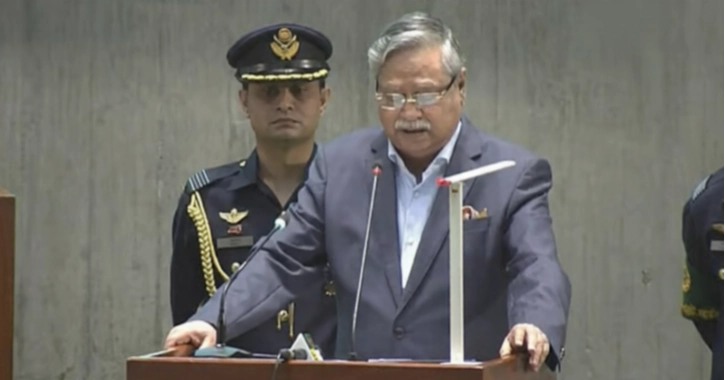
President Mohammed Shahabuddin on Thursday emphasised the need for firm control of corruption and improvement of law and order to successfully implement the government’s reform agenda and strengthen democratic governance in the country.
The President said this while delivering the inaugural address on the first day of the new parliament, in line with constitutional practice.
He said the popular uprising of 2024 sought to bring about the fall of fascism and establish a democratic state and society based on justice and equity, where the government would remain accountable to the people through their direct vote.
As part of rebuilding state institutions in the aftermath of that political change, the government constituted 11 reform commissions to recommend reforms in sectors of critical national importance.
The President said the government also presented its electoral manifesto to the people under the slogan “We Will Work, and Will Build the Country Together, Bangladesh Before All.”
According to him, the manifesto places special emphasis on three key principles in reforming governance — democracy, accountability and good governance.
However, he noted that the successful implementation of these initiatives largely depends on bringing corruption under firm control and ensuring improved law and order across the country.
“On both these fronts, the present government is acting with determination and resolve,” the President said.
Referring to earlier anti-corruption efforts, he said that when the previous government left office in June 2001, Bangladesh had gained the unfortunate distinction of being ranked among the most corrupt countries in the world.
After assuming office in October 2001, the government led by former prime minister Khaleda Zia took several decisive measures to combat corruption, including the enactment of the Anti-Corruption Commission Act, 2004, aimed at strengthening institutional mechanisms to prevent corruption.
As a result of those initiatives, Bangladesh was able to overcome the stigma of being labelled as the world’s most corrupt country, he said.
He added that even before the government left office in October 2006, the country had shed that negative image and began to gain international recognition as one of Asia’s emerging economic performers.
The President reaffirmed that suppressing corruption and maintaining law and order will remain the government’s first and foremost priorities as it moves forward with reforms and institutional strengthening.