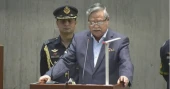
President's Speech
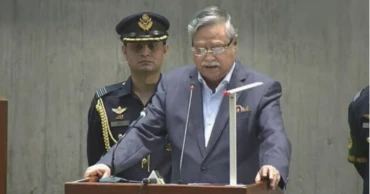
President's Speech at JS: Firm action needed against corruption to strengthen governance
President Mohammed Shahabuddin on Thursday emphasised the need for firm control of corruption and improvement of law and order to successfully implement the government’s reform agenda and strengthen democratic governance in the country.
The President said this while delivering the inaugural address on the first day of the new parliament, in line with constitutional practice.
He said the popular uprising of 2024 sought to bring about the fall of fascism and establish a democratic state and society based on justice and equity, where the government would remain accountable to the people through their direct vote.
President's Speech at JS: Govt committed to democracy, corruption control and economic transformation
As part of rebuilding state institutions in the aftermath of that political change, the government constituted 11 reform commissions to recommend reforms in sectors of critical national importance.
The President said the government also presented its electoral manifesto to the people under the slogan “We Will Work, and Will Build the Country Together, Bangladesh Before All.”
According to him, the manifesto places special emphasis on three key principles in reforming governance — democracy, accountability and good governance.
However, he noted that the successful implementation of these initiatives largely depends on bringing corruption under firm control and ensuring improved law and order across the country.
“On both these fronts, the present government is acting with determination and resolve,” the President said.
Referring to earlier anti-corruption efforts, he said that when the previous government left office in June 2001, Bangladesh had gained the unfortunate distinction of being ranked among the most corrupt countries in the world.
After assuming office in October 2001, the government led by former prime minister Khaleda Zia took several decisive measures to combat corruption, including the enactment of the Anti-Corruption Commission Act, 2004, aimed at strengthening institutional mechanisms to prevent corruption.
As a result of those initiatives, Bangladesh was able to overcome the stigma of being labelled as the world’s most corrupt country, he said.
He added that even before the government left office in October 2006, the country had shed that negative image and began to gain international recognition as one of Asia’s emerging economic performers.
The President reaffirmed that suppressing corruption and maintaining law and order will remain the government’s first and foremost priorities as it moves forward with reforms and institutional strengthening.
6 months ago
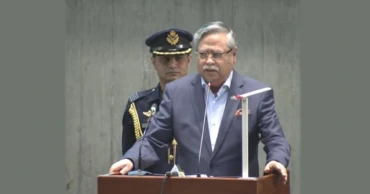
President's Speech at JS: Govt committed to democracy, corruption control and economic transformation
President Mohammed Shahabuddin on Thursday said sustainable development cannot be achieved without the political and economic empowerment of people and reaffirmed the government’s commitment to ensuring democratic rights in all aspects of state governance.
Addressing Parliament, the President said the government, despite inheriting a fragile economic situation, is moving forward with determination to build a just, humane, self-reliant and democratic Bangladesh.
He acknowledged that the newly formed government faces major challenges, particularly in poverty alleviation, combating corruption and maintaining law and order.
“The path ahead may be difficult, yet with genuine political will, no obstacle is insurmountable,” he said, urging all to work together with unity and a common purpose to build a secure Bangladesh for future generations.
The President said the popular uprising of 2024 aimed to end fascism and establish a democratic state founded on justice and accountability where the government remains answerable to people through their direct vote.
As part of rebuilding state institutions following the fall of the previous regime, the government formed 11 reform commissions to carry out reforms in sectors of critical national importance, he said.
He noted that the government presented its electoral manifesto to the people under the slogan “We Will Work, and Will Build the Country Together, Bangladesh Before All,” placing priority on three key principles—democracy, accountability and good governance.
However, he said the successful implementation of the government’s plans depends largely on firm control of corruption and improvement in law and order.
Highlighting past initiatives to combat corruption, the President referred to the steps taken by the government led by Khaleda Zia, including the enactment of the Anti-Corruption Commission Act, 2004 aimed at strengthening institutional mechanisms to prevent corruption.
He said suppressing corruption and maintaining law and order will remain among the government’s top priorities.
In formulating the Annual Development Programme (ADP) for the 2025–26 fiscal year, the government has given priority to sustaining economic growth, reducing unemployment, creating jobs, alleviating poverty, advancing agriculture and industry, developing human resources and improving the quality of life of people, the President said.
He said the government is also committed to democratising the economy by dismantling oligarchic structures and ensuring greater participation of citizens.
“Our central objective is to transform a debt-dependent economy into one driven by investment,” he said, adding that the government has set a target of building a one-trillion-dollar economy by 2034.
Recalling the July–August 2024 mass uprising, the President said it will remain a defining chapter in the country’s democratic history.
He said the movement, which began as a quota reform protest, gradually evolved into a broader national movement against authoritarianism.
Students, farmers, workers, teachers, journalists, intellectuals, members of the diaspora and people from all walks of life joined the movement alongside pro-democracy political parties, he said.
Their collective struggle ultimately led to the fall of the then government on August 5, 2024, he added.
The President paid tribute to those who lost their lives and were injured during the uprising, noting that more than 1,000 people were killed and at least 30,000 others injured, many of whom suffered permanent disabilities.
He also remembered the sacrifices of citizens who endured enforced disappearances, killings, extrajudicial executions and repression during years of authoritarian rule.
The government remains committed to fulfilling the aspirations of the martyrs of the 2024 uprising as well as those who sacrificed their lives in the country’s democratic struggles, including the Bangladesh Liberation War, the President said.
Shahabuddin said public confidence in the country’s constitutional institutions, particularly the Bangladesh Election Commission, had fallen to a near-zero level during what he described as 'a fascist regime', in reference to the fallen AL government that elected him as president.
He went on to note that the situation has begun to improve following the Thirteenth National Election.
Addressing Parliament, the President said the present government is committed to ensuring that future electoral processes further strengthen people’s trust in the Election Commission.
He said the government will take necessary steps so that national institutions, including the Election Commission, can perform their responsibilities independently and strictly in accordance with the law.
However, the President expressed optimism that with strong political will those challenges can be overcome.
He emphasised the need for unity and collective efforts, saying that the nation must always come before party interests and the party must come before individual interests.
6 months ago