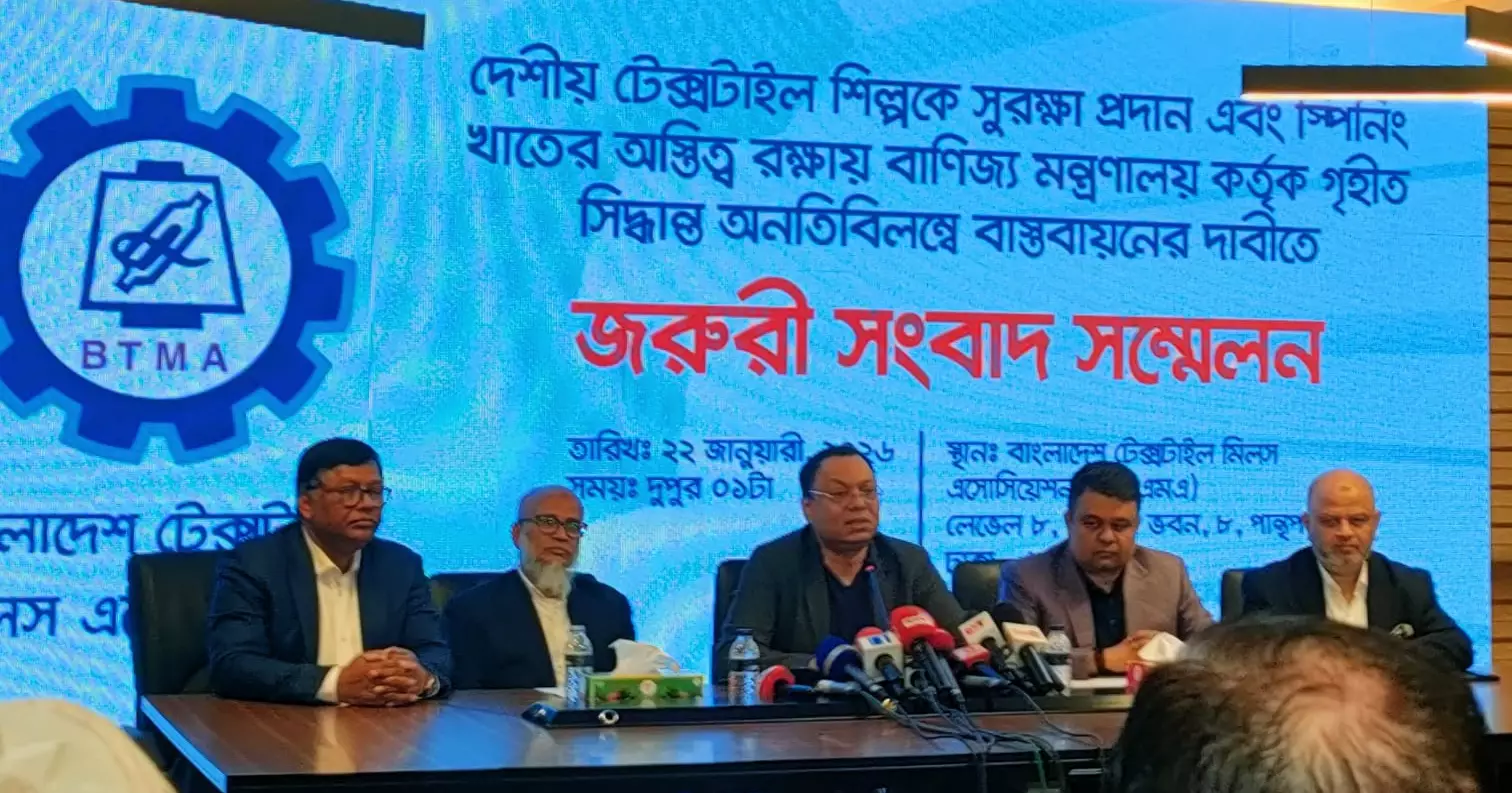
Bangladesh Textile Mills Association (BTMA) on Thursday threatened to shut down all spinning mills across the country from February 1 if the government does not withdraw duty-free import facilities for certain categories of cotton yarn.
BTMA President Showkat Aziz Russell issued the ultimatum at a press conference held at the association’s office in Dhaka.
The association is demanding the immediate suspension of bond facilities on the import of 10–30 count cotton yarn, arguing that the measure is essential to protect the local spinning industry from what it describes as unfair competition.
11 more institutions inc. banks, municipal bodies join BIDA’s One-Stop Service portal
The dispute centres on the National Board of Revenue’s (NBR) bond facility, which allows export-oriented industries to import raw materials duty-free on the condition that the finished products are exported.
According to the BTMA, this policy is severely undermining local spinning mills, particularly those producing 10–30 count yarns.
Highlighting the urgency of the issue, the BTMA said the government must implement the Commerce Ministry’s recommendation to withdraw the facility within the current month.
Russell clarified that withdrawing the duty-free facility should not be confused with the imposition of a new tariff. Importers, he said, would still be able to claim duty drawbacks from the government under existing rules.
The demand follows a recent recommendation by the Bangladesh Trade and Tariff Commission (BTTC), which advised the Commerce Ministry to suspend the bond facility for 10–30 count cotton yarn.
Proposed amendments to Bank Company Act faces fierce opposition from BAB
Local millers say 10–30 count yarn is a core product of the domestic spinning sector, and the continued influx of duty-free imported yarn of the same count is making local production economically unsustainable.
Earlier, the Commerce Ministry formally recommended to the NBR that the bond facility be suspended to safeguard domestic investment and ensure a level playing field for local textile manufacturers.