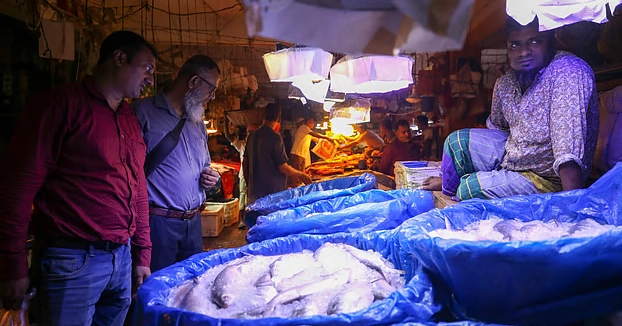
Bangladesh’s hilsa catch is shrinking at an alarming pace as rising temperatures, erratic rainfall and shifting river flows disrupt breeding cycles, threatening supplies of the country’s national fish and a key source of income for thousands of fishermen.
Researchers warn that without urgent climate adaptation and river management measures, the decline could deepen, posing long-term risks to food security and rural livelihoods.
Even during the peak season, rivers across the country are yielding far fewer hilsa, a geographical indication (GI) product and Bangladesh’s national fish, compared to previous years, fishermen say.
In Chandpur’s Haimchar upazila, widely known as the hilsa capital, veteran fisherman Asad Hossain, who has been casting nets in the Meghna basin for nearly four decades, said the current season has been disappointing.
“During the September-October and March-April peak seasons, my boat would return brimming with silver hilsa. This year, even at the height of the season, the catch has been far from satisfactory,” he said.
Subhas Paik from Shahrasti upazila echoed similar concerns, saying that despite fishing throughout the night, catches remain poor. Hilsa supply in Shahrasti and Chandpur Sadar markets has nearly halved compared to previous peak seasons, he added.
The same frustration is heard in the southern district of Barishal, particularly along the Gajaria River flowing through Mehendiganj and Hizla upazilas, once considered a prime hilsa zone.
Moslem Hawlader, a fisherman from Hizla, said the large-sized hilsa has almost disappeared from the river. “We comply with the government’s fishing bans, but after the restriction period ends, we still fail to get expected catches. Mostly small-sized hilsa are being caught now. Fishermen are getting lower prices while consumers are paying more.”
Another fisherman, Abdul Karim, blamed increasing siltation and formation of shoals in the erosion-prone Gajaria River for shrinking fish stocks.
According to the latest report of the Department of Fisheries, hilsa production in fiscal year 2024-25 stood at 512,000 metric tonnes, down from 529,000 tonnes in 2023-24 and 571,000 tonnes a year earlier.
Although production remained above 550,000 tonnes for three consecutive years since FY2020-21, output has declined by more than 10 percent in recent years.
Acknowledging the concern, Fisheries and Livestock Adviser Farida Akhter said hilsa catch during July-August 2025 dropped by around 45 percent compared to the same period in 2024. “Both natural and man-made factors are responsible for the decline of hilsa in Bangladesh’s rivers.”
Farida identified climate change as a major factor, noting that rising sea temperatures have increased salinity, creating an adverse environment for hilsa survival. Hilsa breeding is closely linked to rainfall patterns, she said.
“If rainfall does not occur at the right time, hilsa do not migrate upstream to spawn. Due to climate change, reduced and erratic rainfall is negatively affecting reproduction,” she added.
Every October, the government enforces a 22-day nationwide ban on fishing in rivers to protect breeding hilsa, aligning the schedule with Ashwini Purnima and new moon phases based on rainfall patterns. However, shifting rainfall timing due to climate change may be undermining the effectiveness of the existing schedule.
“We need further research. The traditional ban period may no longer be producing the desired results. Climate change may have altered the breeding cycle of hilsa,” the adviser said.
Professor Harunur Rashid of Fisheries Management at Bangladesh Agricultural University said the current extraction rate is unsustainable. “In the present situation, annual hilsa harvest should not exceed 250,000 to 300,000 tonnes. But more than 500,000 tonnes are being caught every year. Monitoring exists in rivers, but there is almost no effective monitoring in the sea. Many hilsa are caught before they can migrate upstream to spawn.”
He also warned that excessive catching of immature hilsa is accelerating biological changes, causing the fish to mature and reproduce at smaller sizes.
According to the National River Conservation Commission, 308 out of Bangladesh’s 1,008 flowing rivers have already lost navigability, while around 90 percent face navigability stress.
The situation is particularly severe in rivers surrounding Dhaka and adjacent districts, where industrial encroachment and untreated effluents are polluting waterways that eventually connect to the Meghna.
“Industrial waste flows into rivers and eventually mixes with the Meghna. At the same time, transboundary river issues are reducing timely freshwater flow. These factors directly impact hilsa production,” Harunur Rashid said.
Siltation and newly formed shoals are also obstructing hilsa migration routes from the sea into rivers for spawning, experts noted.
Molla Imdadulla, Project Director of the Hilsa Development and Management Project under the Department of Fisheries, said rapid siltation has made river navigation increasingly difficult. “In places where there were no shoals a few months ago, new shoals have formed. If speedboats struggle to move, how will hilsa breed?”
He also pointed to illegal nets and inadequate manpower for monitoring, particularly in marine areas. Many fishermen, burdened by informal loans, continue excessive harvesting despite regulations.
Kazi Ahsan Habib, Chairman of Fisheries Biology and Genetics at Sher-e-Bangla Agricultural University, warned that prolonged ecological degradation could eventually alter hilsa migration patterns. “Hilsa traditionally return to the same rivers to spawn. But if they repeatedly fail to access suitable breeding grounds, future generations may not consider these rivers suitable.”
Besides Bangladesh’s Padma-Meghna system, he said, hilsa are also found in Myanmar’s Irrawaddy, Pakistan’s Indus, India’s Hooghly and parts of the Persian Gulf.
Bangladesh currently receives the lion’s share due to its favorable ecological conditions.
No approval yet for indoor, artificial hilsa farming: Ministry
“If this environment continues to deteriorate, hilsa that once migrated to Bangladesh may eventually shift towards other river systems,” Habib warned.
Muhammad Kamruzzaman, Deputy Chief of the Hilsa Management Section at the Department of Fisheries, said authorities are working continuously to protect hilsa resources despite existing challenges, expressing hope for improvement in the coming years.
Experts, however, caution that without coordinated action addressing climate change impacts, overfishing, pollution, siltation, river encroachment and altered rainfall patterns, Bangladesh’s once-abundant hilsa may gradually become scarce.