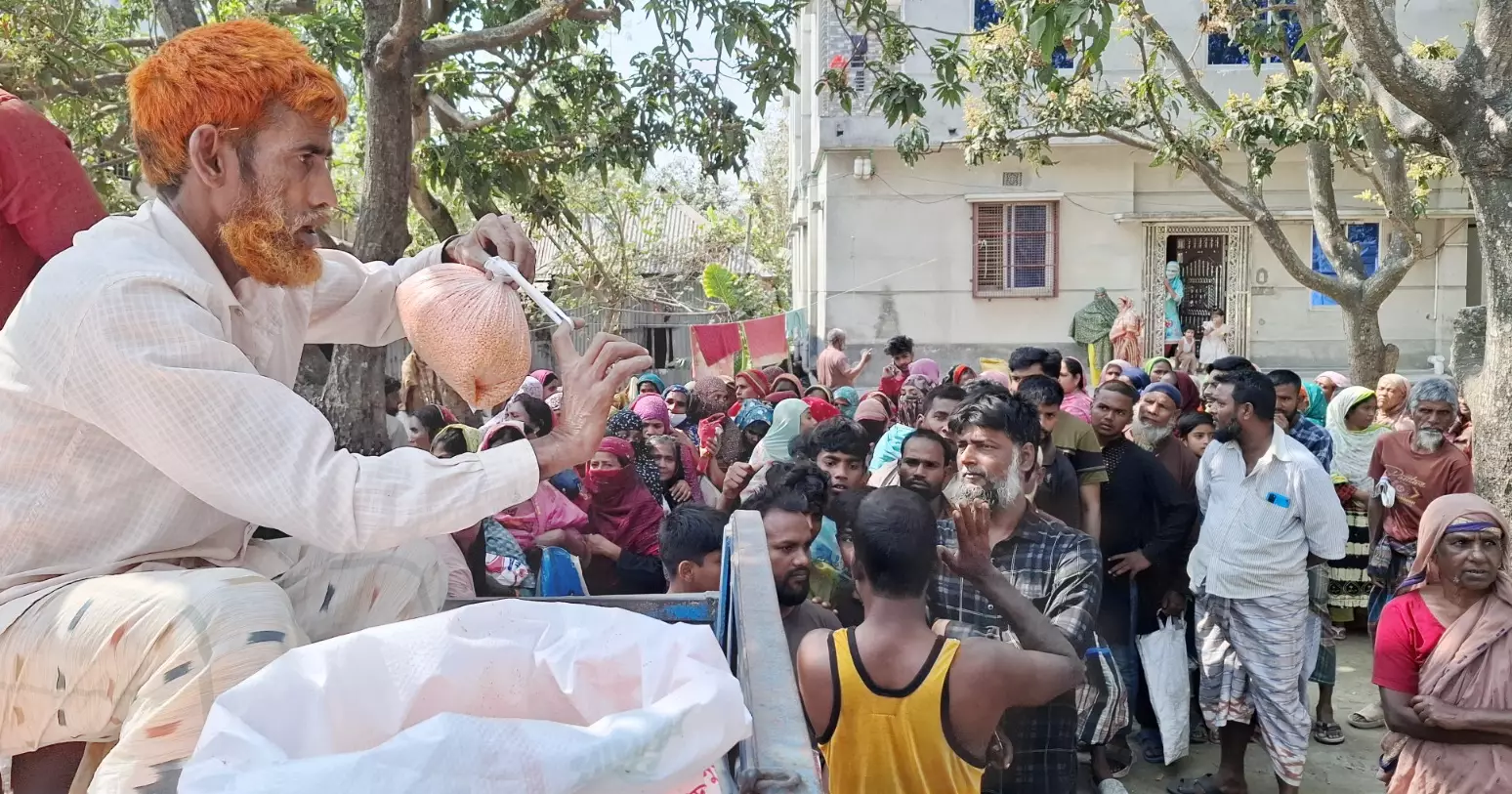
As household budgets tightened amid Ramadan across the country, subsidised sales in trucks by the Trading Corporation of Bangladesh (TCB) have emerged as a vital lifeline for many low- and middle-income families in Naogaon.
Yet the relief they offer is tempered by limited supplies, long queues and mounting frustration among consumers.
Since February 17, TCB has been operating mobile truck sales across 99 unions and three municipalities under 11 upazilas in the district.
The programme, scheduled to continue until March 12, aims to give a relief to the vulnerable groups from the seasonal spike in essential commodity prices.
Across Naogaon, the cost of daily necessities has risen sharply with the onset of the holy month, placing additional strain on working-class families.
For many, the opportunity to purchase essentials at subsidised rates can mean the difference between managing and falling short.
Under the scheme, five key items are being sold at reduced prices. But while the initiative has drawn appreciation, the scale of demand has far outstripped the allocation available at each point.
At distribution sites, scenes of anticipation begin at dawn. Hours before the trucks arrive, people gather to secure a place in line, knowing that sales are conducted on a first-come, first-served basis.
At the Raninagar Upazila Parishad premises, around 200 men and women waited for the truck on a recent morning. Some used bricks to mark their positions in the queue; others hurried into line as soon as word spread of the truck’s approach.
Occasional verbal disputes broke out over who had arrived first.
Many had come before sunrise. Others joined between 6:00am and 9:00am. Despite the uncertainty, few were willing to leave without trying.
Nasir Uddin, a van-puller from Khotteshwar village, said he had sacrificed a day’s earnings to stand in line.
“I run my family by driving a van. If I can buy these items at lower prices, it saves me a lot,” he said.
He believes that increasing the allocation would significantly ease the hardship faced by families like his.
For elderly residents, the process can be especially challenging.
Sakhina Bibi, 75, a beggar from West Balubhura village, arrived leaning on a stick after borrowing money to make her purchases.
In a crowd of more than 300 people, she was pushed out of the women’s queue several times before finally managing to buy the goods.
Concerns have also been raised about the management of the sales process. Rahidul Islam, a day labourer from Simba village, said that unlike in previous years, serial slips were not distributed before sales began.
Narayanganj’s daily battle with traffic and broken roads
“Last Ramadan, slips were given according to serial numbers, which maintained order. This time, whoever can push ahead gets the products first,” he alleged, calling for a more disciplined system to prevent harassment and ensure fairness.
On the supply side, logistical constraints remain a challenge. TCB dealer Abdur Razzak Molla of Raninagar said products must be collected daily from the Bogura regional office, and trucks often arrive late, making it difficult to begin sales at the scheduled 10:00am.
“The allocation is much lower than the demand. If we could operate four to five points simultaneously as in previous years, the pressure would be reduced,” he said.
He added that efforts are made to maintain order and to prioritise elderly and disabled individuals.
Naogaon Deputy Commissioner Mohammad Saiful Islam said that through TCB dealers, eligible residents are being provided one kilogram of sugar at Tk80, two kilograms of lentils at Tk70, two litres of edible oil at Tk115, one kilogram of chickpeas at Tk60 and 500 grams of dates at Tk80. Each truck serves around 400 people.
He urged consumers to remain patient, acknowledging that supply remains significantly lower than demand.
Strict instructions have been issued to dealers to follow proper procedures, and legal action will be taken against any irregularities, he added.
As Ramadan continues, the subsidised truck sales offer essential, if limited, support.
For hundreds lining up each morning in Naogaon, they represent both hope for relief and a reminder of the economic pressures shaping daily life, locals said.